The best places to keep your emergency fund
Published in Business News
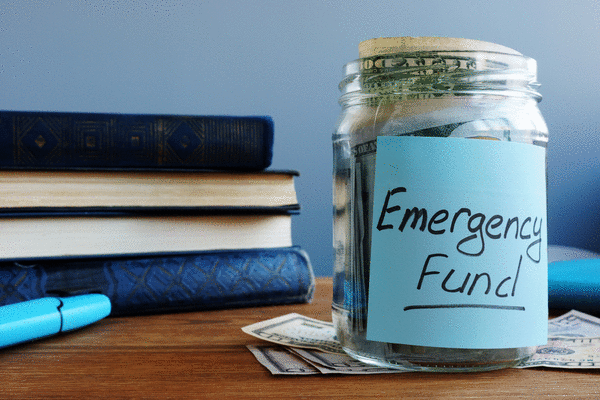
Unexpected events, such as an emergency room visit or a broken-down car, can result in major financial problems when you don’t have an emergency fund in place.
It’s not just about having some cash — ideally enough to cover at least six months of your expenses — set aside for those worst-case scenarios, though. Where you keep that money is equally important to make sure it’s protected and immediately accessible.
If you don't have a fully-funded emergency nest egg, you're not alone
— 16% of Baby Boomers, 24% of Gen Xers, 28% of Millennials and 34% of Gen Zers have no emergency savings.
— 1 in 3 Americans have more credit card debt than emergency savings.
— 60% of U.S. adults are uncomfortable with their emergency savings.
The best places to put your emergency savings
The best place to keep your emergency savings is in an account with a competitive annual percentage yield (APY) and easy access to your funds for when emergencies arise.
Here are the best places to stash your emergency cash:
How to keep your saving insured
You need to be able to sleep at night with the assurance that your emergency fund has no chance of disappearing, so safety is a key ingredient. Keep your money in an account with Federal Deposit Insurance Corp. (FDIC) coverage or National Credit Union Association (NCUA) share insurance coverage and avoid high-risk investments.
High-yield savings account
A high-yield savings account offers easy access to your money and a competitive APY to help your money grow. You can typically find high rates at banks that operate mostly online, as opposed to larger brick-and-mortar banks.
When choosing a high-yield savings account, opt for one that has:
— No or minimum fees
— No (or low) minimum balance requirements
— FDIC or NCUA insurance
— Convenient methods of withdrawal, including fast transfers from the account
Keep in mind that you may have a limit on withdrawals from your account, which is typically six per month, though some savings accounts do not impose these limits.
Money market account
Another option to store your emergency savings is a money market account. Like a savings account, a money market account typically offers a higher APY than a traditional savings account. With both, you often have easy access to your funds, within a potential withdrawal limit.
What sets a money market account apart from a savings account is that it often comes with a debit card or the ability to write checks, for even easier access to your savings.
Standard bank or credit union savings account
If you have a checking account at a bank or credit union that does not offer a high-yield savings account, you can still consider opening a savings account there for your emergency fund. This can simplify your financial life by keeping everything under one roof, while distinguishing your emergency fund from the one you use for your day-to-day finances. The downside, though, is that standard savings accounts often pay little to no interest.
A high-yield account protects your purchasing power; a standard one doesn't
With the best high-yield savings accounts paying an APY around 4%, you can earn interest to keep growing your emergency fund and preserve your purchasing power by outpacing inflation, which was 2.6% year-over-year as of November 2025.
Money market mutual fund
A money market mutual fund is another relatively safe place for emergency funds. Although they don’t come with the guarantee of FDIC insurance protection like most savings accounts, these conservative investments are typically low-risk and easily accessible parking spots for cash.
That access will take a bit longer than standard bank accounts, though. If you need funds from a money market mutual fund, expect to wait for a couple of business days to sell and see the cash in your bank account.
The worst places to put your emergency savings
Knowing where not to keep your money is an equally important lesson. While these places can serve a valuable purpose for your other financial needs, they aren’t designed for emergency safekeeping.
Checking account
Lumping your emergency savings in with the checking account you use on a regular basis presents the challenge of making it too accessible. You run the risk of dipping into your emergency stash for non-emergencies.
Certificate of deposit (CD)
A traditional CD comes with a penalty for any early withdrawal of the funds. So, if you park your emergency savings in a one-year CD and wind up needing the money in four months, you’ll forfeit interest and, potentially, some of your principal.
The stock market
With an average of an approximately 10% annual return, the stock market is great for a long-term investment strategy. But returns are not guaranteed and can vary. If you have your emergency fund in the market when it takes a downturn, you can find yourself in a very tough spot without enough money to cover your needs.
Savings bonds
Savings bonds are a good choice for saving, just not for your emergency fund. After purchasing a savings bond, you cannot cash it in for a full year.
At home
If you’re considering keeping your emergency fund under a mattress or in a safe at home, it’s time to rethink your strategy. In the event of an at-home emergency such as a fire or theft, it creates another dire emergency: Your cash will be gone — without any way of getting it back.
In retirement accounts
It’s pivotal to save for both an emergency fund and your future retirement. However, it’s imperative to keep these separate. Retirement accounts, such as a 401(k) or Individual Retirement Arrangements (IRA) should hold money you plan on using in retirement — not to pay for an emergency. Utilizing funds from a retirement account prior to your retirement can result in paying penalties, the loss of the benefit of long-term growth and make you less prepared for your retirement.
Bottom line
An emergency fund is a critical piece of minimizing your financial stress. As you work to build it, make sure you’re putting that money in a place where it will grow and stay safe. And while you’re at it, make sure you’re regularly reviewing what you would really need in a true emergency. While three months of expenses might be plenty for someone who is 25 and living on their own, someone who is 35 and married with children will likely need a bigger cushion.
Frequently asked questions
— Why should you keep your emergency fund in a separate account? Storing your emergency fund in a dedicated account can help keep you from dipping into the money for other purposes. Some savings accounts conveniently allow you to set up buckets devoted to different goals, including emergency expenses. A separate account makes it easy to be aware of exactly what you have in that account as well.
— Why shouldn’t you keep an emergency fund in a checking account? Checking accounts are designed for transactions such as paying bills or writing checks. As such, your emergency fund may be better off in a separate account where the money generally remains untouched. Checking accounts also tend to earn low (or no) interest, so your emergency fund could earn a higher return in a high-yield savings account.
— What is the safest place to keep cash within your home? Because cash is paper, it’s subject to damage from water or fire. For this reason, a fireproof safe is often the best place to keep cash at home. A locked safe can also help keep your money or other valuables intact in the event of a burglary.
— When should you tap into your emergency fund? An emergency fund is a source of money for unplanned expenses that can crop up, especially when you have to go into debt to pay for these things. Examples include a large medical bill, a major home repair or a job loss.
_____
©2025 Bankrate.com. Distributed by Tribune Content Agency, LLC.










Comments