Minnesota has a record number of apprenticeships. Here's why they're growing in popularity
Published in Business News
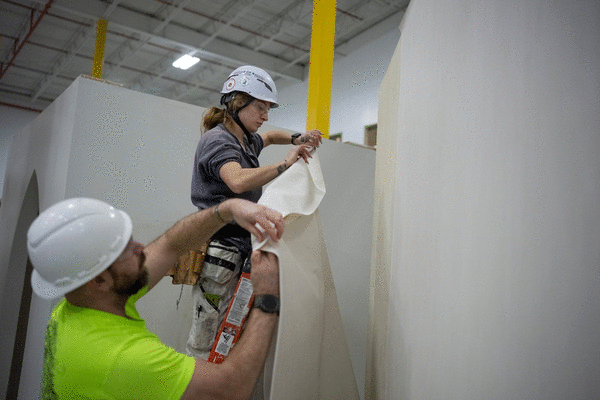
Apprenticeship opportunities in Minnesota are booming as high schools, two-year colleges and employers embrace the value of workers earning a solid wage while simultaneously training for a career.
The number of state-registered apprenticeships hit a new high in 2025, with 12,220 in Minnesota spread across 166 programs, according to the U.S. Department of Labor. Minnesota is on track to beat that record in fiscal year 2026, said Erin Larsen, the apprenticeship director at the Minnesota Department of Labor and Industry.
Apprenticeships generally include a full-time, paid position where an apprentice “learns while they earn” and works with a mentor. They also attend classes through their employer or a community or technical college, typically earning a degree or another kind of credential, and usually, a job at the end.
The increased interest in apprenticeships comes as conversations with high school students about career and college options are changing due to rising student loan debt and growing enthusiasm for the trades, said Stephanie Holland, director of apprenticeships and dual training at Minnesota State College Southeast.
“You’re learning on the job, you’re getting paid while you’re doing it, but your employer is also aligning that with education,” Holland said. “And it also gives (workers) a livable wage.”
Many industries are also turning to apprenticeships because they’re facing hordes of retiring workers, she said.
There are currently about 700,000 registered apprenticeships across the country. Apprenticeships have been associated mostly with specific trades, such as plumbing or electrical work, but can also range from golf course maintenance to the insurance industry.
In 2014, President Barack Obama aimed to double the number of apprenticeships in five years and dedicated funding to that goal. President Donald Trump, who has generally emphasized workforce training initiatives, signed an executive order last year striving to “support more than one million apprenticeships per year.”
Tom Dicklich, executive director of the Minnesota State Building and Construction Trades Council, said there’s a lot of “growth and excitement” around apprenticeships in construction: “We’re making it so the trades aren’t Plan B anymore,” Dicklich said.
Velvet Walker, Normandale Community College’s director of adult learning and workforce partnerships, said companies are starting apprenticeship programs to tap into new groups of potential employees.
At Normandale, corporations like Seagate and Medtronic offer pre-apprenticeship programs in manufacturing while local government agencies partner to provide “pathways” to jobs in human services.
“Organizations are looking to diversify their workforce and they’re looking to do that in sort of nontraditional ways,” she said.
Apprenticeships may be registered with the federal government or, in Minnesota, with the state. Most registered apprenticeships are three to five years; with registered apprenticeships, the state ensures the standards are the same across every program in a given occupation, Larsen said.
Officials at both Normandale and Southeast said they’re looking to add chances for people to work, learn and earn by connecting with interested employers; each school offers three such options now.
A two-year apprenticeship program with Aon, an international insurance company with a Bloomington location, has been highly successful, Normandale officials said. The program seeks out people who would have never considered careers in the field or with a large corporation, including those from disadvantaged backgrounds.
Apprentices work a full-time, entry-level job starting at $23 an hour and earn an associate’s degree at Normandale; the program also offers many support services to help apprentices.
“The students can’t really believe it’s true,” said Brenda Dickinson, Normandale’s dean of continuing education and customized training, adding that they get a job, a mentor, college advisers and a degree for free. “We say, ‘Yes, really. That’s really what’s going to happen.’ ”
The program shows that apprenticeships can work in business and finance careers, she said.
Ray Longo, Aon’s market leader for the Upper Midwest, said the program came to the Twin Cities in 2020, partly to attract more workers to the industry long-term.
Aon found “a completely untapped market” of hard-working, talented people with a high school diploma, he said, adding that the workers bring “a new energy and vibrancy” to the firm’s offices. Aon has persuaded other large corporations like Cargill and Best Buy to start similar programs, Longo said.
Ebony Walker, 38, has been a receptionist and worked retail before her apprenticeship. She’s now an associate property broker at Aon, where she helps her manager present insurance options to clients. The apprenticeship model was invaluable because it offered stability and support while she navigated a new career and the culture of a large, global company. She hopes to become a senior broker one day, she said.
Construction apprenticeships make up 84% of Minnesota’s registered apprenticeships, more than twice the national average. Nationally, the construction field is short 500,000 workers.
Dicklich said he and his trades group members have become “much more aggressive” in recruiting high school students in the last five years, setting up booths at events and launching introductory programs about the construction trades, which range from bricklaying to roofing.
A program exposing high schoolers to jobs operating heavy machinery enrolled 352 students in 2025 compared to 54 in 2020 when it began, Dicklich said.
Keith Bailey, a commercial painter for 20 years, now teaches painting to 150 apprentices each year at the Finishing Trades Institute of the Upper Midwest, a trade school focused on six construction trades.
The school works with 30 contractors who hire their own apprentices as part of a three-year program. In addition to their jobs, apprentices attend classes two days a month where they can ask questions and get hands-on training in painting and related skills, like hanging vinyl wallcovering, he said.
“That way they’re more valuable and versatile,” Bailey said.
Kasity Benedict, 26, had nearly two years of painting experience elsewhere. She became an apprentice with Wasche Commercial Finishes so she could join the union, where painters start at $30 an hour and get insurance and a pension.
At her previous job, she didn’t get as much training: “I wasn’t informed of either the safety things or ... tips and tricks,” said Benedict, who is getting an associate’s degree in construction management at a reduced cost through scholarships from the school.
“It’s for anybody, and as long as you apply yourself, you’ll get what you want out of it,” Benedict said of her apprenticeship.
Nationally, most apprenticeships are clustered in popular fields like construction, education and manufacturing, but they can also offer a path to a specialized career that may otherwise be hard to enter.
A pottery apprenticeship at St. John’s Pottery in Collegeville, Minnesota, began in 1979 and has trained 55 apprentices since then. Supported by grants, sponsors and St. John’s University, three apprentices — the most the program has had — receive free housing, meals and benefits and start at $15 an hour. They also get a stipend from selling their wares, said Daniel Smith, the studio manager.
For two to four years, they spend 40 hours a week working with all-natural and local materials, including clay and glazes.
“That kind of time is not something many are afforded during their college experience or can afford to do independently,” said Smith, a former apprentice.
Artists draw on the traditional Japanese methods and fire their creations once every two years in an enormous wood-burning kiln. Apprentices also gain a community of former apprentices living and working in the St. Cloud area.
“It’s very hard to be a potter in isolation,” Smith said.
Another Minnesotan has gained job skills from an apprenticeship in a unique field. Brooke Heikkila, a University of Minnesota Duluth graduate just finished a one-year apprenticeship at a North Carolina golf course in December 2025, where she was taught how to mow fairways and set up golf courses. Now in its fourth year, it’s funded by the United States Golf Association.
Classes at a local community college helped her understand the soil science and chemistry behind creating meticulous greens.
“Since I was brand new to golf course maintenance, they taught me everything there was to know,” she said.
She’d wanted to learn more about golf courses but feared leaving a stable job at an environmental testing lab. Plus, a high-level course wouldn’t have hired “some random person from Minnesota” without the program, she said.
The experience pushed her to pursue a master’s degree in crop and soil science. She hopes to make golf courses more environmentally friendly, she said.
Previously, she thought only plumbers or electricians could be apprentices.
“I never thought this would be the path I would take, but when I stumbled on to it, it was wonderful,” she said.
©2026 The Minnesota Star Tribune. Visit at startribune.com. Distributed by Tribune Content Agency, LLC.










Comments