Ford's modern era begins as key EV executive departs
Published in Business News
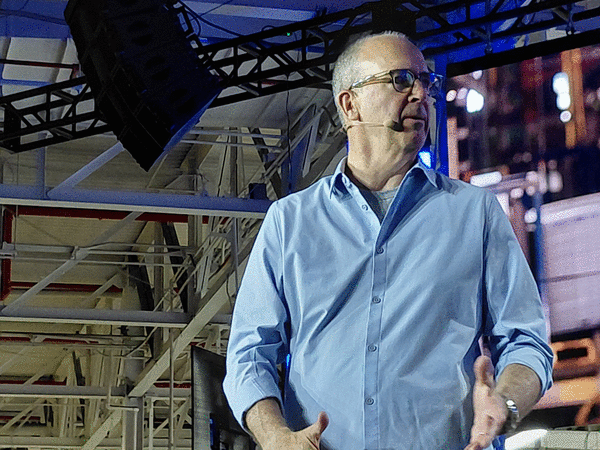
The modern Ford Motor Co. has emerged, CEO Jim Farley declared Wednesday as the company detailed some restructuring and said it will refresh 80% of its North American vehicle volume by 2029 as part of efforts to compete against new competitors like Chinese brands.
Also announced Wednesday is that former Apple Inc. executive Doug Field, Ford's chief EV, digital and design officer, will depart over the next month as Ford prepares to launch next year its new Universal Electric Vehicle platform.
The first vehicle built off the UEV platform, a midsize pickup expected to start at $30,000, will help to reverse that narrative, Ford executives have said, and position the 123-year-old company to compete against such emerging Chinese rivals as BYD Co. Ltd. that are expanding globally with low-cost, high-quality electrified vehicles. Farley has called them an "existential threat" to legacy car makers. Ford introduced a new organization within the company called Product Creation and Industrialization to facilitate this next chapter.
"We have a lot more work to do," Farley said, "but we feel like we're on the path to get to fully competitive with Toyota and the Chinese, depending on where we execute this."
He added: "I just want to emphasize that this organization is really, in my mind, the moment that the modern Ford has emerged."
In addition to the midsize pickup, the next-generation F-150 and F-Series Super Duty trucks will be a part of the North American portfolio refresh. Meanwhile, 70% of Ford's global vehicle volumes will also be updated by 2029.
Ford said nearly 90% of its global nameplates will offer electrified versions by 2030, which include fully electric vehicles, hybrids and range-extended electric vehicles that incorporate an on-board engine working as a generator to recharge the vehicle's battery.
Aiming to boost margins
Also by then, 90% of Ford’s volumes will have updated electrical architectures developed in-house that can be updated over the air. They will support greater rollout of Ford's BlueCruise hands-free automated driving system and its infotainment system, as well as lay the groundwork to launch Level 3 autonomous driving that allows drivers to take their eyes off the road. Ford has said it will launch that technology in 2028.
Supporting these plans and Ford's expectations for an 8% adjusted operating margin by 2029 (up from 3.6% last year), the company introduced the new Product Creation and Industrialization group. The structure helmed by Kumar Galhotra, chief operating officer, integrates Ford’s Electric Vehicle, Digital and Design team with its global Industrial System. The goal will be scaling production of software-defined vehicles that can compete against Chinese brands.
Ford developed these two teams separately over the past few years to address their individual strengths and needs such as quality, costs and manufacturing efficiency on the industrial systems side and maturing the EV and software technology to be ready for execution on the other, Galhotra said.
"This creates an end-to-end team," he said. "This team — the Product Creation and Industrialization team will be responsible for understanding the customer, creating the cycle plan, creating the concepts that meet those needs, executing all the engineering, hardware and software seamlessly together, producing it within our industrialization system, and then continuing to care for the vehicle and the customer. That's what's different. It becomes one end-to-end team with accountability for our entire product creation and industrialization process."
It's not so much about physical separation, he said, as the EV team is based in California and employees in industrial systems are around the world. But it integrates communication and workflow to make decisions faster, eliminate complexity and deliver vehicles and software services with greater efficiency.
Field's impact assessed
Field, the tech maven with stints at Tesla Inc. and Segway Inc., came to the Dearborn, Michigan, automaker in 2021. But after breakthroughs in EV and software technology, Field says he's confident leaving Ford with its current strategy, even as sales of all-electric vehicles decline amid consumer reluctance tied to prices, range anxiety and concerns that such models don't meet their needs.
Field, during his nearly five years at Ford, embedded technology and a new way of thinking into the automaker's culture, according to the company. Following years of experience in disruption and innovation, he said in a statement that he looks forward to "giving some of that experience back to the world." Field, on the briefing, however, said he hasn't figured out what is next for him.
"It's actually quite an opportune time" to leave, Field said, despite the forthcoming launch of the UEV, "because I came to Ford to partner with people that knew how to industrialize at massive scale, and the product has reached a level of maturity where the experts in bringing it to a factory like Kentucky, running it at high volume, building it with the highest quality, keeping it affordable — I'm completely dependent on these folks at Ford to do that. So, that's really why this transition point is an opportune time for me to pass the baton and pass the torch."
Alan Clarke, executive director of advanced electric vehicle development, is getting new duties as vice president of advanced development projects. He will continue to lead the advanced electric vehicle development team. Ford plans to reutilize the “skunkworks” model used for the UEV — small teams of engineers given freedom to innovate before industrialization — for select future programs.
Ford shares were declining 1.3% to $12.54 in after-market trading after closing flat on Wednesday.
"Doug was a huge win for Ford when he came and (it's) disappointing to see him go," said Daniel Ives, analyst at investment firm Wedbush Securities Inc. "Ford is in a different spot (than) when Doug came, and it's all about product transition."
Although Ford executives claimed success from Field's tenure and the skunkworks project, they really have yet to be tested, said Sam Abuelsamid, vice president of market research for automotive communications firm Telemetry Group. Preparing for launch is a milestone that follows a trail of scrapped vehicles like a three-row SUV and all-electric full-size pickup and electrical architectures.
"It remains to be seen if Field had any real success at Ford," Abuelsamid said. "Certainly what we've heard from skunkworks sounds very promising with respect to what it intends to do. But whether or not it’s going to work, it's too early to tell."
Abuelsamid described Ford's reputation as an "ADHD company," constantly turning its attention to the next new thing instead of following through on plans.
"Field put together a good time in skunkworks," he said. "Now they have to build it and sell it and continue to iterate on it and build more products off that architecture and avoid stumbling problems that legacy Ford has had for a long time, like with quality."
An intense product launch cadence following a couple years of few major launches will be a test for Ford, he added, but the company needs fresh, low-cost product: "It can't get by forever on selling $60,000 to $100,000 pickups and SUVs."
Kieran Cahill, Ford's vice president of manufacturing, Europe and international markets group, is retiring effective May 1. Cahill, over 37 years, emphasized continuous improvements in manufacturing and oversaw some of Ford's most innovative and best-performing plants, according to the automaker.
"He led the transformation of our manufacturing operations across our most critical global sites," Galhotra said, "delivering breakthroughs in quality and efficiency that now serve as the benchmark for Ford worldwide."
©2026 www.detroitnews.com. Visit at detroitnews.com. Distributed by Tribune Content Agency, LLC.









Comments