WA envisioned as Napa Valley of tea, with new large matcha farm
Published in Business News


Exactly 130 years ago, Seattle welcomed the Miike Maru, a Japanese cargo steamship that established the first shipping lane between Tokyo and the U.S.
"Their first shipment was actually tea," Luke Larson, CEO and founder of Vale Concepts matcha company, said last week.
Since then, tea has secured its spot in the hearts of Washingtonians, despite Seattle's reputation as a coffee city.
Now, the state's tea connoisseurs want to capitalize on that history and nurture a longstanding legacy — all while embracing the surging interest in matcha. But the industry's vision for Washington's role in the tea market goes beyond service to harvesting and processing.
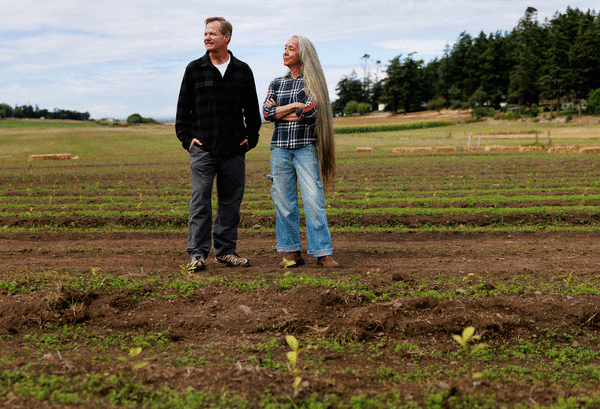
Vale Concepts is launching a 365-acre operation on Whidbey Island. The project, Vale Farms, is set to become one of the nation's largest tea farms, with a laser focus on matcha.
"We think that the Pacific Northwest can become a region known for tea, much like Napa Valley became known for wine," Larson said.
Matcha lover Janelle Gonzaga, 26, traveled to Seattle from the Washington, D.C., area a year ago, sampling matcha at six establishments across the city, Redmond and Bellevue.
"It's just really interesting to see the high demand," Gonzaga said. "I just thought it was really cool to see what Seattle had."
'There's not enough' matcha
Though tea has been a staple for centuries, matcha, a powder milled from green tea leaves, is having its own special moment.
The North American matcha market was valued at $2.4 billion last year, according to data research firm Market Data Forecast, with a possible surge to $3.5 billion by 2034.
Social media has played a part in matcha's rising popularity.
"TikTok and Instagram are definitely my friends when it comes to searching" for matcha cafes, said Gonzaga, 26.
The onslaught of demand led to a worldwide matcha shortage. Last year, local shops felt the pinch of supply chain issues, combined with climbing prices tied to tariffs.
"The world has fallen in love with matcha," Larson said, "and there's not enough."
During the shortage, his company began importing matcha and supplying it to other retailers. Now, Vale will be producing it, too.
"People have been growing tea in the Pacific Northwest for decades," Larson said. For example, Washington State University kicked off its tea research project in 2019, developing propagation techniques.
In the U.S., tea is largely grown in South Carolina, Mississippi and Hawaiʻi, but "the Pacific Northwest has a favorable temperate climate with adequate rainfall and acidic soils that make it well-suited for growing tea," academics at WSU and Oregon State University found.
As of now, local tea processing remains very limited, though Goodness Tea Farm in Sequim, Clallam County, produces a variety of blends. Instead, the matcha used by many Seattle retailers originates from Japanese locales like Kyoto, Uji and Shizuoka.
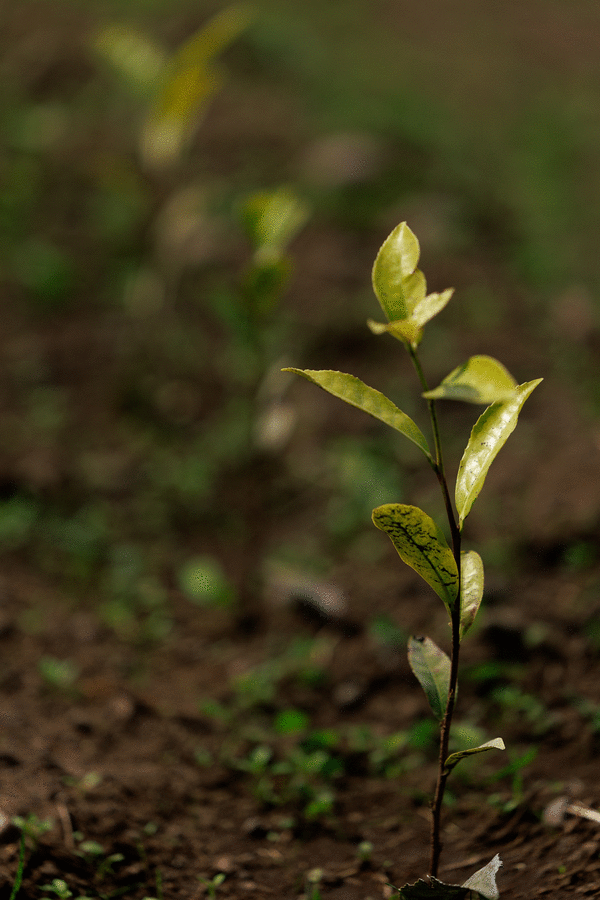
Vale Farms plans to cultivate close to 1 million tea plants across 200 acres of the 365-acre property.
The farm's Whidbey Island Cascadia matcha will be available at Vale's South Lake Union cafe and various rotating matcha bars. The company will open three more cafes in the Seattle area over the next six months.
Its tasting room will follow in 2028.
Over the next five years, Larson expects his company could hire more than 2,000 people in the Greater Seattle area.
"Our ambition for Vale Farms is bigger than just one farm," he said.
And given the waxing interest in matcha, "a rising tide lifts all ships," Larson added. "We also really want to encourage other people to join this movement as well."
Locals are thrilled by the prospect.
"It would be so cool to have that recognition of being one of the first states in the U.S. to be known for their matcha," said Alex Nguyen, 30, a Renton resident and avid matcha drinker.
'Great place to grow tea'
Skagit County wasn't the right location — and neither was Whatcom County when Fife Symington, president of Vale Farms, said he and Larson were on the hunt "for the perfect place to grow matcha in the Pacific Northwest."
They'd almost given up hope — until a detour brought them through Whidbey Island, a land where camellias flourish, last summer. As it turns out, all tea varieties stem from Camellia sinensis, otherwise known as tea shrub or tea tree.
"It is a great place to grow tea," Symington said. "It's just nobody had ever really done it in a big way before."
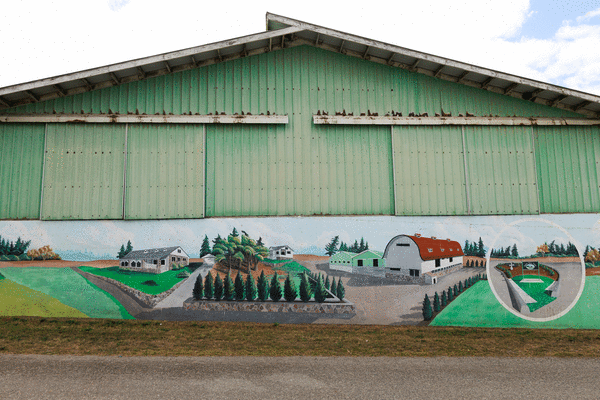
The pair came across a former dairy farm near Oak Harbor. It previously belonged to Captain James Griffiths, a shipping pioneer who moved to Tacoma from England in 1885, according to Seattle's Museum of History & Industry.
Griffiths would play his own part in the Miike Maru's journey from Asia to American soil as its receiving agent for the shipping lane.
With the property under Vale's ownership since January, the link between Japan and Washington will persist — with a slight deviation to Hawaiʻi Island, Symington said.
Tea Hawaiʻi & Company, founded by Eva Lee and her husband Chiu Leong in Volcano Village, will receive the tea cultivars from Japan and nurture them for Vale Farms until they hit a certain maturity.
"From our island to theirs," Lee said.
Then, they're planted in the Evergreen State.
In August, 12,000 tea plants went into the ground across three acres, Symington said. It will take about five years to reach full production.
The first harvest is planned for 2030.
"A lot of exciting times ahead, as to what will be developed," Lee said. "We'll give domestic production a leap forward.
©2026 The Seattle Times. Visit seattletimes.com. Distributed by Tribune Content Agency, LLC.










Comments