Dollywood's billionaire owners plot future without Dolly Parton
Published in Business News
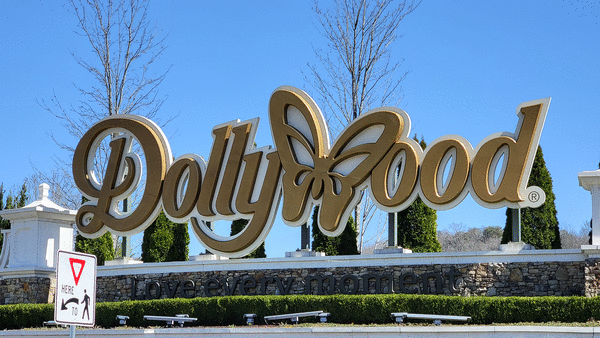
Since it opened in 1986, Dollywood has been both monument to Dolly Parton and a bustling venue where visitors can wander through a replica of the two-room log cabin where the singer-songwriter grew up and munch on loaves of her fragrant cinnamon bread between thrill rides.
Now the Tennessee theme park’s legacy rests in the hands of a low-key billionaire family.
Following Parton’s death last month at age 80, her long-time partner and Dollywood’s co-owner, Herschend Entertainment, has assumed the role of overseeing and growing the venue, which was molded in the entertainer’s image near her birthplace in the Smoky Mountains. Her impact will keep unfolding in the years ahead as the park is in the middle of a $500 million expansion with rides and amenities that were all Parton-approved.
“We want to honor her by continuing to make Dollywood what she intended it to be,” said Chris Herschend, chair of Herschend Entertainment and a third-generation member of the family that owns the closely held business. He spoke in a video conference from his office in front of shelves stuffed with children’s books, surplus from Parton’s Imagination Library. “Nobody could replace Dolly. She was one of one.”
In Herschend, Parton found a partner that shared her mix of business savvy and social responsibility, said Robert Niles, founder and editor of Theme Park Insider. Herschend offers a range of perks to its 22,000 employees, or “hosts,” from profit sharing to free tuition, while donating 1% of its top-line revenue to charity.
“Dolly was a businesswoman, it’s not like she was some altruistic saint, she hustled every day of her life,” Niles said. “But she treated her customers with respect and delivered value.”
The success of Dollywood has allowed Herschend to expand significantly. The suburban Atlanta-based company now owns and runs 10 other U.S. theme parks as well as water parks, resorts, campgrounds, aquariums, a jeep-touring operation and the Harlem Globetrotters.
Moody’s estimated the company generated around $1.2 billion in revenue last year. Based on that and other financial information, the Bloomberg Billionaires Index values the business at at least $1.7 billion. It’s entirely owned by the Herschends, who declined to comment on the valuation.
The company doesn’t disclose financials or the performance of individual parks, but Herschend said business has tripled in the past decade, while earnings before interest, taxes, depreciation and amortization have grown at a compound annual rate above 8% over the last two decades. A Moody’s credit report from January estimated that 43% of its park-level Ebitda came from the Southeastern U.S., where Dollywood is easily its biggest attraction.
Herschend declined to say how large a stake Parton owned in the park, but said “considerations” had been made in advance to ensure it would continue as usual following her death.
Pigeon Forge
Located in the town of Pigeon Forge (population 6,600), Dollywood sprawls over 165 wooded acres and boasts roller coasters, numerous music stages, a pair of World War II-era steam trains and a dedicated Dolly museum whose facade is dominated by a glittering pink butterfly.
In 2024, the most recent year available, it drew 3.1 million visitors, according to the Themed Entertainment Association, making it the 18th-most visited U.S. theme park on a list dominated by Disney attractions. Among seasonal theme parks — Dollywood is open mid-March through early January — it ranks among the top three, and is the biggest ticketed tourist venue in Tennessee.
The Herschend family business traces back to the early 1950s when Chris’s grandparents — Hugo, a door-to-door vacuum salesman and his wife Mary, a librarian — came across a cave while on a trip through Missouri. On a whim they bought the cave and turned it into a tourist attraction. After Hugo’s death in 1955 Mary continued to run the site with her sons Jack and Pete, and expanded it to include a reconstructed 1880s mining town, which they named Silver Dollar City. After the 1970s oil embargo curtailed road-tripping visitors, the brothers decided to broaden their geography and bought a second park, a small destination in the Smokies that they rebranded as Silver Dollar City Tennessee.
When Parton announced in an interview with Barbara Walters that she wanted to open a theme park in her Tennessee hometown of Sevierville – just up the road from Silver Dollar – “it was like a shot, not an invitation,” Herschend recalled. “It was perceived by us as ‘Oh Lord, we’ve got to figure this out.’”
As it turns out, Parton was a regular visitor to Silver Dollar, where she’d bring her nieces and nephews and set them loose with pocket money.
Coincidentally, the mother of the park’s general manager at the time worked at the post office with the mother of Parton’s tour bus driver. The moms brokered an introduction and the GM pitched Parton on collaborating after catching up with her at one of her concerts.
Convincing Herschend board members of the merits of teaming with Parton wasn’t easy, Herschend said. They were wary of some hotshot celebrity running roughshod over the organization.
A board member from Nashville brokered the deadlock and cast the deciding vote, according to Herschend. “He said, ‘Y’all don’t understand. This is not like most people, she’s one in a billion and you’ve got to do this deal.’”
Bluegrass bands
Parton’s talent for storytelling and connecting with people informed both the feel of the park and the specific attractions, most of which nod to local culture, like stages featuring bluegrass bands and Appalachian roots music, blacksmithing demonstrations and the Lumberjack Lift tower climb. Boosting the region was a major motivation for her founding the park, which is the county’s largest employer and was estimated in 2021 to generate $1.8 billion annually for the local economy.
Her business instincts affected the Herschend group in other ways, as well. She encouraged the company to open a resort near Dollywood years ago — a suggestion Herschend said they resisted given it wasn’t their expertise.
“She was patient with us as we explained over and over again why we weren’t willing to do it,” Herschend said. Eventually they gave in and the hotel – the Dollywood DreamMore Resort and Spa — was an immediate success, he said. They now have two with a third Dolly Parton-branded hotel under construction in Nashville.
Dollywood provided a template of sorts for theme parks they own elsewhere, most of which are regional venues far from major cities that aim to be immersive and reflect the locality. The company acquired Palace Entertainment’s 24 U.S. attractions (some of which it’s since sold) from Spain’s Parques Reunidos in 2025 for $700 million. Five months later, they bought Silverwood Theme Park near Coeur d’Alene, Idaho, from its founding family for an undisclosed amount. The purchases have contributed to the company’s more than $1.1 billion of debt, which Moody’s rates as stable.
Being family-owned and private has allowed the company to reinvest in its parks and attractions at a level above what a private equity firm or public company would, Herschend said. The family encompasses around 70 members across five generations and operates under the unofficial motto “family held forever,” although the firm has been professionally run by non-family members for more than 20 years.
The Herschends’ family office, Elmwood Management, invests across public and private asset classes that offer diversification from family entertainment and theme parks.
In the wake of Parton’s death, Dollywood’s president announced the park’s plans to honor the singer posthumously, including new features like a cascading waterfall with a guitar sculpture next to the park’s existing chapel.
“The thing that made Dollywood work was the trust between Dolly and our family and the mutual confidence that each would kind of do our part,” Herschend said. “And Dolly always over-delivered.”
©2026 Bloomberg L.P. Visit bloomberg.com. Distributed by Tribune Content Agency, LLC.


Comments