Trump set to host Nvidia, Anthropic CEOs to discuss AI risks
Published in Business News
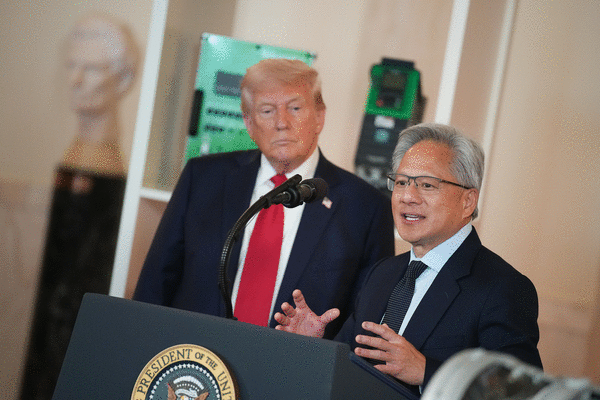
Artificial intelligence industry leaders including Anthropic PBC Chief Executive Officer Dario Amodei and Nvidia Corp. CEO Jensen Huang are descending on Washington for meetings with President Donald Trump to discuss growing global concerns over threats posed by the technology.
Trump was set to welcome the executives for a lunch Tuesday at the White House with House Speaker Mike Johnson, joined by other technology industry attendees including Meta Platforms Inc. CEO Mark Zuckerberg, Palantir Technologies Inc. CEO Alex Karp and OpenAI President Greg Brockman. The decision to engage on AI safety marks a shift for Trump, who only last week rejected fears of catastrophic risk as “a hoax.”
Other industry attendees were to include Microsoft Corp. CEO Satya Nadella, SpaceXAI’s Elon Musk and Advanced Micro Devices Inc.’s Lisa Su, according to a list released by the White House. Vice President JD Vance, Treasury Secretary Scott Bessent, Commerce Secretary Howard Lutnick and White House Science and Technology Policy Advisor Michael Kratsios were also expected to join.
It was unclear before the meeting began whether the gathering would yield any progress toward new AI safeguards that Trump and other administration officials have consistently rejected. Pressure to take action has increased following high-profile security breaches by rogue AI models that fueled calls by Silicon Valley AI developers and world leaders for new standards on the technology.
During remarks at a Tuesday morning event, however, Trump signaled his continued distaste for regulations.
“You’re going to have a winner and a loser and you’re probably not going to have a second place,” Trump said at the unveiling of a new AI-powered website for government services. “We’re leading now over China and everyone else and I want to keep it that way. The only way you can keep it that way is to do exactly what we’re doing right now. We don’t want to stifle growth.”
The debate has posed a political conundrum for Trump, who has cast himself as one of the nation’s loudest champions of AI, arguing that its unfettered development is key to beating China and sustaining the U.S. economy. But polls show Americans have rapidly become more wary of the technology’s risks, including job loss, higher electricity costs and major cyber attacks, threatening to put Trump on the wrong side of the issue ahead of the November midterm elections.
Trump has recently become preoccupied with AI’s name, suggesting he sees the controversy surrounding the technology as a branding problem more than an issue with its potential dangers. The president said Tuesday he would sign an executive order renaming it “super intelligence.”
“We’re changing the name to super intelligence, and so far, I mean, everybody likes it. Artificial intelligence is like the news, fake news,” he said.
The lunch was set to take place after Trump met with Amodei on Sunday, bringing together two men at opposite ends of the AI safety debate. The late-night dinner marked their first private sit-down after months of rocky relations between the Anthropic chief and the administration over safety-related issues involving the company’s AI tools.
Amodei has long warned about AI’s existential risks, and he propelled the safety debate into the mainstream with a Sept. 12 essay, promising to slow development of the most advanced models and urging more regulation. His pledge to pace development was embraced by his rivals, OpenAI CEO Sam Altman and Musk.
Highlighting those concerns, OpenAI said Monday it would hold back a version of its Astra model while it establishes stronger safeguards. Saachi Jain, OpenAI’s head of safety systems, said the in-development GPT-6.1 Astra model wasn’t as good as the company wanted when it came to “staying within scope and authorization, and how it communicates back to the user about the type of work it’s done.”
Earlier this month, Johnson responded to dire warnings coming from within the AI industry by saying that Congress “potentially” will need to impose guardrails, though he cautioned it would likely take “some time” to fashion legislation with broad enough support to pass.
Ahead of the lunch, Johnson said he’d “been urging this meeting for a long time” and added he hoped it would lead to voluntary steps to mitigate AI risk, such as audits or other transparency measures.
“The leading minds need to get together at the White House and have this discussion,” Johnson said Tuesday on CNBC. The AI companies “have fiduciary obligations to their own corporations, of course, but we have a broader obligation to the people and to safety and to ensuring that this is done right and well.”
In the near term, Congress is unlikely to act on any AI legislation. House lawmakers have already left town for recess and won’t return until after the midterms, and the Senate is preparing to begin its own preelection recess later this week.
(With assistance from Hadriana Lowenkron, Shirin Ghaffary, Alexandra S. Levine, Rachel Metz, Lynn Doan and Nick Turner.)
©2026 Bloomberg L.P. Visit bloomberg.com. Distributed by Tribune Content Agency, LLC.





Comments