Iowa cheers a $15 billion steel mill deal. Minnesota offers a warning
Published in Business News
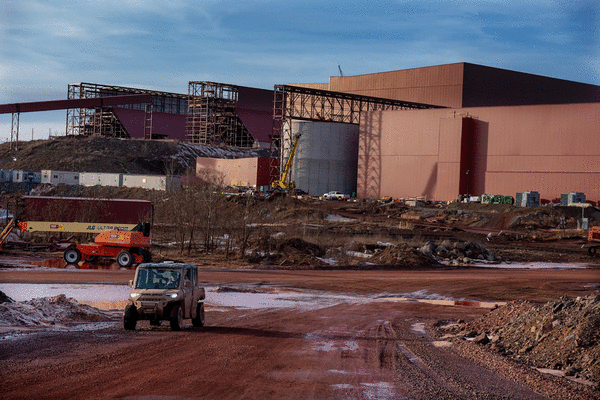
The Oval Office announcement that an Iron Range mining company plans to build a colossal, $15 billion steel mill in Iowa rather than in Minnesota sparked two weeks of political finger-pointing about the latter state's business climate.
Minnnesota House Speaker Lisa Demuth, a Republican candidate for governor, said the news shows the state is “anti-business.” Sen. Amy Klobuchar, Democratic gubernatorial candidate, called for Minnesota to “aggressively compete” for big projects.
The proposed Iowa mill would make steel from the iron ore extracted from a new Minnesota mine that took years of political and financial effort to open. The mine will still benefit Minnesota, but critics say it may now be missing out on a greater economic windfall.
But several state and local officials say Iowa’s deal with the Mesabi mine’s owner, Essar, may prove more elusive than promised.
The opening of the Minnesota mine was delayed nearly a decade by multiple missed deadlines amid financial setbacks, including a bankruptcy. Minnesota officials grew so weary of the delays that they pulled mineral leases in 2021. Now they have a message for Iowa.
“My first thought was, ‘Y’all need to be vigilant,’ ” Minnesota State Auditor Julie Blaha said in an interview, about Iowa. “You need to have clear deadlines (with Mesabi) all the way, and the moment they miss one, you need to take action.”
A steel mill like the one slated for Iowa requires a substantial supply of mined ore.
Mesabi held an opening ceremony for its new $3 billion iron ore mine in Minnesota in September, complete with a rock blast and red, white and blue puffs of smoke. Trump administration officials with the Export-Import Bank of the United States looked on as officials marked the first new U.S. ore-mining operation in half a century.
Locals welcome the activity, but remain wary of the company’s promises.
The mine’s corporate owner, Essar Group, which is owned by India’s wealthy Ruia family, said in 2007 it planned to build the Iron Range’s first steel mill, while also buying a shuttered mine outside Nashwauk.
Essar began construction on the Nashwauk mine in 2011, but financial trouble halted the project. In 2016, with the mine only half built, the company filed for bankruptcy. The project exited bankruptcy the following year with a new identity as Mesabi Metallics. In 2019, Essar regained ownership of the mine.
That’s when Gov. Tim Walz’s administration moved to ban Essar from doing business in Minnesota, based upon the company’s broken promises in the state. A court later blocked the ban, but the state revoked mineral leases in 2021 when the company missed a deadline to have $200 million available in its accounts. The state then awarded the leases, covering more than 2,600 acres, to Mesabi’s rival Cleveland-Cliffs in 2023.
In 2024, Essar restarted construction of the mine on private mineral leases, after lining up financing to finish the job. The biggest source of money: a $770 million loan from the Export-Import Bank approved this year.
“We are gratified by Ex-Im Bank’s interest in the project, and our discussions with them are ongoing,” said Charles Sutton, chief development officer with Mesabi Metallics, in an email.
But Mesabi still owes Minnesota money. The company has nearly $22 million left to repay on a $65 million state-approved fund, according to a spokesperson with the Minnesota Department Employment of Economic Development. The company is expected to finish making payments by the end of 2028.
Today, Mesabi says this checkered history is in the rearview mirror. But the September announcement of the subsidized steel mill in Iowa, dashing hopes on the Iron Range that Mesabi might build a mill in Minnesota, also reawakened tension and distrust in a relationship between a mine and the state that many hoped had been put in the past.
“It came up so suddenly,” former Nashwauk Mayor Calvin Saari said. “This is an opportunity for the Trump administration to take advantage of trying to get votes in Iowa and Minnesota.”
Mesabi’s leadership, including the Ruia family and Joe Broking, Mesabi’s CEO, stood for a photo op in the White House with President Donald Trump and a slate of Iowa’s GOP members of Congress when announcing the deal last month.
Steel and mining industry experts say the decision to build the Mesabi steel mill in Iowa is likely a reflection of logistics more than politics.
“This agreement is playing to the strengths of the two locations,” said Monica Haynes, director of the Bureau of Business and Economic Research at University of Minnesota Duluth. “It’s really a good development for the Iron Range.”
Haynes said the mill’s proposed location — in southeastern Iowa — has better proximity to steel buyers located farther south and east in the United States.
Furthermore, steel mills have long been economically uncompetitive in northern Minnesota largely because of higher transportation costs. It’s cheaper to send the ore elsewhere to be turned into steel.
“Sometimes you’ve got to put the politics aside when it’s going to do something good for folks,” said Timothy Hagle, a political science professor at the University of Iowa.
The steel mill, slated to be operational by 2030, could boost confidence in the Nashwauk mine by providing a steady buyer of the iron ore pellets.
“I don’t think it’s really a conversation about a snub,” said Rolf Weberg, executive director of the Natural Resources Research Institute at the University of Minnesota Duluth. “This is an exciting step in the evolution of the iron industry here in Minnesota.”
The Iowa Legislature has approved $1.4 billion in tax credits for Mesabi in hopes of attracting 1,750 mill jobs.
But the Trump administration has backed projects that ultimately fizzled in the past. A 2017 announcement by Trump of a proposed Foxconn plasma TV plant in Wisconsin ultimately failed to materialize.
Iowa state Rep. J.D. Scholten, a Sioux City Democrat, voted against the Mesabi package.
“Is this Foxconn 2.0?” Scholten said in an interview.
Some politicians remain convinced Minnesota has lost out.
State Rep. Cal Warwas, a northern Minnesota Republican who works for U.S. Steel, said it took a while for Iron Rangers to become confident in the completion of the mine in Nashwauk. Today, Warwas’ daughter works at Mesabi Metallics.
“This was always going to be the Iron Range steel deal,” said Warwas, frustrated that Minnesota lost the mill. “We’re exporting jobs.”
Minnesota may yet have chance to add additional job growth related to steel production.
In July, Broking wrote to Walz that Mesabi is planning a $5 billion expansion of the mine’s capacity, which would make it the largest taconite mine on the Iron Range. Broking also said the company sought to build a $2 billion iron-purification facility in Minnesota that Mesabi estimates would create 500 direct jobs. Broking repeated his goals at a September Itasca County Board meeting.
But, in return, Broking asked for state-backed incentives, including faster permitting, forgiveness of its debt to DEED and return of the public leases currently held by competing steelmaker Cleveland-Cliffs. Broking also said Mesabi had received “no incentive support” from the state government.
“We need the state to be a genuine partner on the next phase,” Broking said.
Two months later, Broking was among the company officials standing at the White House next to Iowa’s congressional delegation to announce the new steel mill.
©2026 The Minnesota Star Tribune. Visit at startribune.com. Distributed by Tribune Content Agency, LLC.









Comments