Boston Mayor Wu's tax battle with Senate dividing residents bracing for 13% tax hike: 'Creating tension and hate'
Published in News & Features
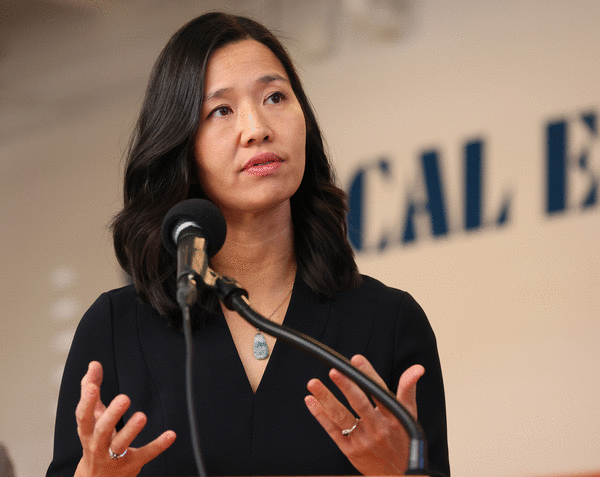
Boston residents are saying Mayor Michelle Wu’s two-year battle with the state Senate over a stalled plan to hike commercial taxes is causing them stress at a time when homeowners are bracing for a 13% increase in their property taxes.
No matter where they stand on the mayor’s legislation to shift more of the city’s tax burden onto businesses beyond the state limit, residents who attended a community meeting in Allston/Brighton Monday night said they were frustrated by how Wu and senators opposed to her proposal have pitted residents against businesses with their debate.
“I’m really frustrated that it seems no one is talking to each other on this at all,” said one woman who attended the meeting at the Presentation Foundation Community Center.
The discussion was hosted by state Sen. William Brownsberger, a Democrat who represents Allston/Brighton and co-led last year’s opposition to kill the mayor’s bill in the Senate, where it died last December and has stalled again this year.
“There’s a lot of conversation, but as far as closing a deal on this, no, that’s not really happening,” said Brownsberger, who has put forward alternative targeted tax relief legislation in the Senate.
Opinion in the room was split, with some residents laying into Brownsberger for helping to stall the city’s tax relief legislation at the State House at a time when they’re struggling to make ends meet, while others placed the blame on the mayor for refusing to cut the city budget instead of increasing their taxes.
One man accused the mayor of using the tax debate as a political tactic to make the state Senate out to be the “bad person” by telling the public that homeowners and other residents will suffer without approval of her legislation, in order to distract from her “out-of-control” spending.
“It’s just pathetic,” the man said. “It is creating tension and hate.”
He said the mayor’s rhetoric around the issue is creating a “false hatred” for commercial property owners “that are making money by being a contributing member to the city.”
“These are not evil people,” the man said. “I just can’t believe the hate that comes out of people’s mouths. It’s like, why do you hate people that are rich? I just don’t get it. So why are we creating this artificial tension?”
“The issue,” he added, “is we’re spending too much money. We need to control the money or we need to raise taxes. We want to spend the money, but then be upfront and honest about it — and don’t pit two groups who are very important to the city, both residents and commercial entities, against one another and then make the fall guy be the state. It just doesn’t make sense to me. It’s wrong and it’s hateful.”
The city’s budget grew by 8% last year, and 4.4% this year. It’s grown by $1 billion, or 26%, over the past four years that encompass Wu’s first term as mayor, from $3.8 billion to $4.8 billion this fiscal year, per data on the city website.
Wu has directed all city departments to submit budgets with a 2% spending cut, but her chief financial officer, Ashley Groffenberger, has said the overall budget will still grow for the next fiscal year, saying a budget cut is not feasible and would require cuts to city services that would be devastating to residents and businesses.
Others had a different take on where the blame for their looming tax increase lies.
“This was a home rule petition … that was pretty substantially approved by the Boston City Council, signed by the mayor of the City of Boston, twice enjoyed substantial support in the House,” one man said. “I thought it was a bad visual last year at the end when you and (state Sen. Nick) Collins announced that this thing wasn’t going any further in the Senate.”
He added that he found it particularly “unsettling” that Collins repeatedly used a procedural move to prevent a vote on the bill in the Senate late last year.
As for this year, the man said it’s “disrespectful” to the city’s residents that the bill hasn’t been pulled out of the clerk’s office at the Senate upon the mayor’s amended refiling, and assigned to a legislative committee for a fair hearing.
Brownsberger defended Collins for delaying a vote until the Senate was provided with final city property valuation data, saying that it was “important” because the certified assessment data from the Department of Revenue showed the actual residential tax increase was much lower than what the city had been projecting last year.
The discrepancy led business groups and senators concerned about impacts to a struggling commercial sector to pull their support, Brownsberger said. He added that before that point, he was prepared to support the compromise legislation agreed upon by the mayor and four business groups.
Still, some residents at the meeting implored their senator to change his mind, as they brace for a second straight year of double-digit property tax hikes in Boston.
“Most of your district is not wealthy and most of them cannot afford the residential increase of 13%,” one man who favors the mayor’s bill said, adding of corporate landlords facing a higher tax burden, “I don’t feel for them.”
A woman looking to buy a home in the city added of the projected tax hike, “I want to be a homeowner. Me and my husband want to raise a family here and we are absolutely priced out, and this would be the final nail in the coffin.
“Affordability is hitting us at every single level,” she said, “and this would price us out.”
Brownsberger said residential taxes will increase by 13% next year, regardless of what the Senate does.
“We’re at a stage where the 13% — that ship has sailed,” Brownsberger said. “The mayor reinitiated these conversations when the ship had already sailed. We could have been doing this in April.”
_____
©2025 MediaNews Group, Inc. Visit at bostonherald.com. Distributed by Tribune Content Agency, LLC.






Comments