Trump announces military 'warrior dividend' amid inflation woes
Published in News & Features
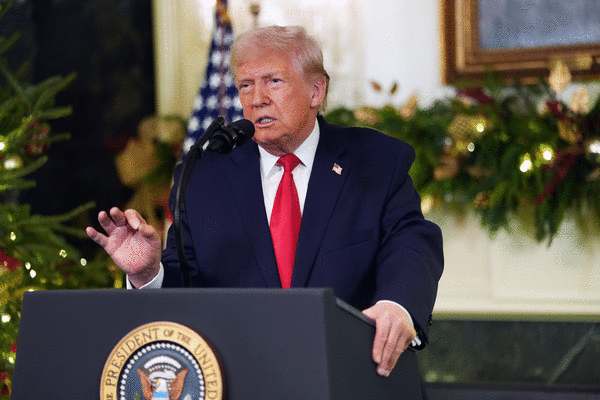
President Donald Trump looked to reassure Americans concerned about the rising cost of living by announcing plans to award a special holiday payment to military service members and roll out new housing reforms in the new year.
Trump announced the plans Wednesday during a prime-time address from the White House, which he used to extol his accomplishments from his first year back in the White House and convince voters they should still blame his predecessor for persistent economic anxieties.
“Eleven months ago, I inherited a mess, and I’m fixing it,” Trump said.
Trump’s biggest announcement was a move to award service members $1,776 payments, a decision that should provide a holiday boost to 1.45 million Americans.
“Military service members will receive a special — we call Warrior Dividend — before Christmas — a Warrior Dividend,” Trump said. “In honor of our nation’s founding in 1776, we are sending every soldier $1,776. Think of that. And the checks are already on the way.”
But he also sought to allay fears that his economy had not yet taken off, telling voters they would see the benefits of his tax cut legislation, lower mortgage rates, and broader housing reform in the new year.
“I’ll soon announce our next chairman of the Federal Reserve, someone who believes in lower interest rates, by a lot, and mortgage payments will be coming down even further,” Trump said. “Early in the new year — and you will see this in the new year — I will announce some of the most aggressive housing reform plans in American history.”
Administration officials cast the event as an opportunity to highlight the president’s accomplishments in his first year back in the White House and preview new policies for 2026, but the remarks come at a critical moment with Trump confronting mounting public anxiety about his economic agenda and his advisers struggling to hone their messaging.
The speech also came against the backdrop of Trump’s escalating campaign to pressure the Maduro regime in Venezuela, including an announcement Tuesday of an embargo against sanctioned oil tankers. While Trump mentioned counter-narcotic efforts broadly, he did not address a possible escalation in military activity.
Voters returned Trump to office in part to address the persistent inflation that plagued former President Joe Biden. And Trump spent much of his remarks looking to lay the blame at the foot of his predecessor, detailing price increases during the prior administration.
“When I took office, inflation was the worst in 48 years, and some would say in the history of our country, which caused prices to be higher than ever before, making life unaffordable for millions and millions of Americans,” he said.
Trump now finds himself facing the same economic headwinds. Surveys show Americans are worried about the cost of living and inflation, fears that powered rival Democrats to key electoral wins in November and pose a major threat to Trump and Republicans in 2026 elections that will decide control of Congress and the future of his legislative agenda.
A Reuters/Ipsos poll released Tuesday showed Trump’s approval rating had slipped to nearly its lowest level of his second term in office, with just 39% of U.S. adults approving of his job performance.
Trump’s own inconsistent messaging on the economy has made his task harder. The president has vacillated between deriding voter anger over affordability as a Democratic “hoax” and at times emphasizing lower prices for gasoline and eggs as positive bellwethers.
Trump has graded his record on the economy as an “A-plus-plus-plus-plus-plus,” while insisting that his administration needs more time to remedy what he says was a mess left by Biden.
Trump sought to rally viewers by touting his work on other issues, saying he had stopped the flow of undocumented migrants and drugs while bolstering the military and brokering a ceasefire in Gaza. He also touted his controversial tariff regime, which critics have blamed for rising prices but that Trump framed as a diplomatic tool and way to offset costs like his payment to service members.
The White House said the new one-time “warrior dividends” would apply to active-duty service members and reserve component members on active-duty orders of 31 days or more as Nov. 30. The program announced Wednesday could cost nearly $2.6 billion.
“Boy, are we making progress. Nobody can believe what’s going on,” Trump said.
Economic headwinds
Democrats have seized on voter fears over sluggish wage growth and high prices. They have blamed the run-up in consumer costs on Trump-imposed tariffs, the imminent end of expanded health care subsidies and mounting electricity demand from data centers serving the artificial intelligence industry.
While inflation has eased substantially from the four-decade high seen in 2022, prices overall have continued to climb this year — stacking on top of the surge in costs during the wake of the pandemic.
Trump pledged to cut electricity costs in half within a year of taking office. Instead, they’ve spiked amid surging demand. Nationally, the average retail price for electricity gained 7.4% in September to a record 18.07 cents per kilowatt-hour, the biggest gain since December 2023, according to the latest government data. Residential prices have jumped even higher, rising by 10.5% between January and August 2025, one of the largest increases in more than a decade, according to the National Energy Assistance Directors Association.
Health care also poses a particular challenge with expected cost increases for millions of Americans. Enhanced subsidies under the Affordable Care Act are slated to expire at year’s end and Congress is deadlocked over how to address the issue.
Trump depicted his opposition to extending the subsidies as an effort to take on health insurance companies, though many questions remain about how his strategy would work and if it could deliver cheaper or better health outcomes.
“The money should go to the people, that’s you, so they can buy their own health insurance, which will give far better benefits at much lower cost,” he said.
Trump also touted his plans to launch a new website next year that will allow Americans to buy discounted prescription drugs directly from the government. Numerous pharmaceutical companies have offered to participate in exchange for tariff exemptions.
The pressure on housing also remains acute after home prices skyrocketed and mortgage rates doubled in the wake of the pandemic. While rates have been coming down recently, the current level of 6.22% is still well above the 3% rates seen just a few years ago.
That combination of high home prices – driven by a supply shortage years in the making, after construction cratered following the subprime crisis – and high rates has kept both buyers and sellers on the sidelines, stalling sales and leading builders to take a more cautious approach.
Tariff impact
Many economists say Trump’s tariffs have contributed to higher prices for some goods, though the overall impact has been much less than many forecasters predicted earlier this year. Trump on Wednesday argued his tariffs are delivering economic gains and luring investment in domestic manufacturing.
Still, Trump’s speech offered a muddled message on price levels. He said at one point that he was “bringing them down very fast,” while later acknowledging ongoing inflation he said was outpaced by wage growth. Trump also heralded his tariff barrage, indicating it would fund the payments to military members and had been a useful cudgel in settling conflicts abroad — though the levies are import taxes that historically raise costs.
Adding to Trump’s woes, U.S. hiring has been lackluster in recent months, with any gains largely propelled by steady hiring in health care. The latest jobs report showed employers added 64,000 jobs in November, thanks to health care hiring and the strongest advance in construction employment in more than a year. Manufacturers, however, shed jobs for a seventh straight month.
Meanwhile, the unemployment rate climbed to a four-year high, underscoring how many Americans are struggling to find work in the low-hiring environment. Layoff announcements have also picked up in recent months, fueling Americans’ worries about job stability.
Trump, however, pointed to increases in real wages, citing gains for factory workers and miners.
_____
(With assistance from Reade Pickert, Naureen S. Malik, Katy O'Donnell, Josh Wingrove and Jordan Fabian.)
_____
©2025 Bloomberg L.P. Visit bloomberg.com. Distributed by Tribune Content Agency, LLC.






Comments