Maryland Gov. Moore's redistricting commission passes maps, state Senate leader Ferguson calls the group 'irresponsible'
Published in News & Features
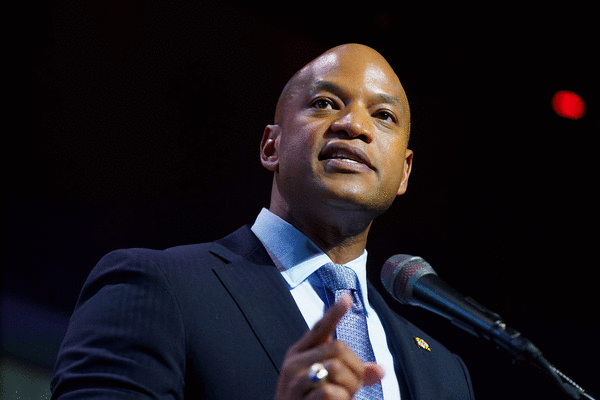
Maryland Gov. Wes Moore’s redistricting advisory commission decided on Thursday to “recommend a congressional map to the Governor and the General Assembly,” after the group’s final meeting. The commission will make the submitted maps publicly available after Christmas and will hold two additional public meetings to gather feedback.
“At a moment when other states are moving aggressively to redraw maps — and with some already signaling they want the Supreme Court to weaken or effectively nullify key protections in the Voting Rights Act — Maryland cannot afford to sit on the sidelines,” U.S. Sen. Angela Alsobrooks, a Democrat who chairs the commission, said in a statement. “We have a responsibility to move forward so the next Congress reflects the will of the people and can serve as a real check on this President. That’s what tonight’s announcement is about: doing the work, inviting the public in, and getting this right.”
The announcement comes shortly after Maryland Senate President Bill Ferguson rebuked Gov. Wes Moore’s redistricting commission ahead of its closed-door meeting, saying that the group had approved redrawing Maryland’s congressional maps before its members had even met.
Ferguson is a member of the five-person commission, which includes Alsobrooks and members: Democratic Del. C.T. Wilson, former Attorney General Brian Frosh, and Cumberland Mayor Raymond Morriss, the commission’s lone Republican.
“Earlier this afternoon, I was asked to comment on a forthcoming story about the Governor’s Redistricting Advisory Commission (GRAC) approving a decision to move forward consideration of new Congressional maps,” Ferguson said in a statement. “The meeting is scheduled for 5:00 p.m. — it has not happened, but the outcome is already known. Clearly, the Commission’s work was pre-determined from the moment the GRAC was announced.”
Ferguson accused the commission of being “irresponsible” and said it “lacks transparency,” given that the oral and written testimony the commission has received showed Marylanders overwhelmingly opposing redrawing Maryland’s maps to eliminate its lone Republican congressional seat.
Following the meeting Morriss, who has opposed redistricting measures in Maryland, told The Baltimore Sun that the commission’s decision wasn’t reached unanimously. He added that the commission didn’t formally vote — and instead came to a consensus — on the issue, since Maryland’s Open Meetings Act prescribes decisions made in closed-door meetings to be reached by consensus.
But regarding Ferguson’s allegations, Morriss said it was “rather sort of disappointing that people would think a decision has been made before we’ve actually had the meeting to convene to discuss it.”
“With a lot of my colleagues, they’re looking at this from a national perspective, whereas I look at it as what’s right for the citizens of Maryland,” Morriss said in a phone call with The Baltimore Sun. “To me, it’s systematically been done for the last 25 years that the Republicans in this state, their voices have been discounted and disenfranchised through all of the redistricting that’s been done. And this is just one more step in that direction.”
Other Republicans also swiftly spoke out against the commission’s decision. House Minority Leader Jason Buckel called Moore’s commission “a farce.”
“Sen. Ferguson has hit the nail on the head. The Governor has put together a highly partisan “commission” to solve a problem that doesn’t exist,” Buckel said in an emailed statement to The Sun. “There has been limited and rushed public input — and at least 50% of it is against any redistricting.”
Republican Del. Kathy Szeliga shared that sentiment.
“Maryland is facing a massive budget shortfall, repeated audit failures across multiple state agencies, and crushing electric bills that are hitting families and seniors especially hard,” Szeliga told The Sun. “Governor Wes Moore should be focused on solving Maryland’s real problems, not playing political games designed to eliminate all Republican representation in Washington, D.C. Eliminating your political opposition is the tactic of fascist authoritarian regimes. It is fundamentally un-American.”
Earlier this week, the University of Maryland, Baltimore County released a poll in which a majority of Marylanders said they cared more about economic issues than redistricting, echoing Ferguson’s sentiment. Additionally, The Sun last Friday obtained access to written testimonies collected by the Maryland Department of Planning that showed Marylanders overwhelmingly opposed redistricting measures.
“We did not engage in a thoughtful, informed conversation that would have included, at the very least, testimony from the Office of the Attorney General, or our State and local boards of elections,” Ferguson said. “Pushing forward a pre-ordained recommendation outside the public eye is irresponsible and lacks transparency.”
Ferguson and Moore have seemingly been at odds since October, when the Senate president publicly opposed eliminating the state’s only Republican-held congressional district — a move Moore, much like California Gov. Gavin Newsom, announced in retaliation to President Donald Trump having directed GOP legislatures across the country to redraw their maps to give Republicans a winning edge in the 2026 midterm elections.
In a letter to his Maryland Senate colleagues, Ferguson argued that redistricting in Maryland faces legal challenges that could see Democrats failing at their efforts to create an entirely Democratic congressional delegation and also lead to the current congressional map — which an appeals court judge considered highly gerrymandered — being thrown out. Ferguson argued that Democrats’ redistricting efforts could cost them congressional seats as opposed to gaining them.
Backlash against Ferguson ensued swiftly. Political analysts told The Sun that Ferguson risked losing his power over his chamber by continuing to push against redistricting efforts.
Moore and Ferguson are now at a crossroads on the issue. Moore has been adamant that Ferguson doesn’t have the final say on how the redistricting issue is decided in Maryland.
“My only ask right now is that we want to make sure that the vommission is doing their job, that the commission that will come back with their recommendations,” Moore said last week, responding to The Sun having asked him the status of his redistricting conversations with Ferguson. “And then it will be Senate President Ferguson, as well as other members of the Senate, as well as the House, who will then have a say.”
And Ferguson has signaled that his Senate colleagues are firmly behind him, telling The Sun on Tuesday that the Senate is going to spend its time on issues that are “core, fundamental” to Maryland voters — a point he reiterated in his Thursday statement.
Marylanders “want their government focused on fostering growth, affordability, and real protections against this lawless federal administration,” Ferguson said. “The Senate of Maryland remains focused on this important agenda as we continue to try to tackle a $1.4 billion budget shortfall in Maryland’s state budget.”
(Mennatalla Ibrahim contributed to this story.)
©2025 Baltimore Sun. Visit baltimoresun.com. Distributed by Tribune Content Agency, LLC.






Comments