5 Nevada laws that go into effect on Jan. 1
Published in News & Features
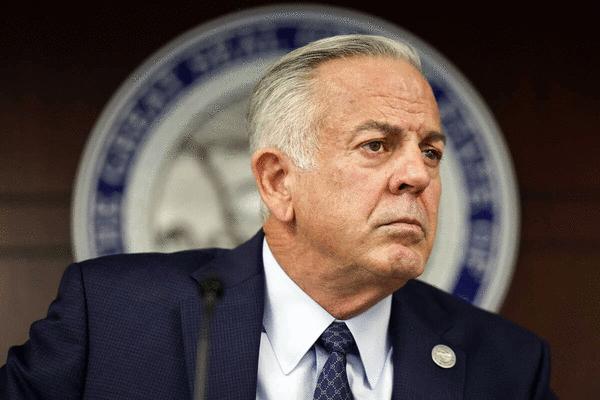
In a year in which the Nevada Legislature met twice, including a special session in November, legislators passed hundreds of bills. Some of the laws take effect the first day of 2026.
They include an expansive crime bill re-introduced by Gov. Joe Lombardo and “Lizzy’s Law,” which is named after a Reno girl who died in a bounce house accident.
Here are some of the new laws that fully take effect Thursday:
Crime bill
Assembly Bill 4, passed during the special session, will amend dozens of portions of the state’s criminal justice laws.
The law will bolster penalties for DUI, attacks against hospitality workers and create a felony charge for burglaries that lead to property damage.
Other provisions include expanded definitions for stalking and domestic violence. The bill could also lead to the return of a controversial Clark County specialty court that gives judges the authority to ban offenders from the resort corridor.
Bill inspired by tragedy
Lizzy’s Law was inspired by an accident that fatally injured Lizzy Hammond in 2019.
The 9-year-old girl was in a bounce house that went airborne during a gust at a birthday party in Reno.
Assembly Bill 198 will regulate inflatable devices, such as bounce houses and air-filled water slides.
Operators will have to regularly inspect the devices, properly anchor them, make sure the safety tags are legible and constantly inspect wind conditions.
If winds are blowing at 15 mph or greater, the operator has to cease operation, according to the new law.
New provisions also include requirements for licensing and a minimum liability insurance of $1 million.
Training requirements for regents
Senate Bill 322 is sending the 13 elected regents in the Nevada System of Higher Education to school — sort of.
The law will require the elected members of the 13-person board to “complete certain training for professional development,” according to the new law’s text.
Existing law calls for the regents to serve on a school district’s board of trustees.
Starting next year, the regents will have to complete six-hour training courses during their first and third years of their terms, according to the bill.
Mandatory training will include Nevada’s open meeting law, bias and discrimination in higher education, and “other specified topics and any other topic relating to the duties of the Board,” according to the text.
The law will establish a mechanism to log attendance and compensate the regents for up to 18 yearly hours of outside training.
Politicking transparency
Going into the 2026 election season, political advertisements will have to disclose if any image, video or audio has been digitally manipulated by tools such as artificial intelligence.
Assembly Bill 73 applies to campaigns and those who advocate on behalf of the candidates and political parties.
A provision will allow candidates who are misconstrued by the synthetic media to seek legal relief.
The law will not punish companies who publish or broadcast the ads or anyone who creates satirical media meant for entertainment, according to the law.
New food delivery regulation
Under Assembly Bill 116, food delivery platforms will have to confirm that the eateries under contract are licensed to operate and have a verifiable address where the food is prepared.
Restaurants that don’t comply can be fined up to $100 for each online food order processed.
The platforms have 10 days to remove illegal eateries from their listings and can be subject to fines up to $500 a day for each business that remains listed.
_____
©2025 Las Vegas Review-Journal. Visit reviewjournal.com.. Distributed by Tribune Content Agency, LLC.





Comments