Transcript: ICE agent Jonathan Ross' law enforcement, military career dates back two decades
Published in News & Features
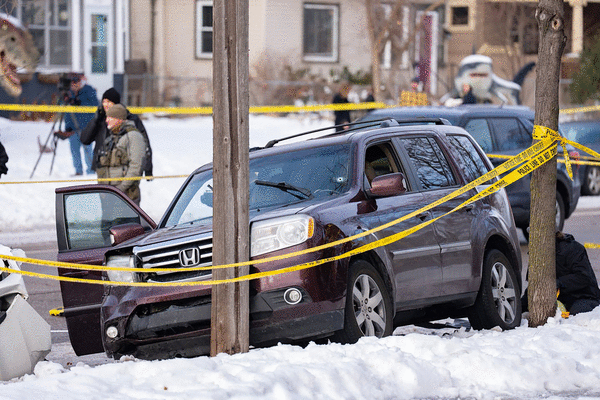
MINNEAPOLIS — The U.S. Immigration and Customs Enforcement agent who shot and killed Renee Good on a south Minneapolis street served in a multitude of law enforcement roles during a two-decade career that also included military service.
Federal court records show Jonathan Ross’ career includes U.S. military experience and mostly high-level federal law enforcement positions. The details of his tenure are revealed in a federal criminal case against a driver who seriously injured Ross after dragging him 100 yards during an immigration operation several months before Wednesday's shooting.
The Minnesota Star Tribune reviewed transcripts from the trial of that driver, later convicted of dragging Ross during an arrest in Bloomington. They share some of Ross’ background and shed more light into the traffic stop in June.
The shooting of Good, 37, was caught on video from multiple angles, including Ross’ perspective, and has drawn widespread protests in the Twin Cities and across the country. Federal officials have quickly pointed to the June 17 encounter to in part defend Ross’ actions in the shooting of Good.
Vice President JD Vance referenced the case during a news conference at the White House.
“That very ICE officer nearly had his life ended ... six months ago,” Vance said.
“You think maybe he’s a little bit sensitive about somebody ramming him?”
ICE has declined to confirm the identity of Ross, first reported by the Star Tribune, but Tricia McLaughlin, assistant secretary of the Department of Homeland Security, maintained that “he acted according to his training,” noting that this specific agent was selected for ICE’s Special Response Team, is an expert marksman and “has been serving his country his entire life.”
Ross’ law enforcement and military experience includes overseas assignments and federal terrorism work, according to the court transcripts. Ross testified that he was deployed to Iraq in 2004 and 2005 as a machine gunner while part of the Indiana National Guard. In 2005, he returned from Iraq and became a member of the U.S. Border Patrol and worked near El Paso, Texas.
Ross left Border Patrol in 2015 and joined ICE, where he currently focuses on fugitive operations that “target higher value targets” around Minnesota, he said. Along with his ICE duties, Ross said he is a member of the FBI’s Joint Terrorism Task Force and worked as a firearm instructor.
He told the court he led a team to Bloomington on June 17 in search of Roberto Carlos Munoz-Guatemala before the investigation quickly escalated into the dragging incident. He said Munoz-Guatemala, of Mexico, was illegally in the United States and resided in Bloomington.
Ross told federal prosecutors he’s conducted “hundreds” of traffic stops when he took the stand during Munoz-Guatemala’s trial. Ross said he told Munoz-Guatemala numerous times to roll down his window, and that when he didn’t comply, Ross said he broke the back window and reached into the car.
Munoz-Guatemala then drove off.
At that moment, Ross told the court, he was fearing for his life.
“He almost swiped me off on my vehicle, and at this point, I feared for my life.”
Ross said the only tool left at his disposal was his Taser. Munoz-Guatemala was later found with five Taser probes attached to him when taken into custody, according to police records.
Ross landed on the street with his arm “dripping in blood,” he said. Other officers at the scene applied a tourniquet to stop the bleeding, he said. Photographs from charging documents show Ross in a hospital bed with scrapes on his hand and a long cut on his inner forearm that required nearly 20 stitches.
“It was pretty excruciating pain,” Ross testified.
At the scene, Ross called 911 dispatchers, who said they had also been called by Munoz-Guatemala, who reported he had been injured during an assault by ICE.
“Did you have some kind of an altercation with a guy?” a dispatcher asked, according to police reports.
“We did. We need him pulled over,” Ross replied.
The dispatcher told Ross that medical personnel were on the way.
“Yeah, if you can get him in custody anyway, we’re gonna charge him federally for this,” Ross said.
Ross was not wearing a body camera at the time of the dragging, he said, because his field office “does not have a body-worn camera policy, so we cannot wear them.”
A federal jury ultimately convicted Munoz-Guatemala of assaulting a federal officer with a dangerous or deadly weapon resulting in injury after a two-day trial. He awaits sentencing.
_____
(Liz Sawyer of the Minnesota Star Tribune contributed to this story.)
_____
©2026 The Minnesota Star Tribune. Visit startribune.com. Distributed by Tribune Content Agency, LLC






Comments