Japan, South Korea seek stronger ties as China tensions rise
Published in News & Features
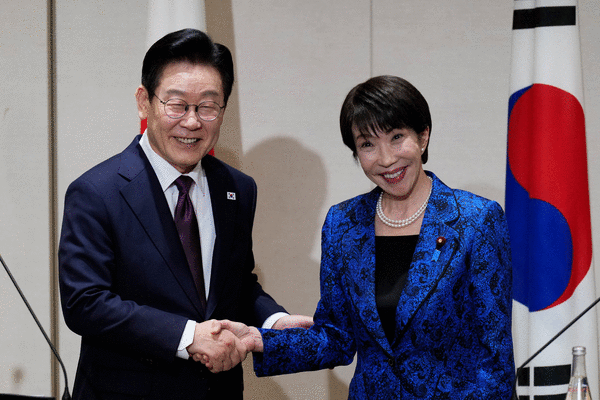
Japanese Prime Minister Sanae Takaichi sought deeper economic security ties with South Korean President Lee Jae Myung, as Tokyo moves to contain a deepening diplomatic and trade dispute with China and counter Beijing’s efforts to drive a wedge between key U.S. allies.
“There will be further talks between relevant departments to deepen cooperation, both in terms of the economy and economic security, in ways that are strategic and beneficial to both sides,” Takaichi said Tuesday during a joint press conference after meeting Lee.
She added that the two leaders held in-depth discussions on supply chain cooperation, without elaborating further.
Lee said the leaders exchanged views on regional and global issues and agreed to expand cooperation in a future-oriented manner.
“As we navigate a complex and unsettled international order and strive toward a new and better future, I believe that cooperation between South Korea and Japan is more important than ever, more important than anything,” Lee said. “This meeting in Nara between us holds particularly profound significance.”
It was not immediately clear how extensively the talks touched on ongoing tensions between China and Japan. Lee appeared to be trying to strike a balance, underscoring the need for broader regional cooperation.
“I emphasized the need for the three Northeast Asian countries of South Korea, China, and Japan to find common ground as much as possible, communicate, and cooperate,” Lee said.
Takaichi hosted Lee in her home prefecture of Nara in their second round of talks in less than three months. Their first in-person meeting took place in South Korea in late October on the sidelines of the Asia-Pacific Economic Cooperation summit, where the two leaders pledged to pursue a stable forward-looking relationship.
The two leaders are scheduled to have dinner together Tuesday and visit a historic temple on Wednesday before Lee returns home.
China was widely expected to loom large over the discussions as Japan-China relations have deteriorated sharply since Takaichi’s first meeting with President Xi Jinping at the APEC gathering. Remarks she made in early November on Taiwan infuriated China, which responded with tougher export controls on Japan and a travel advisory.
Demonstrating rapport with South Korea would bolster Japan’s effort to line up support from allies as it pushes back against China’s global campaign to isolate Tokyo. Japanese Finance Minister Satsuki Katayama has been holding talks with other advanced economies on securing critical minerals, amid fears that China may leverage its grip on rare earths to hit Japan’s economy. Defense Minister Shinjiro Koizumi is also set to hold talks with his U.S. counterpart on Thursday.
Lee, meanwhile, is walking a diplomatic tightrope. Just last week, Lee was courted by Xi in Beijing, where the two posed for selfies. Xi referenced the two countries’ shared history of fighting Japanese militarism.
In an interview with Japanese broadcaster NHK aired Monday, Lee made it clear that he has no intention to get involved in the China-Japan dispute, saying that he’s waiting for the two countries to resolve their differences through dialogue.
“It is evident that Chinese President Xi Jinping holds a very negative view of Japan’s position on the Taiwan issue,” Lee said. “But for me, I believe this is a matter between China and Japan, and not one in which we should be deeply involved or intervene.”
Lee has signaled a more balanced approach to foreign policy than his predecessor, who prioritized closer ties with the U.S. Still, South Korea’s alliance with the U.S. limits any dramatic shift toward China.
China’s outreach to South Korea stands in contrast to its increasingly confrontational stance toward Japan. Beijing has imposed new export restrictions on dual-use goods that could enhance Japan’s military capabilities and launched an anti-dumping probe into a key chipmaking material. Japan has also lodged a protest over China’s deployment of a mobile drilling vessel in the East China Sea.
Takaichi has refused to walk back her November remarks suggesting Japan could deploy its military if China attempted to seize Taiwan, despite repeated demands from Beijing. While the economic and diplomatic fallout continues to mount, it has yet to erode her domestic popularity. Speculation has grown that Takaichi may call a snap election in February to strengthen her coalition’s grip on power.
“I would like to express my deep gratitude to the prime minister for the exceptionally warm and generous hospitality, and for the special consideration shown — almost to the point of devoting herself wholeheartedly— to improving South Korea–Japan relations,” Lee said.
----------
—With assistance from Brian Fowler, Sakura Murakami and Hyonhee Shin.
©2026 Bloomberg L.P. Visit bloomberg.com. Distributed by Tribune Content Agency, LLC.






Comments