SpaceX Crew-11 back on Earth after NASA's 1st medical evacuation
Published in News & Features
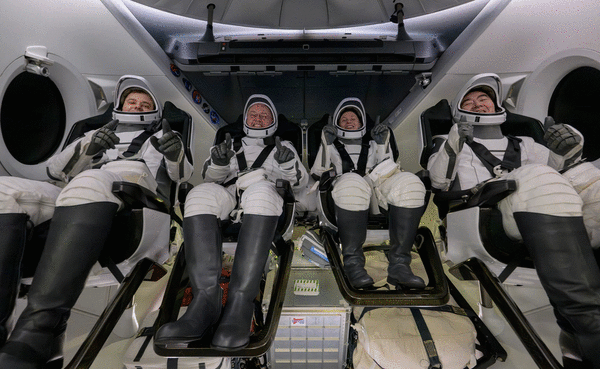
NASA’s first medical evacuation from space went smoothly with the four members of SpaceX Crew-11 splashing down in the Pacific Ocean off the California coast early Thursday after an overnight departure from the International Space Station.
The crew of NASA astronauts Zena Cardman and Mike Fincke along with JAXA astronaut Kimiya Yui and Roscosmos cosmonaut Oleg Platonov had their mission cut short after one of them suffered a medical issue last week.
NASA officials opted to bring the four home early, but did not say which of the crew had been affected. It did force the postponement of a spacewalk last week, though, that was to have involved Fincke and Cardman. After the incident, NASA said the crew member was stable, and all four reported being in good health ahead of their departure from the station.
NASA Administrator Jared Isaacman said the choice to bring the crew member home was to ensure the best medical treatment was available to monitor whatever the episode was. It’s the first time NASA has elected to end a mission for medical reasons.
“This was a serious medical condition. That is why we’re pursuing this path,” Isaacman said ahead of the crew’s departure. “The capability to diagnose and treat this properly does not live on the International Space Station.”
After getting the go from NASA, the quartet climbed on board Crew Dragon Endeavour on Wednesday afternoon, undocking from the orbiting laboratory flying about 260 miles above the Earth at 5:20 p.m. Landing came just over 10 1/2 hours later at 3:41 a.m. Thursday off the coast of San Diego.
The spacecraft endured temperatures of 3,500 degrees Fahrenheit and slowed from 17,500 mph to a gentle parachute-assisted landing of about 15 mph.
“On behalf of SpaceX and NASA welcome home Crew-11,” said SpaceX’s mission control.
“It’s so good to be home with deep gratitude for the teams that got us back,” Cardman replied.
A few curious dolphins inspected the spacecraft as it bobbed in the calm ocean waters awaiting the arrival of support personnel.
The spacecraft was hoisted onto a recovery ship with the side hatch opening only 38 minutes later with the crew assisted out of the vehicle.
First out was Fincke, who gave a big smile as SpaceX support members held him up firmly with the weight of Earth’s gravity having visible effects after spending 5 1/2 months in space. He was followed by Cardman, similarly jovial giving a wave and fist bump, Yui with a smile and Platonov a thumbs up.
Each were helped onto a gurney headed to be checked out medically. All had departed the vehicle less than an hour after splashdown.
The SpaceX Crew Dragon Endeavour on the Crew-11 mission has two drogue parachutes deploy as it nears landing off the coast of San Diego with the Royal Princess cruise ship of Princess Cruises seen in the background on Thursday, Jan. 15, 2026. (Courtesy/NASA) They were next to be flown back to land to a local hospital for continued monitoring and checkouts using medical equipment not available on the space station. They will remain their until Friday before flying back to Houston assuming all medical issues check out, NASA officials said.
“While this was the first time we had to return crew slightly ahead of schedule, NASA was ready,” Isaacman said in a post-landing press conference. “The team responded quickly and professionally, as did the teams across the agency, working closely with our commercial partners, and executed a very safe return.”
He reassured reporters that the astronaut in question was doing fine.
“All crew members right now are, they’re safe, they’re in good spirits,” he said. “They’re going through the standard post-splashdown medical checks. I believe the helicopter, if it hasn’t left the recovery ship, it’s imminent to do so, and they’re all going to the hospital as we as we had determined days ago as the proper thing to do under the circumstances. But as I mentioned, the crew member in question specifically is doing fine.”
And he commended the execution of the plans.
“Watching it play out from the time of the original situation developing to get our astronauts safely in the water and on their way to medical care, was executed almost near flawlessly,” he said.
The quartet launched from Kennedy Space Center on Aug. 1, 2025 and were originally slated to stay on board the space station through late February only leaving after their relief, Crew-12, arrived the station.
The SpaceX Crew Dragon Endeavour departs the International Space Station on Wednesday, Jan. 14, 2026 with the four members of Crew-11 aboard headed back to Earth for a planned splashdown off the coast of California early Thursday. (Handout/NASA) They completed 167 days in space with 165 days on board the station, and orbited the Earth 2,782 times, traveling nearly 71 million miles.
While Cardman, on her first spaceflight, was commander of Crew-11, Fincke, on his fourth trip to space, had last December assumed command of the entire station leading Expedition 74, and only relinquished it during a ceremony Monday.
“It’s bittersweet,” Fincke said. “I wish it were longer, but we have what we have, and it was really — it was a lot of fun.”
Platonov, 39, like Cardman, 38, completed his rookie spaceflight while Yui, 55, flew once before to the station. Fincke, 58, was originally chosen as an astronaut candidate in 1996. His four space missions included the last flight of Space Shuttle Endeavour in 2011.
With this mission’s completion Fincke moves into fourth place on the all-time NASA list for cumulative days in space with 549. That puts him 20th among all space agencies.
Cardman became the final member of her 2017 astronaut class to make it to space.
“Our timing of this departure is unexpected, but what was not surprising to me was how well this crew came together as a family to help each other and just take care of each other,” Cardman said.
With their departure, the space station population dropped from seven to three. Staying behind are NASA astronaut Chris Williams and Roscosmos cosmonauts Sergey Kud-Sverchkov and Sergei Mikaev, who arrived to the station on a Soyuz spacecraft last November. They will be joined by the four members of Crew-12, which is currently slated to launch no earlier than Feb. 15 from the Space Coast.
“We’re leaving you with all a lot of work, but also with a lot of knowledge, knowing that you guys are really going to do super well,” Fincke said.
New commander Kud-Sverchkov’s first command was for the seven to have a group hug, following the same first command Fincke had given when he took over.
“I have no doubts we’re going to work. We’re going to continue working as as a family, as a team,” Kud-Sverchkov said.
The station has been continuously occupied for more than 25 years, and ran with just three-person crews from 2011-2020 for the most part after the end of the Space Shuttle Program. SpaceX then brought launches from the U.S. back when it flew test mission Demo-2 in May 2020, and have since performed 11 crew rotation missions to the station, so the normal ISS crew complement was seven.
Crew Dragon Endeavour is SpaceX’s fleet leader debuting on Demo-2 and having since flown five additional missions.
SpaceX has opted to bring its Crew Dragon spacecraft home a few times before the relief crew arrives, but normally there’s a few days of handoff where the station population climbs to 11.
NASA and SpaceX remain in discussions to see if Crew-12’s timetable could be pushed up. When it does fly, it will be making only the second ever human spaceflight from Cape Canaveral Space Force Station’s Space Launch Complex 40 after Crew-9’s debut in 2024.
All four of SpaceX’s Crew Dragon launches in 2025 came from neighboring KSC. Flying up are NASA astronauts, commander Jessica Meir and pilot Jack Hathaway, mission specialist and ESA (European Space Agency) astronaut Sophie Adenot and mission specialist and Roscosmos cosmonaut Andrey Fedyaev,
Isaacman said the operations around Crew-12 would not compete with the potential launch of the Artemis II mission, which could fly as early as Feb. 6 from KSC’s Launch Pad 39-B.
“These are would be totally separate campaigns. At this point, we would as we mentioned before, we’re still evaluating what earlier dates would be achievable, if any, for Crew-12,” he said. “So right now, we’re going to look at all operations, all of our standard processes to prepare for Crew-12, and look for opportunities if we can bring it in while simultaneously conducting our Artemis II campaign. There’s no reason to believe at this point in time that there’d be any overlap, that we’d have to deconflict for.”
NASA plans to roll out the Space Launch System rocket and Orion spacecraft to the pad Saturday, with the roughly 4-mile, 12-hour trip beginning as early as 7 a.m.
On arrival, the launch hardware will endure more tests ahead of what would be the first crewed Artemis mission. If successful, it could line up launch in early February, although NASA has carved out launch opportunities for early March and April as well.
_____
©2026 Orlando Sentinel. Visit at orlandosentinel.com. Distributed by Tribune Content Agency, LLC.






Comments