Japan's Takaichi calls Feb. 8 election with vow to cut sales tax
Published in News & Features
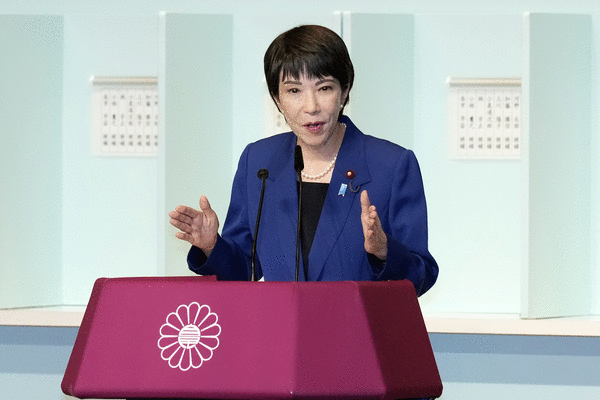
Japanese Prime Minister Sanae Takaichi officially called an early election next month and promised a temporary sales tax cut on food if she wins a fresh mandate for her new coalition.
The premier, who took power in October, is betting that her ruling Liberal Democratic Party can strengthen its slim majority in parliament in a Feb. 8 election. She confirmed the date, which had earlier been reported in the local press, during a briefing on Monday.
“I will put my job as prime minister on the line with these election results,” Takaichi said, adding that a failure to secure a majority would likely result in a different premier taking power.
Japan’s government bond yields jumped earlier in the day as reports of tax cut proposal renewed concerns about Takaichi’s stance on fiscal policy. The yield on 30-year debt climbed 10 basis points to 3.61%, its highest level since its debut, while rates on 10- and 20-year notes rose to their highest levels since 1999.
Some food-related stocks in Tokyo jumped on Monday on bets that lower levies would spur demand. Yamazaki Baking Co. shares rose 4.8%, the most since August 2025, while 7-Eleven operator Seven & i Holdings Co. shares gained 5%.
With the snap election, Takaichi appears to be banking on her high personal approval ratings to give her a national mandate to pursue expansionary fiscal policies.
A poll by the Asahi newspaper conducted over the weekend showed that support for Takaichi remained high at 67%, with 52% saying that the ruling bloc should win a majority. Still, half of respondents disagreed with plans for a snap election, with 36% supporting the timing of the election and 50% disagreeing.
“I signed an agreement last October to not apply the sales tax on food for a limited period of two years,” Takaichi said. “There was some debate within the LDP, but we have decided to include this in the LDP’s campaign pledges, too.”
The prime minister also said the vote would provide a mandate for fundamental changes to strengthen both economic and defense policy, adding that no one will help a country that can’t help itself. On recently frosty relations with China, she said the door was open to communication.
By advocating a cut in the sales tax on food items, Takaichi is looking to deprive the opposition of a policy initiative that has resonated with the public. Voter frustration over costs of living was a major factor leading to setbacks for the LDP in the last two national elections.
But it’s a pledge that economists say will cost around ¥5 trillion ($31.6 billion) per year. Takaichi said she was still considering how to fund the move.
“The Takaichi administration is taking risks regarding fiscal discipline,” said Hideo Kumano, economist at Dai-Ichi Life Research Institute. “While they claim the 0% consumption tax on food is only for two years, I believe it will be nearly impossible to revert to the original rate once implemented.”
When asked if she was putting an election before policy to tackle inflation, Takaichi said she was calling the vote precisely so she could accelerate the execution of her policy platform.
Soaring food costs are a key component driving broader inflation higher, with data Friday expected to show consumer price growth has stayed above the central bank’s 2% target for four straight calendar years. The proportion of food spending within overall household consumption came to 28.9% in November, the highest for that month since comparable data became available in 2000.
Japan currently applies an 8% tax on most purchases of food and non-alcoholic beverages, compared with a standard consumption tax rate of 10%.
The earlier reports of Takaichi’s plan to cut the sales tax on food emerged after the Constitutional Democratic Party and Komeito last week formed a larger opposition bloc called the Centrist Reform Alliance. The new party has increased the riskiness of the prime minister’s election gamble.
The CRA aims to eliminate the food sales tax for good by generating the necessary financing through managing a new sovereign wealth fund, according to CDP and Komeito officials.
The CDP believes a sales tax cut could be achieved as quickly as six months after passing the bill, its policy chief Satoshi Honjo said, adding such a cut would be funded by dipping into reserve funds. The sovereign wealth fund may take at least a year to establish, Honjo’s Komeito counterpart Mitsunari Okamoto added.
That more ambitious stance would also give Takaichi an opening to argue that the opposition proposal is more likely to worsen Japan’s fiscal health.
Although local media estimates based on the previous lower house poll in 2024 showed that the merger between the CDP and Komeito could tip the scales in some districts and make for a much closer election, the broader public appears skeptical of the new opposition alliance.
In the Asahi survey, 69% said that the new party wouldn’t be a viable force against the ruling bloc, compared with 20% who thought it would be a strong competitor.
--------
—With assistance from Akemi Terukina and Momoka Yokoyama.
©2026 Bloomberg L.P. Visit bloomberg.com. Distributed by Tribune Content Agency, LLC.






Comments