Study: Florida reefs offer multimillion-dollar flood protection -- if they survive
Published in News & Features
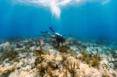
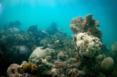
MIAMI — It’s no secret that Florida’s iconic coral reefs are in trouble.
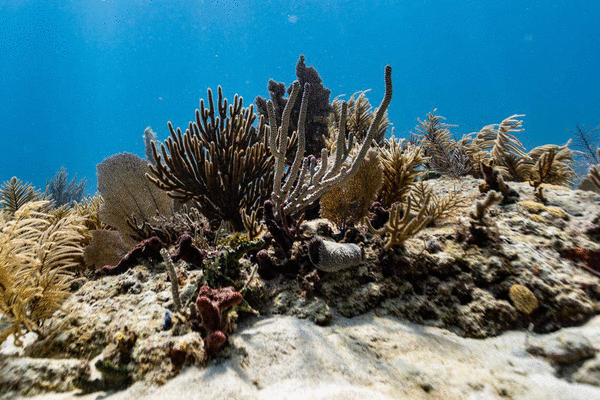
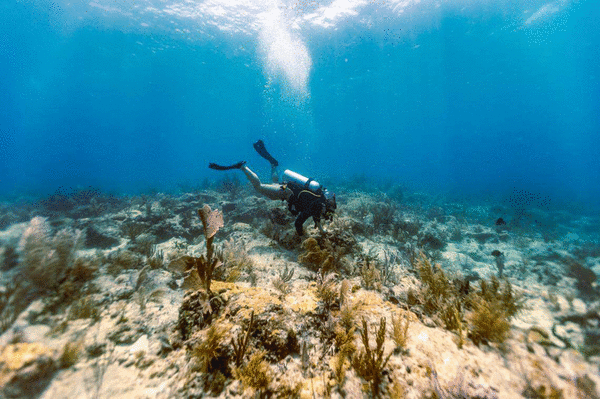
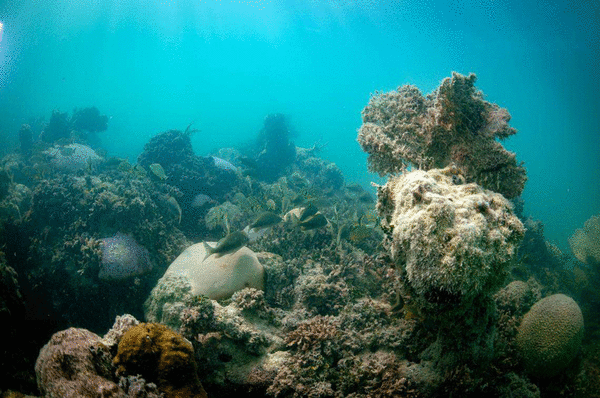
Repeated body blows from hurricanes, pollution, disease, climate change — and a near-knockout punch from a 2023 marine heat wave — has effectively wiped several species off the map and shrunk the reefs that stretch from the Keys throughout South Florida.
Scientists, nonprofits, the state of Florida and the federal government are all scrambling to rescue and rebuild the reef tract. But a new study found that if Florida doesn’t preserve what we have now, residents could see hundreds of millions of dollars of extra flooding damage in the future — much of it concentrated in Miami-Dade.
“We’d love to restore and enhance and make the reefs even better, but this is just saying ‘my gosh, let’s protect what we have’,” said Curt Storlazzi, a research geologist for the U.S. Geological Survey and lead author of the study, which published in the journal Earth’s Future last week.
As coral reefs break down they get shorter and flatter, leaving less friction to slow incoming waves. Bigger waves can reach further inland, swamping more homes and businesses. A 2017 study by one of the co-authors of the paper, Kimberly Yates, found that reefs in the Florida Keys had already lost nearly three feet of height in the last few decades alone.
For this new study, a group of federal scientists ran an analysis comparing how much flooding South Florida’s coast would see today in a hurricane versus after a century of eroding reefs.
The result: about $438 million in extra economic damages every year with no reefs for protection.
The study also zoomed in on Bal Harbour in particular, as an example of community where losing reef protection could lead to a hefty additional dose of flooding. “That shows how it’s punching further inland,” Storlazzi said.
Reef restoration makes economic sense
But this study is more than just another entrant into the steady drumbeat of doom-and-gloom predictions about the future of Florida’s corals, Storlazzi said. It’s a dollars-and-cents look at which spots of the reef could be most helpful to save.
The study identified “hot spots” where coral reefs provide the most physical protection from storm-driven waves and storm surge, which is the water that sloshes above land and floods coastal communities. Those spots, Storlazzi said, would have the greatest return on investment to protect them, and therefore the people and buildings that shelter behind them.
“There’s a dozen good reasons to restore coral reefs. This is just saying hey, these are the areas that reduce coastal flooding,” he said.
Perhaps unsurprisingly, all of those hot spots are near the most populated and developed barrier islands. Miami Beach and Fort Lauderdale top the analysis as spots where coral reef preservation would have the most bang for its buck, storm-protection wise.
And that analysis doesn’t even account for all the other economic benefits of coral reefs, which provide nursery habitat for fish that people like to catch and beautiful vistas for tourists to pay to visit.
Information like this has been the scientific backbone for a recent push for “nature-based” solutions to flooding, like a strip of mangroves along a shoreline instead of a gray, concrete sea wall.
Miami-Dade famously made the pitch for more green flooding solutions to the federal government while in the midst of the Army Corps of Engineers Back Bay study a few years ago. The county rejected the Corps’ initial suggestion of tall steel and concrete flood walls along the coast and instead asked for a more environmentally-based solution, like a new manmade, landscaped barrier island in Biscayne Bay, potentially in combination with some of the usual concrete-based fixes.
Since then, the Corps has agreed to re-study the issue. A final answer, much less funding for any kind of solution, is still years away.
Storlazzi points out that coral reefs are a great nature-based flood fix, both because they provide extra economic benefits for tourism and fisheries and because they can be self-repairing.
“Coral reefs, if not stressed by humans, they can grow with rising sea levels and can repair themselves after storms. Those are things pure gray infrastructure cannot do,” he said.
Puerto Rico used similar data — collected by Storlazzi and his co-authors — on the economic benefits of reef restoration to snag a $38.6 million grant from the Federal Emergency Management Agency’s Hazard Mitigation Program, the first of its kind to restore natural systems instead of manmade ones.
Putting a dollar value on coral reefs also helped nonprofit The Nature Conservancy secure insurance policies on coral reefs in Mexico and Hawaii. In both spots, injuries to the reef kick off an insurance payout that funds divers to go repair the reef so it can stay in good shape to protect the nearby coast.
Storlazzi said he and his fellow scientists have repeatedly found that the numbers are in favor of protecting coral reefs around the world, and not just for the sake of preserving beautiful natural places.
“The analysis our group and others are doing shows the benefits are greater than the potential cost,” he said.
©2026 Miami Herald. Visit at miamiherald.com. Distributed by Tribune Content Agency, LLC.






Comments