Maryland Gov. Wes Moore said he's 'working with judges' on redistricting, prompting ethics concerns
Published in News & Features
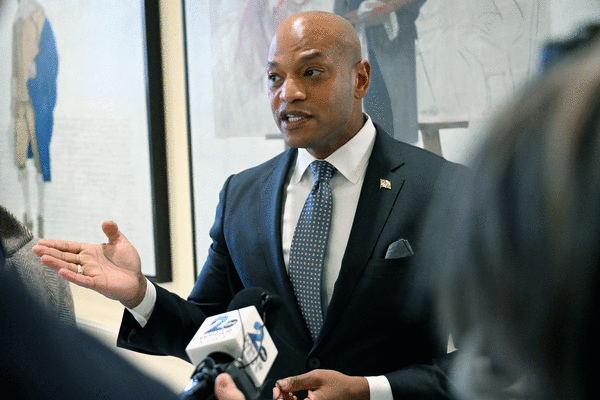
BALTIMORE — When asked recently if Maryland Courts might strike down his efforts to redraw congressional districts to stamp out the state’s only Republican seat, Gov. Wes Moore told “MS NOW” that his team has been “working with judges” to prepare for legal challenges. The statement raised ethical red flags among some law professors and Republicans.
“You cannot ask a judge about how the judge would rule in a pending case,” Mark Graber, a law professor at the University of Maryland’s Carey School of Law, told The Baltimore Sun.
“Governors, presidents [and] congressmen sit at the dinner table with judges all the time, and they don’t say, ‘Well, we can’t talk to one another.’ Inevitably, there are conversations. The more the conversations concern the details of specific litigation or matters likely to be litigated, the more problematic they are.”
Cumberland Mayor Raymond Morriss, the only Republican on Moore’s redistricting commission, said while he believes the governor isn’t actively trying to influence the judicial system, there’s a fine line between seeking general advice from judges and trying to shape legal outcomes.
“He has [an] outcome that he desires,” Morriss told The Sun. “He’s trying to set the table to get the ducks in a row for the redistricting map to go through.”
Senate House Minority Leader Justin Ready had one question: “If it’s such a fair map, why would we be worried about what the judges say?” he said, referring to Moore’s argument that the redistricting process has been fair thus far.
A broad range of legal experts
The Baltimore Sun asked Moore’s office whether he has been speaking to sitting or retired judges, what the nature of those conversations has been, and what legal advice he has implemented so far in his redistricting push.
Moore’s office said the governor has sought advice from a wide net of individuals, including retired judges, but none currently on the bench.
“Governor Moore regularly consults with a broad range of legal experts as part of the effort to defend and strengthen our democracy, including former judges,” Rhyan Lake, Moore’s senior communications strategist, wrote in an email to The Sun. “He has the utmost respect for the independence of Maryland’s courts and has not discussed redistricting with any current members of the judiciary.”
Guha Krishnamurthi, another law professor at the Carey School, said that Moore shouldn’t be working with judges to craft law that could end up in the state constitution.
While there are legislative reforms that judges can legally participate in, Krishnamurthi said, there is still “a basis of recusal if a judge has advised the governor on the constitutionality of some effort and then that case comes up before the judge.”
Eric Holder as advisor
While Moore’s office didn’t name which judges he has or has not spoken to, he has sought advice from former U.S. Attorney General Eric Holder, who currently chairs the National Democratic Redistricting Committee (NDRC), according to a source close to national Democratic leadership, who requested anonymity to divulge details of private conversations.
This source added that Holder has been in communication with “almost every state” that has considered redrawing its maps. The NDRC is preparing to defend Democrats embracing redistricting measures.
The committee did not respond to multiple requests for comment. Moore’s office also did not respond to questions about the nature of Moore and Holder’s conversations.
Shortly before Moore’s “MS NOW” appearance, the Maryland House of Delegates passed a redistricting measure that is now headed to the Senate, where senators will decide whether to approve implementing new boundaries recommended by the redistricting commission to Maryland’s current congressional map. If enacted, the proposed new map would reshape Maryland’s 1st and 3rd congressional districts and leave Republicans at a disadvantage in winning elections in these areas.
Despite overwhelming support from Democrats in the House, Senate President Bill Ferguson has been a staunch opponent, refusing to bring the proposed map to the Senate floor for a vote. Ferguson has argued that Maryland’s Supreme Court already considers the state’s current map — which comprises seven Democratic districts and one Republican one — extremely gerrymandered.
Lacking transparency
If Democrats succeed in implementing the map, Ferguson has also argued, Republicans could triumph in a potential lawsuit that could end with Maryland’s Supreme Court throwing out the current congressional map and replacing it with one that dilutes Democrats’ districts and earns Republicans a few more seats.
Last year, Ferguson, who is one of five members on Moore’s commission, also blasted Moore’s commission for lacking transparency in how it conducts business and accused the commission of making a decision despite overwhelming opposition Maryland voters expressed in written testimony to the commission.
Republicans have also criticized Moore’s redistricting push as deferential to the desires of national Democratic leaders they claim are out of touch with Maryland’s political realities. Although Moore repeatedly claims he’s working independently, he and the U.S. Minority Leader Hakeem Jeffries, in January, appeared on Capitol Hill and called on Ferguson to bring the redistricting issue to a floor vote in the Senate.
Jeffries also met with Senate members of The Maryland Legislative Black Caucus last December to make the case for why the state should redraw its maps. Holder was present on that call, Sen. Arthur Ellis who attended that meeting told The Sun, and expressed his support for redistricting measures.
“Jeffries brought him in,” Ellis said.
A Senate death
Ready sees Moore’s redistricting push as part of the governor’s presidential ambitions.
“It’s about making sure he can say he did everything he could when he’s running for president in the Democratic primary in 2028,” Ready said, referring to reports that Moore may run for president in 2028 and wants to use redistricting as evidence of how hard he tried to oppose President Donald Trump. Moore had denied that he plans to seek higher office.
Regardless, Moore’s redistricting push is likely to die in the Senate — unless Ferguson and a majority of his caucus change their minds.
And although the Senate President contends that Republicans stand to gain from court challenges to Democrats’ proposed new maps, Republicans, too, say they would prefer that redistricting efforts to fizzle out. Cumberland Mayor Raymond Morriss called this “the best outcome.”
---------
©2026 The Baltimore Sun. Visit at baltimoresun.com. Distributed by Tribune Content Agency, LLC.





Comments