Providence releases body cam footage of Brown University shooting
Published in News & Features
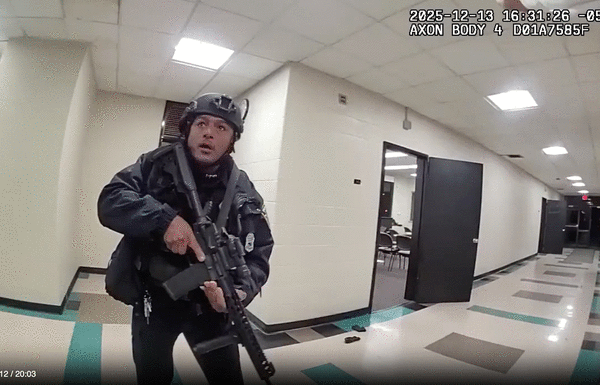
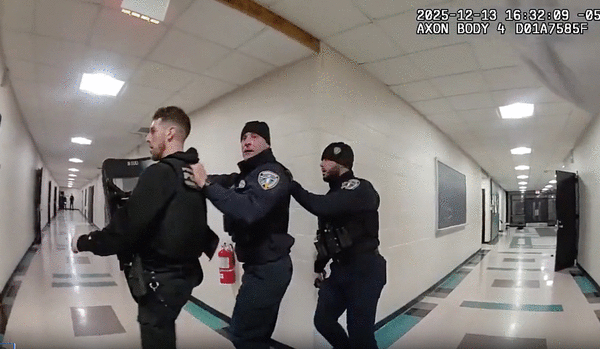
The city of Providence, Rhode Island, released body camera footage, incident reports, and emergency radio recordings from the December double-fatal shooting at Brown University, showing a swarm of officers responding.
The documents, at times heavily redacted, show the initial response to the mass casualty event that took the lives of two students and set off a five-day manhunt for the shooter.
The city had delayed publishing the documents until after a memorial service could be held on Brown’s campus over the weekend, Providence Mayor Brett Smiley said during a press conference Monday.
Mayor Brett Smiley said he’d spoken to victims and families, telling reporters, who had preferred that nothing be released.
“Many of their kids are working really hard at moving forward and moving on,” Smiley said. “And releases like today, they fear, will make it harder to move forward.”
But to strike a balance between revictimizing those who were there, their families, and the entire community, and to comply with Rhode Island’s Access to Public Records Act, the city worked with the police and legal departments to publish Monday’s release.
“Today’s release of video, audio files, and documents is our full and complete response to the public records requests we’ve received,” Smiley said.
Smiley noted that the city would not release any additional body camera footage, although he said that more footage does exist.
The 20-minute video published by the city comes from the body camera of Providence Police Lt. Patrick Potter. The footage starts at 4:16 p.m. on Dec. 13, about 10 minutes after the shooting was reported to police.
Potter was the commanding officer on the scene that day, according to Smiley. The city chose to release his footage because it provided the “most comprehensive view” of the response.
In the video, Potter holds a large automatic weapon and directs officers from multiple agencies to clear the complex of university buildings where the shooting took place.
“Dispatch, be advised this is an active shooter situation,” Potter says into his radio. Other officers can be heard in the background announcing their presence.
Former graduate student Claudio Neves Valente had opened fire on a study session for an introductory economics course only minutes before, killing sophomore Ella Cooke and freshman Mukhammad Aziz Umurzokov and injuring nine others. Then he fled the area.
Valente was found dead in a storage unit in New Hampshire five days later, and authorities have said he is also responsible for the shooting death of Massachusetts Institute of Technology professor Nuno Louriero in Brookline while he was on the run.
But at the time, Potter and other officers did not know if the shooter remained in the building.
“In the absence of better information, we’re going with the shooter might be in this building. So, use caution. Alright?” Potter says over the radio at one point.
Two minutes in, Potter sees another officer who tells him that there are people down at the end of a corridor.
“They’re students?” Potter asks.
The officers nod.
“Are they ... ”
“They’re not shot,” the officer says.
The video blacks out for tens of seconds at a time, either partially or completely. The audio is also cut for portions of the footage. Providence police Chief Oscar Perez told reporters at the press conference that these are moments when Potter is entering the crime scene and/or seeing victims and students.
Over and over again he tells police to keep looking both for victims and a possible shooter.
“We just gotta keep searching this building,” he says. Then again, later, he tells the officer, “search and search again.”
Potter directs officers to shut down traffic on the street in front and behind the building and asks over the radio whether or not they can get video from Brown or the city’s crime center.
At one point, while clearing the basement, police encounter a man. Potter runs down and asks him if he has weapons and pat him down. The man turned out to be a Brown maintenance worker.
At 4:33 p.m., the body camera shows ambulances arriving and gurneys rolling up to the back door of the building. Officers had already transported some victims by cruiser.
Throughout the 20-minute scene, Potter’s camera shows what students left behind when they heard shots ring out. Open laptops sit on tables in the building’s cafe. A backpack has been flung on the floor near the exit. Someone’s scrunchie and even a trooper’s hat have been left lying in a hallway.
Again and again, while going through the building giving orders, Potter walks by an old-fashioned blackboard that has a heart written in chalk.
The city of Providence and Brown University will be conducting independent reviews of their responses to the shooting, Smiley said.
Providence’s “formal after-action review” will take three months to one year to complete, he told reporters, and it will be made public.
“There’s nothing in that video that further explains or advances anyone’s understanding to what I think is actually the big remaining question, which is why did this happened, why did this person do this,” Smiley said. “None of those videos are gonna answer that question, none of them.”
_____
©2026 MediaNews Group, Inc. Visit at bostonherald.com. Distributed by Tribune Content Agency, LLC.



Comments