DHS official reveals in court deportation threat hanging over Haitians TPS holders
Published in News & Features
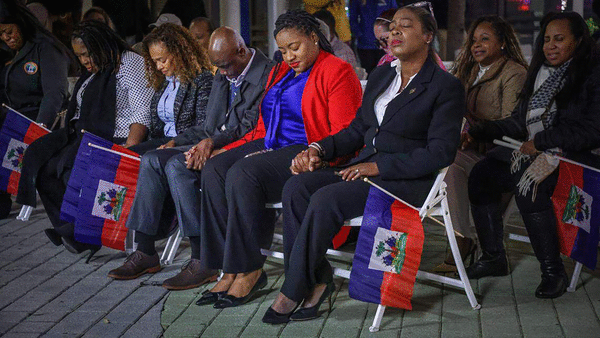
The Department of Homeland Security would have begun deporting Haitians had its order terminating their legal protections from deportations not been halted by a federal judge, an assistant director for field operations told a federal court Tuesday.
But the agency also had no specific plans “to mobilize members of Immigration and Customs Enforcement” to areas heavily populated with Haitians, like South Florida and Springfield, Ohio, for detention and removal if Haiti’s temporary protected status designation had been terminated.
ICE conducts daily enforcement operations nationwide, including in Springfield and South Florida, Liana J. Castano said.
“ICE operations are targeted to those who are removable from the country, regardless of nationality,” she said, “with the end goal of enforcing the immigration laws to preserve the national security and public safety of the United States.”
Castano’s declaration was filed in federal court in Washington, D.C., in response to questions from U.S. District Judge Ana Reyes, who is being asked by the Trump administration to lift her stay of the department’s order terminating Haitians’ TPS. The government has said failure to reverse her order, which protects more than 300,000 Haitians from losing their protections, would cause “irreparable harm” by interfering with national security and national interests.
Reyes issued her ruling pausing TPS termination on Feb. 2, a day before the designation was set to end. The government filed an appeal to Reyes herself and to the appeals court for the Washington circuit.
Government lawyers had requested an answer from Reyes by Monday. She instead scheduled a hearing for Thursday and gave federal authorities until 10 a.m. Tuesday to submit a declaration about their mobilization plans. She specifically mentioned Springfield and South Florida. While the former is home to thousands of recently arrived Haitian immigrants, including over 26,000 TPS holders, South Florida boasts the largest population, about 150,000, of Haitian TPS holders in the U.S.
In her ruling last week, Reyes said there was a risk of detention and removal, family separation and the loss of work authorizations if TPS termination was not paused.
In her response, Castano said that “if the termination had not been stayed, DHS would have acted to enforce the immigration laws in light of the termination, just as it has acted to enforce the immigration laws against past TPS holders based on other terminations.” She identified herself as the assistant director for field operations at ICE Enforcement and Removal Operations division.
Haiti was granted TPS status in 2010 after the country’s devastating earthquake. But 16 years later, conditions have worsened, the top U.S. diplomat in Haiti, Henry Wooster, said during a congressional hearing Tuesday. Detailing the administration’s efforts in Haiti, Wooster, the U.S. Embassy’s chargé d’affaires, told the Senate Appropriations Subcommittee on State and Foreign Operations that the country is “a nettlesome foreign policy problem” and continues to suffer from chronic political, economic and governance dysfunction.
“The immediate threat to Haiti’s state survival is a coalition of some 20 armed, hostile organizations, misleadingly called gangs that, as the Secretary of State mentioned ... threaten systemic collapse,” Wooster said.
U.S. Sen. Brian Emanuel Schatz, the committee’s ranking Democrat, raised the issue of TPS during the hearing.
“The political and security situation in Haiti continues to deteriorate, and there remains a risk of complete government collapse. And so it is disturbing and counterproductive that it took a court order to pause the termination of TPS for Haitians,” Schatz said.
The Trump administration has canceled the TPS designations of about a dozen countries, including Venezuela, Nicaragua and Honduras, arguing that the benefit was meant to be “temporary.” Advocates and lawyers, however, say that conditions in those countries remain unsafe, and the decisions were made in violation of the law. They have claimed in federal lawsuits that “racial animus” has also been a motivation for the administration’s actions.
Homeland Security Secretary Kristi Noem has rejected the allegations, while also arguing that the her decision is not subject to review by the courts.
DHS lawyers have also pointed out that in two instances the Supreme Court has agreed with their request to allow deportations to proceed while the matter is being litigated in lower courts. They again raised that point again last week when they appealed directly to Reyes and to the Washington appellate court.
On Monday, in a separate case involving Central Americans and Nepalese citizens, a U.S. appeals court in California lifted a federal judge’s order blocking the administration from deporting 50,000 Hondurans, 7,000 Nicaraguans and 3,000 Nepalese.
The unanimous three-judge panel cited the Supreme Court’s previous decisions to allow deportations to continue while the cases are litigated, and added that the government is likely to succeed on the merits of its appeal either by showing that the district court lacked jurisdiction or by prevailing on the claim that DHS acted in an arbitrary and capricious fashion in violation of the federal Administrative Procedures Act.
The Act is also at the center of the Haitian case in front of Reyes, filed by five TPS holders. In addition to accusing Noem of not following the law when she ended Haitian TPS, the plaintiffs said Noem was motivated by racial animus and that they were targeted because they are Black. They’ve cited statements from Noem and President Donald Trump portraying Haitians as a drain on U.S. society and falsely claiming that Haitians in Springfield were eating their neighbors’ pets.
Reyes last week ruled that the Haitian plaintiffs were likely to succeed in the merits of their case. She also rejected the government’s claim that the secretary’s decision was not subject to judicial review.
Lynn Tramonte, executive director of the Ohio Immigrant Alliance, is among several advocates who have criticized the administration’s push to end TPS for Haitians. In a statement, she noted that the government’s appeal in the Haitian TPS case was issued on the same day President Trump shared a racist video on his Truth social of former President Barack Obama and former First Lady Michelle Obama.
“The federal courts cannot allow the U.S. government to make decisions based on racism,” Tramonte said. “Haitians cannot be sent back to their native country. Many will literally not survive. This threatened government onslaught against Haitian-Ohioans and others around the country is so cruel and so unnecessary. Let Haitians live.”
Sophia Pierrelus, a Columbus-based community leader and founder of the New American Cultural Center, echoed those concerns.
Ending Haitians’ TPS designation, she said, disregards the ongoing humanitarian crisis in the country, where more than 1. 4 million people have been forced to flee their homes.
“Framing the termination of Haiti’s TPS as a matter of ‘national interest’ ignores the real consequences for families, workers and communities who have contributed to this country for years,” Pierrelus said. “Policy decisions must be grounded not only in authority, but in reality.”
_____
©2026 Miami Herald. Visit miamiherald.com. Distributed by Tribune Content Agency, LLC.






Comments