Michigan House speaker floats nearly $5B in property tax cuts
Published in News & Features
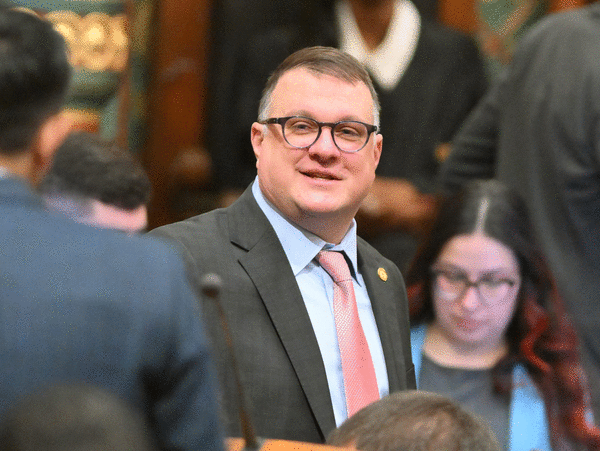
House Speaker Matt Hall unveiled details Thursday of a property tax cut proposal that would slash taxes across four different categories for an estimated total of nearly $5 billion.
The Kalamazoo County Republican told reporters he planned to hold schools and local governments harmless with the tax cuts, but acknowledged it would result, overall, in less revenue for the state. The speaker initially estimated the cuts would amount to $4 billion less in property tax revenue, but his office later said preliminary tallies placed the total closer to $5 billion.
The speaker said he had a plan to generate additional money to make schools and local government whole, in spite of the cuts to a large source of their revenue. Hall declined to detail that plan Thursday.
"We need real, bold and meaningful property tax reform and, also, bold reform to lower the cost of homes," Hall said. "You want to lower the cost of buying and selling the home. You want to lower the cost of having a home and you want to lower the cost of property taxes."
When asked if he was considering a sales tax hike to raise new revenue for schools and local governments, Hall said there were "a lot of ways" to raise revenue. He declined to give further details.
While Hall has spoken about the possibility of a property tax decrease via legislation or ballot initiative, Thursday marked the first time the speaker offered practical details of how he envisioned structuring the plan.
It's one of several property tax relief proposals circulating in the state Capitol.
Last week, Gov. Gretchen Whitmer announced she would seek about $90 million in targeted property tax relief for the state's seniors. State Sen. Sarah Anthony, D-Lansing, has proposed a property tax plan that would remove barriers inherent in the Michigan Homestead Property Tax Credit.
Several school groups expressed concern over Hall's and Whitmer's proposals in a statement Thursday, arguing that they would "blow massive holes" in the state budget and treat schools as piggy banks "to be raided for political tax cut talking points."
“Tax policy should strengthen Michigan, not sabotage it," said Peter Spadafore, executive director for the Michigan Alliance for Student Opportunity. "Lawmakers must reject any proposal that threatens K-12 funding and instead commit to stable, sustainable investments in Michigan’s children."
The statement was issued in coordination with the Michigan Association of School Administrators, the Michigan Association of Intermediate School Administrators and the Michigan Association of School Boards.
Hall's plan, which has not yet been introduced in the House, would eliminate the 6-mill State Education Tax, the personal property tax, the real estate transfer tax and the so-called pop-up tax that occurs upon sale of a home, the speaker said Thursday.
Preliminary estimates would clock the cuts at more than $4.9 billion, according to Hall's office. That's without factoring in the pop-up tax, which will be more complicated to tally.
Hall said he expects the Legislature can find efficiencies within state departments to backfill some of the revenue losses for schools and local governments. He also suggested he was exploring ways to better generate revenue for schools.
"I also would support coming up with a more fair way to raise revenue to make schools whole and local governments whole," Hall said. "But overall it would be a net tax cut."
The speaker argued the personal property tax elimination should be accompanied by legislation requiring the state's largest utilities to lower rates by about $1 billion.
The personal property tax, Hall argued, discourages utilities from upgrading their grids and results in large rate increases when they do. In 2022, 49.8% of Michigan's personal property value stemmed from utilities, according to a 2023 Treasury report on Michigan's real and personal property tax.
"We’re going to have to require the utilities to lower their rates," Hall said. "I would not go forward with eliminating the personal property tax without also mandating at least a billion-dollar rollback in our energy rates." Because you can't take away the cost, push them toward investment, and then not see a major reduction in our utility bills."
Hall's office estimated the elimination of the State Education Tax would cut about $2.9 billion, the real estate transfer tax about $400 million and the personal property tax about $1.6 billion, for a total of about $4.9 billion.
The office had not calculated how much would be cut by eliminating the pop-up tax.
Michigan taxpayers paid nearly $17.5 billion in state and local property taxes in 2022, according to Treasury estimates.
The state Treasury reported about $2.5 billion in revenue in the 2023-24 fiscal year from the State Education Tax, all of which flows to Michigan's School Aid Fund. The SET is a 6-mill tax imposed on most real and personal properties.
That same fiscal year, the Treasury reported about $398 million from the real estate transfer tax, which also flows to the School Aid Fund. The real estate transfer tax is a 0.75% tax assessed on the sale price of real estate.
The Treasury did not have data in its annual report that analyzed personal property tax revenue nor the revenue generated from the pop-up tax.
The pop-up tax is a tax increase that occurs when a property transfers from one owner to the next in Michigan. Under current state law, a property's taxable value cannot increase by more than the rate of inflation or 5% each year. But when a property is sold, that cap lifts and is reset at a new, often higher taxable value, resulting in a "pop-up" in property taxes.
Personal property tax has been assessed on most industrial, commercial and utility possessions — with the exception of business inventory — since 1976. The personal property tax was significantly narrowed starting in 2014, when most manufacturing operations were exempted from the tax, leaving small businesses and utilities largely subject to the levy.
In 2022, according to Treasury estimates, about 8.1% of Michigan's taxable value stemmed from personal property. Utility property made up about 49.8% of Michigan's personal property's taxable value, industrial 21.3% and commercial 28.9%
________
©2026 www.detroitnews.com. Visit at detroitnews.com. Distributed by Tribune Content Agency, LLC.






Comments