What we know about the Florida men accused of trying to invade Cuba
Published in News & Features
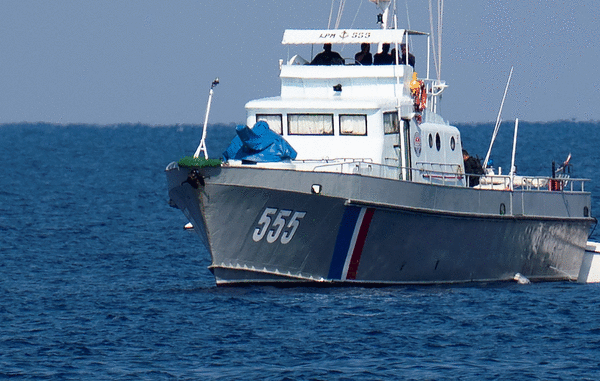
The Cuban government’s accusations that several Floridians attempted to invade the island Wednesday on a speedboat carrying Molotov cocktails and sniper rifles has set off shockwaves across the Sunshine State.
For now, it’s unclear whether the men Havana identified were actually on the boat and what they were doing. The federal government hasn’t confirmed Cuba’s version of the event, with State Department Secretary Marco Rubio highlighting a need for a separate, U.S. investigation.
And the Cuban government initially misidentified one of the men, Roberto Azcorra Consuegra, who denied any involvement with the alleged plot during an interview with the Miami Herald. In fact, he said he was at his Miami-Dade home when the incident took place. He described himself as a political activist who fled Cuba in 2017, as soon as he’d been discharged from mandatory military service.
“I’m scared,” he said. “I don’t know the regime’s intentions for naming me as detained if I’m here in Miami. I’m afraid it could be some kind of retaliation against my family over there. I don’t know if they made a mistake or released the wrong list,” said Azcorra, 31.
Havana said that four people had been killed when it intercepted the boat on Wednesday whose passengers had planned to carry out a “terroristic infiltration.”
Cuban authorities provided an updated list of the men killed and captured on Thursday. It named Pavel Alling Peña, Michael Ortega Casanova, Ledián Padrón Guevara and Hector Duani Cruz Correa as the deceased. Meanwhile, officials identified Cristian Ernesto Acosta Guevara, Conrado Galindo Sariol, José Manuel Rodríguez Castelló, Leordan Enrique Cruz Gómez, Amijail Sánchez González, and Roberto Álvarez Ávila as the men detained.
“This is not an isolated incident. Cuba has been the victim of attacks and countless terrorist acts for more than 60 years, most of which have been organized, financed, and carried out from the territory of the United States,” said Carlos Fernández de Cossío, Deputy Minister of Foreign Affairs of Cuba, in a statement Thursday. He added that aboard the boat had been insignia from “counterrevolutionary terrorist organizations.”
The incident has captured international attention, with questions about the men and their motivations, but details are still emerging. The situation has hit especially close to home for members of Florida’s Cuban exile community, some of whom which knew the men who the Cuban authorities identified.
Azcorra told the Herald he recognizes some of the people included on the list, though mostly by their aliases or from photos. He said that he had socialized with some of the named individuals but claimed they never shared any plans to go to Cuba or carry out any actions on the island.
Azcorra maintains he has had no involvement in any violent plot and remains uncertain why Cuban authorities would include his name.
“They never told me anything about a plan to go to Cuba or to ‘free’ it,” he said.
Fernández de Cossío later acknowledged their error in including Azcorra on the list.
‘Firm in their convictions’
Rene Montes de Oca, vice president of anti-communist group Casa Cuba de Tampa, in an interview on Thursday told the Tampa Bay Times that he personally knew Ortega and Cruz Gomez through the organization.
Ortega Casanova was a leader of the Republican Party’s Tampa chapter and participated in meetings at Casa Cuba de Tampa, said Montes de Oca. Casa Cuba has declared a period of mourning and lowered its flags to half-mast.
“We knew Michel directly as an open person, a friendly man, someone who showed a lot of kindness and goodness,” said Montes de Oca. He added that Cruz Gómez also went to Casa Cuba meetings, though not as often, and that he liked guns and hunting.
“Both (Ortega Casanova and Cruz Gómez) were always very firm in their convictions and believed that to bring down the Cuban government you had to fight with weapons,” he said. “Personally, I was one of those who warned them many times that it was dangerous and could be a suicide mission.”
The Cuban government had previously placed Cruz Gómez, 47, along with Amijail Sánchez González, also 47, on its most recent national terrorism list, updated in 2025 and published in the country’s official state-sponsored newspaper. The list, according to the Cuban regime, includes individuals and organizations that “have been subject to criminal investigations and are wanted by Cuban authorities for their involvement in acts of terrorism.” The list also includes U.S.- and Miami-based Cuban activists, media personalities, and influencers who criticize the Cuban government.
The list, which is in Spanish, alleges that Sánchez introduced firearms, ammunition and other supplies through the northern coast of Matanzas for the “purpose of carrying out acts of terrorism in military units, among other plans of this nature” and claimed the plans were “organized, financed, and supported by” people in the U.S.
Cruz, who was born in Cienfuegos, was wanted for “initiating sabotage activities in the province of Villa Clara,” which led to detention and criminal charges, according to the list.
Police report shows boat was stolen
A police report from the Monroe County Sheriff’s office obtained by the Herald showed that the boat had been reported stolen by its owner from the Florida Keys. Angel Montera, 65, told deputies that the boat is usually docked behind a home in Big Pine Key, whose owner lets him keep it there in exchange for construction work. When he saw the boat’s registration floating around on the media, he realized it matched his own vessel.
One neighbor said she witnessed a pick-up truck pull into the house and leave on the vessel at around 6:30 p.m on Wednesday. Montera saw the truck the next day and identified it as belonging to Hector Cruz Correa, a contractor who does tile work for him and who has two daughters living in Cuba. Montera told law enforcement that Cruz Correa did not have permission to use the boat, the report said.
Cruz Correa had been trying to fix his own twin-engined boat, Montera continued, and he’d so far not been able to reach him. The Cuban government listed a man named Hector Duani Cruz Correa as among the deceased involved in the incident.
The incident on waters near the Cuban province of what comes as diplomatic relations between Cuba and the United States are at a sensitive point. The Trump administration has choked Cuba’s oil supply through tariff threats and maritime blockades, worsening a dire situation on the ground. Cuban authorities have stopped supplying jet fuel to international airlines and cancelled all scheduled surgeries.
On Thursday, in the wake of the interception of the speedboat, Cuba said it would defend its territorial sovereignty.
“Cuba has a duty and responsibility to protect its territorial waters,” said Fernández de Cossío, the deputy minister.
______
(Staff writers Sofia Saric, Nora Gamez Torres and Milena Malaver contributed to this story.)
©2026 Miami Herald. Visit at miamiherald.com. Distributed by Tribune Content Agency, LLC.




Comments