Feds kick off analysis of expanding offshore drilling in California
Published in News & Features
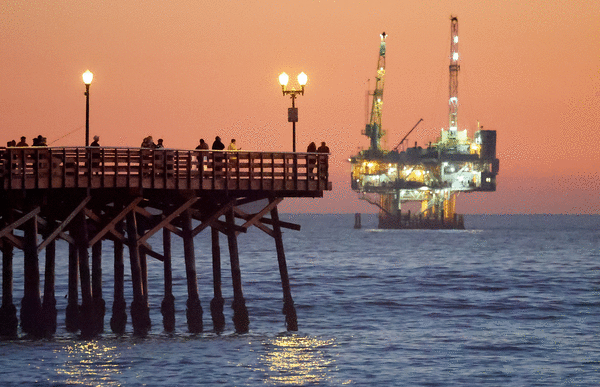
Another step has been taken in the Trump administration’s efforts to expand offshore drilling in California — but the process is still in its early stages, and it’s not clear if oil companies are interested in building new platforms off the coast of the Golden State.
The Bureau of Ocean Energy Management has announced its intent to prepare an environmental impact statement for sales of proposed oil and gas leases in Northern, Central and Southern California areas of the Outer Continental Shelf.
That’s the initial step under the National Environmental Policy Act that kicks off the process to analyze potential lease sales.
Managing offshore oil and gas development is a core responsibility of the Bureau of Ocean Energy Management, known as BOEM. The bureau is an agency within the U.S. Department of the Interior.
Almost immediately after Inauguration Day last year, President Donald Trump issued multiple directives in an executive order titled “Unleashing American Energy.” One of the directives mentioned “exploration and production on federal lands and waters, including on the Outer Continental Shelf, in order to meet the needs of our citizens and solidify the United States as a global energy leader long into the future.”
There are already 23 oil and gas production facilities in federal waters off the coast of California, according to the State Lands Commission, although some of them are no longer profitable to maintain. Twenty-two of those produce oil and gas, while the other is a processing facility.
If an expansion is completed, it would mark the first new oil and gas leases in federal waters off the coast of California since 1984.
“California households are facing an energy affordability crisis, and inaction is no longer an option,” acting BOEM Director Matt Giacona said in a news release. “This Notice of Intent reflects the administration’s commitment to responsibly evaluating offshore leasing as part of a broader strategy to lower costs, strengthen energy security, and support American jobs.”
California has the highest gasoline prices in the country. On Friday, the average price for a gallon of regular stood at $4.64 in the Golden State, according to AAA. The national average was $2.98 per gallon.
If approved, the first lease sales in Southern California and Central California are tentatively scheduled for 2027.
But the plans have drawn opposition from many California elected officials.
“Coastal communities throughout our district do not want this,” Rep. Mike Levin, a Democrat in the 49th congressional district, said in a news release Friday. “Cities up and down the coast have stood together on a bipartisan basis to oppose offshore drilling because protecting our coastline is common sense.”
According to a November 2021 report from the California Energy Commission, offshore production from facilities in federal waters equated to just 1% of all crude oil processed in California refineries.
When news of expanding leases first came to light in November, oil and gas expert Ed Hirs, an energy fellow at the University of Houston, said the crucial question is whether companies will be willing to make the significant investments required to build offshore facilities.
“Just because leasing is permitted doesn’t mean somebody’s going to actually pony up real money for it,” Hirs told The San Diego Union-Tribune, adding that “it really comes down to, can they drill a well and extract the oil profitably?”
California has jurisdiction for the first three nautical miles from the shore. But the federal government has control beyond that distance.
In state waters, there are three offshore oil platforms — one off of Santa Barbara County and two in the Huntington Beach area.
There is also a set of artificial islands that produce oil, including the THUMS Islands in San Pedro Bay near Long Beach. The acronym comes from the names of the four oil companies at the time that formed the project decades ago — Texaco, Humble, Union Oil, Mobil and Shell.
Within state waters, the California Energy Commission reported that offshore facilities accounted for about 6% of total California production from 2011 through 2020.
As for BOEM’s notice of intent, it was published Friday in the Federal Register. The notice opens a 30-day public scoping period in which BOEM invites input from state, local and tribal governments, as well as the public.
©2026 The San Diego Union-Tribune. Visit sandiegouniontribune.com. Distributed by Tribune Content Agency, LLC.






Comments