Defense theory is attempt to coax jury to nullify Prairieland case, prosecutors say
Published in News & Features
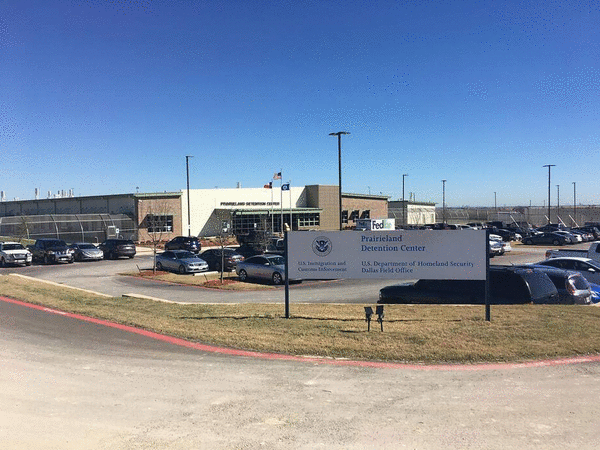
FORT WORTH, Texas — The suggestion that self-defense or defense of others entitled Benjamin Song to shoot at a police officer outside an immigrant detention center in North Texas is absurd, and the judge presiding at the ongoing trial of Song and eight other people under indictment in connection with the shooting should bar defense attorneys from offering evidence or argument supporting those theories, the U.S. Attorney’s Office has argued in a motion and brief in the case.
Prosecutors assert that the defense argument is legally invalid and should stop because it fuels the potential for the jury in U.S. District Court in Fort Worth to ignore the law in nullification. The defendants are charged in connection with the shooting in July of Alvarado Police Department Lt. Thomas Gross at the Prairieland ICE facility and what the government alleges was the attack’s criminal underpinning.
Government prosecutors, who are at the midway point of the core of their case, on Friday filed a motion seeking an order from Judge Mark Pittman to end the defense pursuit of the justification argument. Two defense attorneys filed responses on Monday. Judge Pittman has not ruled on the matter.
It is the “defendants’ apparent intention, revealed through questioning at trial, to claim that [Song] was legally justified in attempting to gun down law enforcement officers because a responding police officer purportedly used excessive force in pointing his service weapon at a defendant who was refusing to comply with the command to stop,” Assistant U S. Attorney Matthew Capoccia wrote in a brief supporting the motion.
Song, a former Marine Corps reservist, shot Gross when the police lieutenant responded to a detention center employee’s report that a person was trying to enter the facility, prosecutors allege. Gross drew his pistol when he saw a person dressed in black tactical clothing running from a pursuing detention officer, the lieutenant testified during the trial’s second day on Feb. 24.
Defense attorneys have suggested in cross-examination of government witnesses that Song may have been justified by defense of a third party because he was lawfully defending the running person wearing black clothing.
The defense is flawed, the government argues, because Song is not free from fault in prompting Gross’ use of force and the defense cannot show Gross’ pointing his gun at the fleeing person was objectively unreasonable under the circumstances.
The defense suggests in its response that it should be permitted to explore the justification theories in part because new accounts of the shooting came to light from the witness stand.
The defense attorneys “learned for the first time in trial last week that there is evidence of self-defense and defense of another as it applies to the person who shot at Lieutenant Gross, and thus to those alleged to have aided and abetted him,” Patrick McLain, an attorney for Song co-defendant Zachary Evetts, wrote in his response.
Gross testified that he emerged from his vehicle “with pistol raised in one hand,” McLain wrote, and noticed someone running away from him, dressed in black and apparently unarmed.
“In that instant, Lieutenant Gross thought the person running away from him may have had something to do with words spray-painted on an unoccupied guard shack he had also seen at that same moment. Lieutenant Gross testified that he pointed his pistol at the back of the fleeing person.”
Alvarado Police Department Sgt. Seth McDonald described in testimony the rifle seized at the scene that the government alleges Song used to shoot Gross.
McDonald testified that a magazine was not removable because a bullet had struck the magazine, contorting it, McLain wrote.
“Thus, logically, since [Gross] was the only person, other than [Song], to fire at that scene, and certainly within those six seconds, [Gross] must have been pointing his pistol at [Song] as the latter held his rifle in a manner that exposed that side of his magazine to being hit by [Gross’s] bullet,” McLain wrote.
The government does not believe that Gross pointed his weapon at the running person wearing black clothing, prosecutor Capoccia wrote in his brief.
Gross’ pistol is not visible in the lieutenant’s body-worn camera video.
An accessory light that was mounted on the pistol was an element of testimony on Friday from Texas Ranger B.J. Hill.
Hill collected the pistol and the vest in which the projectile that left Gross’ neck was found. Gross was shot in his upper shoulder, and the projectile left the back of his neck and took a path through tissue and muscle, but avoided vital organs, Gross testified.
The ranger, under cross-examination, testified that he had assessed that Gross’ use of force was proper.
“It’s OK for a cop to shoot someone in the back?” defense attorney Phillip Hayes, who represents Song, asked.
“Yes,” Hill said.
The ranger offered as an example of such a justified act a police officer facing the back of an assailant with a firearm running toward a school.
Gross’ withdrawal of his pistol was “extremely reasonable” under the circumstances, FBI Special Agent Clark Wiethorn, the case agent, testified.
Terrorists or protesters?
The Dallas-Fort Worth U.S. Attorney’s Office sought the indictments in a novel case against what the government alleges is a group of antifa cell members who intended to kill.
The defendants’ attorneys refer to their clients as noise demonstrators and argue that they wanted, in a protest, to bring hope to immigrants detained by ICE. The indictment represents an attempt to prosecute citizens for their political beliefs, defense attorneys have argued.
Thirteen people wearing black clothes were at Prairieland at the time of the shooting late on July 4, 2025, Wiethorn testified.
Some ignited fireworks and others spoke from a bullhorn or spray-painted anti-ICE phrases on vehicles and an unoccupied guard booth.
Beyond Song and Evetts, the defendants are Autumn Hill (referred to as Cameron Arnold in the indictment), Savanna Batten, Meagan Morris (referred to as Bradford Morris in the indictment), Maricela Rueda, Elizabeth Soto, Ines Soto and Daniel Rolando Sanchez Estrada.
Song is charged with attempted murder and discharging a firearm during, in relation to and in furtherance of a crime of violence. Evetts, Hill, Morris and Rueda are charged with aiding and abetting.
Song, Batten, Evetts, Hill, Morris, Rueda, and Elizabeth and Ines Soto also were indicted on charges including rioting, providing material support to terrorists and conspiracy to use and carry an explosive.
Rueda and Sanchez Estrada also are charged with conspiracy to conceal documents, and Sanchez Estrada is charged with corruptly concealing a document or record.
The trial, expected to take two and a half weeks, was in recess on Monday. The courtroom in Fort Worth is often at capacity. A live video feed of the trial is available at the federal courthouse in Dallas. The trial has attracted observers from North Texas legal circles.
The chief federal law enforcement official in the region, U.S. Attorney for the Northern District of Texas Ryan Raybould, was in the Fort Worth gallery for a time on Friday.
Senior U.S. District Judge Terry Means attempted to observe from the gallery while testimony was underway, and, in accordance with Judge Pittman’s order prohibiting entrance then, was turned away by a deputy U.S. marshal.
________
©2026 Fort Worth Star-Telegram. Visit at star-telegram.com Distributed by Tribune Content Agency, LLC.




Comments