Florida House OKs bills targeting 'terrorism' and 'sharia law'
Published in News & Features
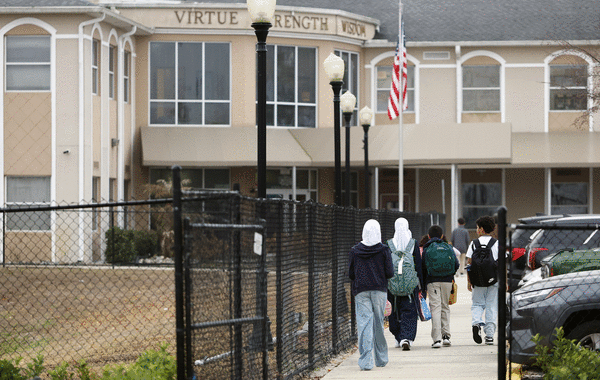
ORLANDO — New legislation targeting “terrorist” groups passed the Florida House on Tuesday, a measure some fear could unfairly cast organizations as dangerous, punish politically active college students and cost Islamic schools millions of dollars by cutting them out of state voucher programs.
But supporters of the bill in the Republican-dominated chamber said the recent attacks on Iran, officially the Islamic Republic of Iran, by the United States and Israel highlighted the need for legislation.
“It should not be lost on any of us that approximately 72 hours ago, America and our ally Israel engaged Iran, a regime that since the 1979 revolution, replaced constitutional governance with theocratic rule under sharia law, curtailed the rights of women, crushed dissent and exported terrorism across the globe,” said bill sponsor Rep. Hillary Cassel, R-Dania Beach.
The bills would allow the Florida Department of Law Enforcement’s chief of domestic security to designate terrorist organizations. The Florida Cabinet, which the governor chairs and is made up of three other statewide elected officials, would have to approve the designation.
The Senate is slated to take up its version of the legislation later this week.
While the bills do not name specific organizations, the proposals mention sharia law, the duties required of all Muslims, and that wording has alarmed supporters of the state’s Islamic schools, especially as they follow comments from state leaders tying Islam generally to terrorism.
Gov. Ron DeSantis issued an executive order in December, for example, designating the Council on American-Islamic Relations, or CAIR, as a terrorist organization, writing it was created “to conceal ties to Islamic extremist groups.”
The bills use a definition of terrorism already in state law, which includes activities “dangerous to human life which violate state or federal law.”
If the legislation is approved, state universities and colleges that “advocate for” these groups might have their performance funding withheld and students who associate with these organizations could be expelled. Additionally, anyone who works for state-designated terrorist organizations could face felony charges.
The legislation would also ban “terrorist” organizations from receiving money through the state’s school voucher program, which students use to pay tuition at nearly 2,500 private schools across the state. A small fraction of those campuses — about 1% — are Islamic.
Two related proposals would exempt from public disclosure records concerning the decision to designate groups as terrorist organizations.
Lawmakers debated the legislation for more than an hour on Tuesday, with several Republicans who supported the bill tying the proposal to war with Iran.
Rep. Jeff Holcomb, R-Spring Hill, reminded members of the ongoing conflict and ticked off a list of laws enforced in some Muslim-majority countries, including the criminalization of homosexuality and restrictions on interactions between men and women.
“Members, we cannot let entities come into our state to not assimilate in Florida, with a desire to implement laws that discriminate against women and are misogynistic and immoral,” Holcomb said. “Sharia law has no place in Florida.”
House Democrats pushed back, saying that singling out sharia law could lead to discrimination against Muslims and pointing out that many liberals might consider certain conservative groups to have “terrorist” objectives as well.
Rep. Ashley Gantt, D-Miami, proposed an amendment removing references to sharia law in the legislation, saying that they were “unconstitutional” and deleting them would “ensure no one religion is singled out or antagonized.”
“It eliminates viewpoint discrimination,” said Gantt, who works as an attorney.
Rep. Michele Rayner, a St. Petersburg Democrat, added that mentions of sharia law in the bill are a “red herring” as courts here do not uphold religious laws.
“American courts are not going to apply any type of other foreign law,” said Rayner, also an attorney. “They’re only going to apply the laws of the United States.”
But House members rejected Gantt’s amendment. Sharia law was not named to single out Muslims, Cassell said, but rather because it is frequently mentioned in American courts, adding that “naming it provides clarity, not preference.”
“Members, sharia law is named in this bill for a very specific reason,” said Cassell, who is also an attorney. “Sharia law refers to a foreign framework that is codified and enforced by certain governments. It is not a religious practice.”
But passing this legislation would create “a parallel system” that could lead to inconsistent classifications of groups and invite costly legal challenges, said Rep. Rita Harris, D-Orlando.
“The constitution does not disappear when a label becomes emotionally charged,” Harris said.
Last month, CAIR sounded the alarm about the proposals, noting that many students depend on vouchers to pay tuition at Islamic schools and those campuses need that funding to keep their doors open. Several other groups, including Equality Florida, the Florida Conference of Catholic Bishops and the NAACP, also opposed the legislation during committee meetings.
Last school year, Florida funneled $2.8 billion to private schools across the state through the voucher program. Though the awards, which are valued at about $8,000 per student, were initially reserved for low-income students and those with disabilities, the program is now open to all.
Christian schools and the students who attend them are, by far, the biggest beneficiaries, according to data from Step up for Students, a non-profit organization that administers most of the program. About 69% of the nearly 360,000 Florida students who participated in the program attended Christian schools. In all, the state sent more than $1.9 billion to Christian campuses.
But just over two dozen Islamic schools across the state, including six in Orange and Seminole counties, also take the state-backed payments, educating about 6,000 students and receiving about $46 million.
Rep. Anna Eskamani, D-Orlando, acknowledged she is an opponent of the state’s voucher program, but believes it’s important to avoid discrimination when determining who’s eligible to receive the funding.
The state has excellent Islamic schools that do not practice sharia law, she said, and yet their leaders and families are worried that students will be deemed dangerous simply because they wear hijabs or have brown skin. She reminded members that they may have families in their districts who would be impacted if they were no longer allowed to use vouchers to pay tuition at the schools of their choice.
“I think it’s really important for us not to fall into the unfortunate prejudice, the discriminatory practices as it pertains to our Muslim community members,” she said.
------------
©2026 Orlando Sentinel. Visit at orlandosentinel.com. Distributed by Tribune Content Agency, LLC.




Comments