NASA now officially has no plans to use new mobile launcher for Artemis
Published in News & Features
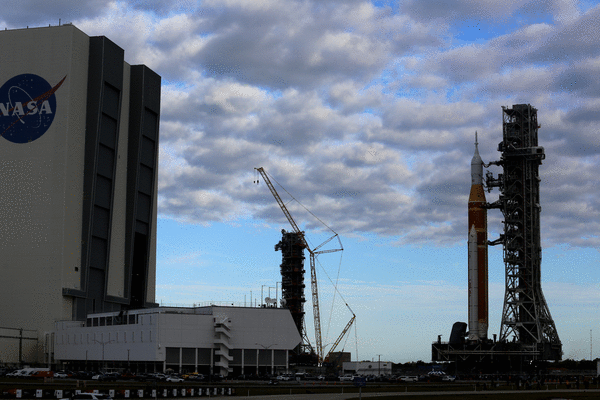
When NASA Administrator Jared Isaacman announced the revamped approach to the Artemis moon program, it was unclear whether the new mobile launcher that has been constructed over the last two years at Kennedy Space Center would ever get used.
A NASA rundown of the reconfigured Artemis launch plans released Tuesday, though, answers that question for the foreseeable future: No.
“The agency is no longer planning to use the Exploration Upper Stage or Mobile Launcher 2, as development of both has faced delays,” according to the agency update.
The Space Launch System rocket for the first three missions is in what is known as the Block 1 configuration, which has an upper stage called the interim cryogenic propulsion stage. Those missions were assigned the use of mobile launcher 1 (ML1), which was converted from the canceled Constellation program created under President George W. Bush in the early 2000s.
Artemis IV and V were to use a Block 1B version of the SLS, including the taller Exploration Upper Stage, which was designed to bring thousands more pounds of cargo to the moon.
The increase in height called for a new mobile launcher, ML2.
Primary contractor Bechtel National Inc. added the last modular block to the tower last summer, bringing it to a height of 377 feet. It has since been in final construction mode before a planned handoff to NASA by late 2026.
Bechtel did not respond when asked if work on the ML2 will cease immediately or be completed for delivery to the agency this year as planned.
Its presence has loomed in the background, with cranes adjacent as the Artemis II rocket on the ML1 has rolled out to and then back from KSC’s Launch Pad 39-B as teams continue to aim for a launch opportunity in April.
ML1 was used once for the Ares I-X test mission of the Constellation program, then sat unused at KSC for years before it was tapped to support the first three Artemis missions.
ML2’s future could find a use potentially, however.
“ML2 is 90% complete. It can be configured however we need to,” said NASA’s Associate Administrator Amit Kshatriya during a press conference Friday about the Artemis changes.
NASA does not plan to use the ICPS as the upper stage for Artemis IV and V.
“NASA is assessing alternative options for the second stage of the rocket,” the agency’s update stated. “The interim cryogenic propulsion stage used for the first three missions will be replaced with a new second stage.”
The ML2 project, which was initially a $383 million contract awarded in 2019, had an original delivery date of 2023. A NASA Office of Inspector General audit released in August 2024 said the costs had already nearly tripled to more than $1 billion, with the delivery date pushed into late 2026.
The project is part of the growing costs and delays associated with all facets of the Artemis program. In 2023, the OIG said by the time Artemis III flies, the program will have topped $93 billion in costs since it was originally announced in 2012. Those costs have now climbed to over $100 billion.
President Donald Trump’s original NASA budget proposal in 2025 —which was ignored by Congress — sought to end the use of SLS after Artemis III, and with it the need for the ML2. After moves by Sen. Ted Cruz, funds were allocated to support Artemis IV and V in Trump’s Big Beautiful Bill, and it seemed like ML2 would be needed after all.
That was until Isaacman’s announcement last Friday.
Part of Isaacman’s criticism of SLS has been the ballooning costs and delays that have seen three-year gaps between launches.
He said shifting from the Block 1 to Block 1B and a roadmap for an even larger Block 2 version of SLS, which would have also used the ML2, was a roadmap for failure.
“You’re going to inevitably learn the same lessons and over again,” he said referencing the idea that with each change in design comes the possibility for new delays. “So standardize, increase production, pull everything in which allows you then to increase your your launch rate.”
The new plan aims to turn around SLS launches once every 10 months.
Artemis II could fly as soon as April 1 while Artemis III, now a low-Earth orbit mission, would come in mid-2027, and Artemis IV and V, both aiming to land on the moon, are both tapped for 2028.
The change in plans has meant other contractors like Lockheed Martin and Boeing will need to refocus to hit those targets.
“They understand what the ask is. They know we’re going to need to pull in hardware. That’s why we’re standardizing the configuration,” Isaacman said. “You’re not going to be able to be able to do that if every rocket is a work of art.”
----------
©2026 Orlando Sentinel. Visit at orlandosentinel.com. Distributed by Tribune Content Agency, LLC.






Comments