Bill allowing physician assistants to practice independently passes Alaska Senate
Published in News & Features
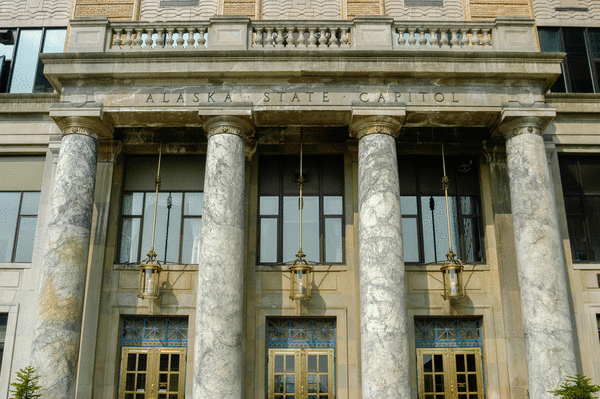
JUNEAU, Alaska — The Alaska Senate has passed a bill that would allow physician assistants with sufficient training to practice under an independent license, removing the state's current requirement that they work under a formal collaborative agreement with physicians.
Supporters say the change would reduce administrative burdens that can delay and increase the cost of care. But physicians who opposed the bill argue it lowers the bar for training and could affect patient care.
Senate Bill 89, sponsored by Democratic Sen. Löki Tobin, passed by a unanimous vote in the Senate on Wednesday, with 18 votes in favor and two members absent. The bill would allow physician assistants to apply for an independent license after completing 4,000 hours of postgraduate supervised clinical practice.
Under current law, physician assistants in Alaska must operate under a collaborative plan with physicians. These plans outline the medical services a physician assistant can provide and require oversight from doctors.
The Alaska State Medical Board regulates physician assistants and authorizes them to provide care only within the scope of their training. Most physician assistants in Alaska work in family practice, though some are specially trained in particular fields. All care must be provided under a physician's license through a collaborative agreement that also requires a second, alternate physician to sign off.
For some clinics, particularly in more remote areas, finding those physicians can be difficult.
Mary Swain, CEO of Cama'i Community Health Center in Bristol Bay, testified in support of the bill before the Senate Labor and Commerce Committee in March 2025. Her practice employs two physicians to maintain collaborative plans for its physician assistants. She said neither of them lived in the community, and the primary physician lived out of state.
Roughly 15% of physicians who hold collaborative agreements with Alaska-based physician assistants do not live in the state, according to Tobin. At the same time, Alaskans face some of the highest health care costs in the nation.
Jared Wallace, a physician assistant in Kenai and owner of Odyssey Family Practice, testified in support of the bill at a committee meeting in April.
Wallace said maintaining collaborative agreements is one of the most difficult parts of running his clinic. He said he pays a collaborative physician about $2,000 per physician assistant per month, roughly $96,000 a year, simply to maintain the required agreement.
"In my experience, a collaborative plan does not improve nor ensure good patient care," Wallace said. "Instead, it is a barrier in providing good health care in a rural community where access is limited, is a threat that delicately suspends my practice in place, and if severed, the 6,000 patients that I care for would lose access to (their) primary provider and become displaced."
Opposition to the bill largely came from physicians, who testified that physician assistants do not receive the same depth of training as doctors.
Dr. Nicholas Cosentino, an internal medicine physician, testified in opposition to the bill last April. He said that medical school training provides crucial experience in diagnosing complex cases.
"It's not infrequent that you get a patient that you're not exactly sure you know what's going on, and you have to fall back on your scientific background, the four years of medical school training, the countless hours of residency to come up with that differential, to think critically and come up with a plan for that patient," Cosentino said. "I think the bill as stated, 4,000 hours, does not equate to that level of training."
The Alaska Primary Care Association said it supports the intent of the bill but argued that physician assistants should complete 10,000 hours in a collaborative practice model with a physician before practicing independently.
Other states that have moved to allow independent licensure for physician assistants have adopted a range of thresholds. North Dakota requires 4,000 hours, while Montana requires 8,000 hours. Utah requires 10,000 hours of postgraduate supervised work, while Wyoming does not set a specific statewide minimum hour requirement.
Tobin said the hour requirement chosen in the bill came from conversations with experts during the bill's drafting.
"When we were working with stakeholders on this piece of legislation, we came to a compromise of 4,000 hours, recognizing and understanding that there was concerns, but also ... understanding that it is a bit of an arbitrary choice," she said.
The bill now heads to House committees before a potential vote on the House floor.
© 2026 Anchorage Daily News. Visit www.adn.com. Distributed by Tribune Content Agency, LLC.






Comments