Iranian barrage sweeps Mideast as Trump weighs in on next leader
Published in News & Features
JERUSALEM — A barrage of Iranian missiles and drones targeted at least five countries across the Middle East, prompting several governments to urge their citizens to take shelter, while Israel carried out a 12th wave of airstrikes on Tehran and the United States suspended operations at its embassy in Kuwait.
As the seventh day of the Iran war began Friday in the Mideast, there was little sign of a reprieve. The previous day saw Bahrain’s oil refinery on fire from a strike, an oil tanker struck off the coast of Iraq and more disruptions to air travel. Oil rose to $81 in the U.S and a global bond rout continued unabated.
At least 1,230 people have died in Iran so far, and dozens more elsewhere in the region. The Pentagon says six U.S. troops have been killed.
In Washington, President Donald Trump said the United States continues to “totally demolish” Iranian forces, saying the country has “no air force, they have no air defense” and adding that “their navy is gone — 24 ships in three days.”
He dismissed concerns about energy prices, saying “further action to reduce pressure on oil is imminent, and the oil seems to have pretty much stabilized. We had it very low, but I had to take this little detour.”
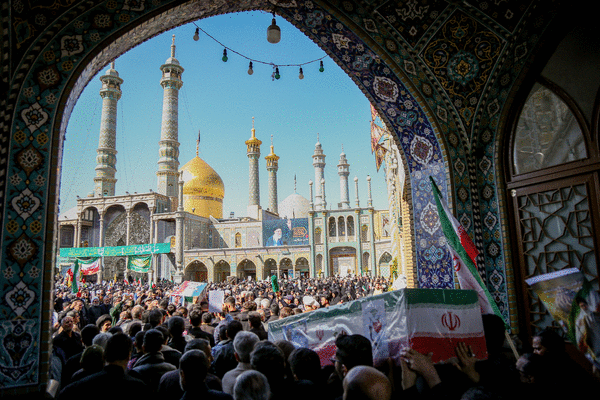
The American president also weighed in on the future of Iran’s leadership as the Islamic Republic prepares to hold a funeral for Supreme Leader Ayatollah Ali Khamenei. Trump called Mojtaba Khamenei, the son of the late ayatollah, a “lightweight” who wouldn’t change the regime’s policies and insisted on being personally involved in picking the country’s next leader.
“Khamenei’s son is unacceptable to me. We want someone that will bring harmony and peace to Iran,” the president said in an interview with Axios.
Explosions were heard in parts of Tehran overnight, while Israel said Iran had launched a new wave of missiles at its cities. Hours earlier, Israel Defense Forces Chief of Staff Eyal Zamir said strikes have neutralized more than 60% of Iran’s ballistic missile launchers and that the IDF is moving into the next phase of its efforts to dismantle the Iranian regime and its military capabilities.
In another sign of the widening scope of the conflict, NATO said it’s increasing its alliance-wide ballistic missile defense posture following the downing Wednesday of an Iranian missile heading toward Turkish airspace.
In all, about a dozen nations have become embroiled since the United States and Israel launched their campaign on Feb. 28. Azerbaijan was the latest: The country threatened to hit back after two Iranian drones struck its territory of Nakhchivan, accusing Tehran of escalating regional tensions.
“These acts of aggression will not go unanswered,” Azerbaijan’s Defense Ministry said in a statement. Response measures “to protect national sovereignty and civilian safety” are being prepared, it added. Iran denied any connection to the drones.
Iran’s Islamic Revolutionary Guard Corps said retaliatory attacks will intensify in the coming days, according to the Nour news agency. Trump was been similarly defiant, telling Politico that the U.S. has an “unlimited supply of weapons.”
The possibility of a protracted war is roiling markets. U.S. oil settled higher on signs the conflict is disrupting crude flows to key buyers, with top importer China moving to conserve fuel. Fed Bank of Richmond President Tom Barkin said the central bank’s response to the war will depend on how long the impact on the economy lasts.
Saudi Arabia continued to thwart attacks on Thursday, saying it intercepted multiple missiles and drones overnight. Strikes have mostly been directed at Al Kharj near Riyadh, where the U.S. has a facility, or the east where Saudi Aramco operates its headquarters.
The kingdom is diverting millions of barrels of crude to a port on its Red Sea coast, helping the world’s top exporter to maintain supply as the critical Strait of Hormuz remains largely shut.
Airlines also remain hamstrung, with the number of canceled flights to Middle East hubs surpassing 23,000 since fighting began. Thousands of passengers remained stranded in the Gulf region.
Disputing Trump administration claims, Iranian Foreign Minister Abbas Araghchi told NBC News that his country hasn’t asked for a ceasefire and had no intention to negotiate. “We see no reason why we should engage once again with those who have, who are not honest in negotiation,” he said.
The Trump administration also showed no sign of letting up, with Defense Secretary Pete Hegseth telling reporters that “it could be six, it could be eight, it could be three” weeks before operations are wrapped up.
At a separate news conference later at Central Command’s headquarters in Florida, Hegseth also dismissed concerns that U.S. weapons inventories are running low.
“Iran is hoping we cannot sustain this,” Hegseth said. “Our capabilities are overwhelming and gathering still, as are those of our Israeli partners. Our munitions are full up.”
_____
(With assistance from Alisa Odenheimer, Benoit Berthelot, Jordan Fabian, Ani Avetisyan, Courtney McBride, Jeff Mason, Roxana Tiron, Kate Sullivan, Andrea Palasciano and Kateryna Kadabashy.)
_____
©2026 Bloomberg L.P. Visit bloomberg.com. Distributed by Tribune Content Agency, LLC.





Comments