SPR drawdown might not be enough for consumers, Democrats say
Published in News & Features
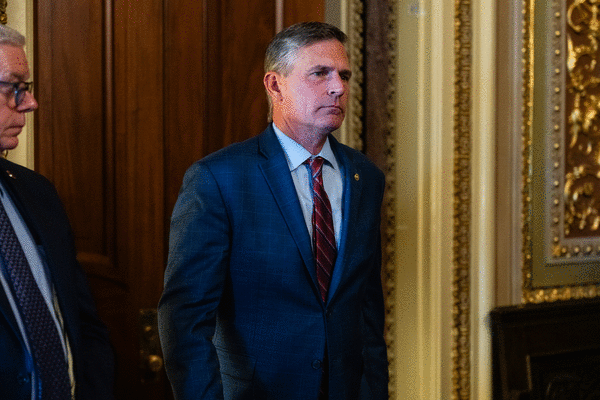
WASHINGTON — President Donald Trump’s decision to draw crude oil from the Strategic Petroleum Reserve received little criticism on Capitol Hill Thursday, although Democrats expressed reservations that it would not do much to insulate Americans from global price volatility resulting from the war in Iran.
Senate Energy and Natural Resources ranking member Martin Heinrich, D-N.M. said in an interview that consumers will still “feel huge impacts with respect to gasoline prices” even with the drawdown.
“The scale of what’s going on in the Middle East almost negates our ability to use [the SPR] in a way that’s meaningful,” Heinrich said. “So when you take 20% of the world’s oil supply offline, even something as large as what they’re pursuing with the Strategic Petroleum Reserve doesn’t begin to fill the gap.”
Trump told Cincinnati news station Local 12 on Wednesday that he planned to draw from the SPR, saying, “We’ll do that, and then we’ll fill it up.”
“But right now, we’ll reduce it a little bit — and that brings the prices down,” he added.
Senate Minority Leader Charles E. Schumer, who earlier this week called on the Trump administration to tap the SPR, released a statement Wednesday pointing out that the president had done what he asked. He also lamented the impacts of the war on the American people.
“Trump is doing what I called for three days ago, after needlessly sowing additional chaos and uncertainty,” Schumer, D-N.Y., said. “But he’s already created a lot more problems than this will solve – from the Strait of Hormuz blockade to his poorly planned and reckless war, Americans are the ones routinely paying the price.”
Sen. Jacky Rosen, D-Nev., had also called for releasing SPR oil in a March 10 letter.
Release plan
The Energy Department plans to release 172 million barrels from the SPR over the next 120 days beginning next week, DOE announced Wednesday. Energy Secretary Chris Wright said the reserve would then be filled with about 200 million barrels within the next year. His department already had begun to refill the SPR late last year, awarding contracts to start that process after a drawdown by the Biden administration at the start of the Russian war on Ukraine in 2022.
Trump’s decision to tap into the nation’s oil reserves amid the Iranian conflict comes in concert with an agreement among International Energy Agency member countries to engage in the largest ever drawdown of their collective reserves — pulling about 400 million barrels of oil total. The move from the global group Wednesday came as ongoing shipping challenges in the Middle East have disrupted the international oil trade, driving up prices worldwide.
The Brent crude oil price Thursday afternoon hovered around $100 per barrel, according to the New York Mercantile Exchange, after closing at $91.98 the day before. Current prices are up more than $25 per barrel from late February when the U.S. launched its military operations in Iran.
The average domestic price for regular unleaded gasoline stood at $3.60 a gallon on Wednesday, according to the motor club AAA. That average is 35 cents a gallon higher than it was a week ago and more than 60 cents higher than the price at the end of February.
The record high of $5.02 was recorded in June 2022, months after the Biden administration tapped the SPR. Congressional Republicans heavily criticized the move at the time, arguing the Biden administration should have done more to increase domestic energy production. The Biden administration later estimated that it reduced the price consumers paid at the pump by roughly $0.40 cents per gallon.
In calling for the global drawdown, the IEA said oil exports from the Middle East currently are at less than 10% of “pre-conflict levels.” The group noted that about 25% of the world’s oil shipped by sea travels through the Strait of Hormuz.
Wright defended the SPR decision Thursday, saying this situation is “what the Strategic Petroleum Reserve is for.”
“So as we have a shortage of market coming through that [the Strait of Hormuz], we’re going to bring oil to market through other avenues to get through a few weeks of a short term dislocation to get to a much better place on the other side,” he said on CNN.
Wright talked about “short-term pain to solve a long-term problem” and said the goal was to keep Asian refineries that receive oil from the Persian Gulf running. He also said the U.S. is not yet prepared to escort ships through the strait.
Gas tax holiday
Some members of Congress are considering other avenues to potentially address the rising prices at the pump, including a proposed national gas tax holiday.
Sen. Mark Kelly, D-Ariz., introduced a bill Monday that would suspend the 18.4 cent per gallon federal gas tax through Oct. 1.
The bill, co-sponsored by Sen. Richard Blumenthal, D-Conn., also would direct the Treasury Department to monitor the program to ensure the tax relief is passed on to consumers and to transfer general funds to keep the Highway Trust Fund and Leaking Underground Storage Tank Trust Fund solvent during the tax suspension.
“This legislation temporarily suspends the federal gas tax, lowering high gas prices squeezing consumers and bringing much needed financial relief to American families,” Blumenthal said in a statement. “Trump’s war of choice with Iran is driving up gas prices across the country—and Americans shouldn’t have to bear the additional economic burden of Trump’s reckless decision making.”
Rep. Chris Pappas, D-N.H., is set to introduce companion legislation in the House, the members said in a press release announcing the bill.
Congress has also mandated sales from the SPR in various legislation since 2015 to offset other spending in laws including the 2017 Republican reconciliation law.
During his inaugural address last year, Trump vowed to fill “our strategic reserves right up to the top again.” The Republicans’ 2025 reconciliation law ended up providing $171 million to fill the reserve, with an additional $218 million for maintenance and repairs to the reserve’s infrastructure, less than the roughly $1 billion that was initially considered during the early stages of negotiations on the bill.
©2026 CQ-Roll Call, Inc., All Rights Reserved. Visit cqrollcall.com. Distributed by Tribune Content Agency, LLC.






Comments