'Not the first time': Cuba compares Trump talks to Obama era
Published in News & Features
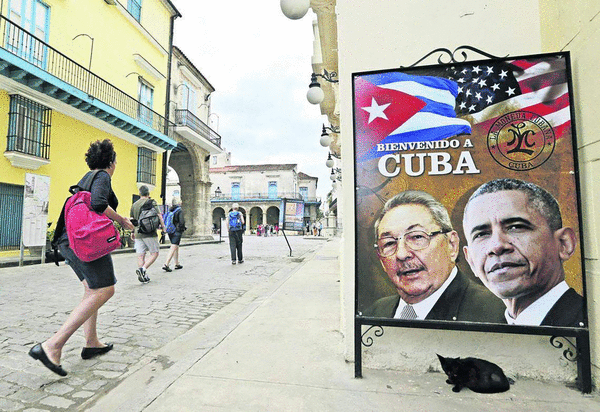
Cuban leader Miguel Díaz-Canel confirmed the government’s talks with the United States on Friday — and tried to draw an unlikely parallel between Donald Trump and Barack Obama.
“It is not the first time that Cuba has entered into a conversation of this type,” Díaz-Canel said in a rare public address. “I believe that the most recent example was the way in which the army general conducted the talks with President Obama, very recently, and we all know the results of those talks.”
His comparison hearkens to a brief era of normalized economic relations between the United States and Cuba, including the reopening of embassies and an easing of the U.S. embargo. Obama visited the island, shook hands with Raúl Castro, celebrities were vacationing in Havana, international artists hosted concerts and cruise ships even started sailing from Miami to Havana.
But Díaz-Canel’s reference to the Obama-era thaw — built on diplomatic outreach and economic openings — is for some in the South Florida Cuban exile community more of a warning than reassurance.
“It was an outrage because they gave him everything in exchange for nothing,” said Miami-Dade County Property Appraiser Tomás Regalado, a Cuban American who was the Republican mayor of Miami while Obama was normalizing relations with Cuba. “The prisoners continued in prison, the party continued to be the only party.”
A decade on, the Trump administration’s talks with the inner circle of the Castro regime — with involvement from the Vatican — are taking place against a very different backdrop. For one, Cuba’s economic situation is dire after the U.S. military captured Venezuelan strongman Nicolás Maduro and cut off oil shipments to the island. And Trump has shown a willingness to use military force against leaders that don’t bend to his will.
While Díaz-Canel may see it as advantageous to compare this moment to an era of normalized economic relations with little political change in Cuba under Obama — it’s also papering over the very different realities on the ground, according to Michael Bustamante, a history professor and the Emilio Bacardí Moreau chair in Cuban and Cuban American studies at the University of Miami.
He said the stark differences between the Obama-era talks and Trump ones outweigh any similarities. That includes the presence of a Cuban American, Secretary of State Marco Rubio, in the talks, and the extreme blockades the Trump administration has placed on the island.
Plus, there’s the more personal angle to comparing Trump to one of his biggest political rivals.
“If they should know one thing about President Trump, it is that he’s really not a fan of Barack Obama,” Bustamante said. “That is not gonna play well. That is not a comparison that they’re going to be comfortable with.”
When the Miami Herald asked about Díaz-Canel comparing Trump to Obama, a Trump administration official said Cuba’s “leaders should make a deal, which (Trump) believes ‘would be very easily made.’ Cuba is a failing nation whose rulers have had a major setback with the loss of support from Venezuela and with Mexico ceasing to send them oil.”
The Marco Rubio factor
Regalado, the former Miami mayor, pointed to a long history of presidents trying to ease tensions with Cuba only to have it backfire.
As he sees it, Jimmy Carter tried to have a “good faith” dialogue, and in response saw the mass migration of Cuban refugees to the United States in the Mariel boatlift. Bill Clinton tried to open a dialogue, and he got the shootdown of the Brothers to the Rescue planes.
“Cubans in exile are used to a bad outcome,” Regalado said. Other Cubans in South Florida also told the Herald on Friday that the talks between the U.S. and Cuba feel like the “same old story.”
But, Regalado argued that despite Díaz-Canel’s attempt to draw a parallel between Obama and Trump, there are a wide range of factors that make this moment feel very different, particularly among Republicans.
“I sense more and more hope in the Cuban exile community, hope that didn’t exist when Obama or Carter or Clinton tried to get close to the Cuban government,” he said.
Part of that hope for political change is tied to who is leading the efforts: a Miami-raised Cuban American.
Former Democratic Congressman Joe Garcia said a major departure between Obama-era talks and the ones the Trump administration is engaging in with Cuba is the presence of Rubio, who has always advocated for hard-line policies against Cuba.
“There’s a huge difference: the Cuban American is involved,” Garcia said. “Marco Rubio, while he may not be of my party — I may have thought of other people, other Cuban Americans that could have been there — he is the right man at the right time and he represents this community.”
Rubio’s involvement has also made the idea of being in talks with the Castro regime more palatable to the enraged South Florida political right, which had initially denounced all talks and was opposed to the Obama era discussions.
Diplomacy versus pressure
Obama used a “friendly posture” to try to create incentives for economic reform in hopes of future political reform, but even as the U.S. tried to normalize relations, the regime would take measures that frustrated exiles who were expecting change on the island.
Cuba tried to force cruise companies to deny Cuban-born Americans from entry into Cuban ports, a stance they dropped when the cruise companies threatened to cancel their routes. Cuban American travelers that returned to the island during the thaw reported feeling harassed by authorities at airports, according to Herald reports. And the Castro regime remained in power.
This time, the United States is using different leverage to pressure Cuba.
“The Trump administration is using coercion,” Bustamante, the historian, said. “They have slapped a de facto oil blockade on Cuba that has taken the economy to the brink.”
Cuba is facing a humanitarian crisis after the United States cut off its supply of oil from Venezuela, triggering relentless blackouts, putting the healthcare system on the verge of collapse and sending food prices skyrocketing.
It remains an open question whether Trump’s aggressive approach will work to force political change. But Cuba is unlikely to get a similar outcome as it did during the Obama era, Bustamante said.
“The world has changed from 10 years ago in ways that many folks may find ugly and uncomfortable, but the idea of trying to replay the Obama script here — if they really think they can pull that off, I think that might be a real miscalculation,” he said.
“On the other hand, with the situation in Iran spinning out of control, I wonder to what extent that means the White House is going to want to lean and just get a quick fix to the Cuba thing and be able to declare victory,” he added.
Garcia, the former Democratic congressman, said Obama’s legacy in Cuba includes changes that paved the way for the current moment, like giving Cubans the ability to visit family back on the island and taking off caps on sending money back creating investment in the island.
“His place in history is secure,” Garcia said. “Now let’s see if we can dig this further.”
He compared Obama’s approach to one that hoped for an outcome, but didn’t force it. What remains to be seen is whether Trump’s approach, with its added humanitarian cost, will have a different result.
“If the Obama attempt to get change in Cuba was a natural birth and progression, this is a birth using forceps,” Garcia said. “They implemented perhaps the most effective embargo since the embargo was implemented. They cut the lifeblood of the country.”
_____
(Miami Herald staff reporters Syra Ortiz Blanes and Garrett Shanley contributed to this report.)
_____
©2026 Miami Herald. Visit miamiherald.com. Distributed by Tribune Content Agency, LLC.






Comments