US and Iran keep up strikes as Trump mulls possibility of a deal
Published in News & Features
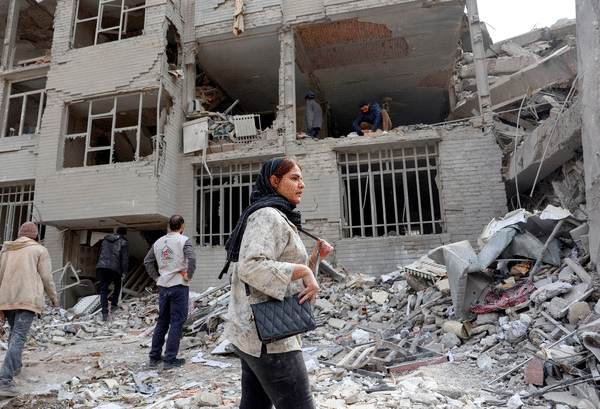
The U.S. and Iran signaled no letup in fighting as President Donald Trump dangled the possibility of negotiations to end a conflict that’s brought shipping in the strategic Strait of Hormuz to a near standstill and upended energy markets.
Iranian Foreign Minister Abbas Araghchi said the Islamic Republic hasn’t asked for talks or a ceasefire after Trump told NBC on Saturday that he’s willing to make a deal but wants better terms.
“Iran wants to make a deal, and I don’t want to make it because the terms aren’t good enough yet,” Trump said, adding that a “very solid” agreement would have to include a commitment by Tehran to abandon nuclear ambitions. He gave no details on any talks and it’s not clear who, if anyone, is conveying messages between the U.S. and Iran.
Trump also urged other countries to send warships to keep open the Strait of Hormuz, through which about a fifth of the world’s oil exports flow, but offered no specifics or commitments from the U.S. side. He said he hoped China, France, Japan, South Korea and the U.K. would take part.
“We don’t see any reason why we should talk with Americans, because we were talking with them when they decided to attack us, and that was for the second time,” Araghchi said in an interview aired Sunday on CBS’s "Face the Nation." Iran will continue to defend itself until Trump accepts that he’s waging an “illegal war” with no chance of victory.
European Union foreign ministers will discuss the idea of expanding the bloc’s Aspides naval mission from the Red Sea to the Strait of Hormuz when they meet Monday, but officials cautioned no decisions are imminent.
The military operation to secure shipping in the Red Sea “has not been effective so far,” German Foreign Minister Johann Wadephul told ARD television on Sunday, adding Berlin was very skeptical about any expansion of the naval mission.
The Pentagon estimates the war, now in its third week, would take between four and six weeks, said Kevin Hassett, head of the White House’s National Economic Council. Underscoring the domestic pressure on Trump, he was among several administration officials on Sunday asking Americans for patience as global oil prices top $100 a barrel.
The conflict has left about 3,750 people dead across the region since it began on Feb. 28 with the U.S. and Israeli bombing of Iran, according to tolls from governments and nongovernmental organizations.
The U.S.-based Human Rights Activists News Agency said more than 3,000 people were killed in the last two weeks in Iran. Dozens have died across the Gulf and in Israel, while the US has lost 13 service members.
The Islamic Republic’s retaliatory attacks on Israel and Arab states in the Persian Gulf continued overnight into Sunday, after the U.S. struck military sites on Kharg Island, home to key export facilities for Iranian oil.
Israeli Defense Minister Israel Katz has described the war as entering its “victory phase.” He also said the war, now in its third week, would last “as long as required.”
Five people were wounded after five missiles hit Baghdad International Airport and its surroundings, Iraqi Lieutenant General Saad Maan said Sunday in a statement.
The United Arab Emirates said Sunday it was intercepting missiles and drones from Iran, telling residents that blasts heard in parts of Dubai were the projectiles being shot down. The UAE says it has engaged 1,600 drones and more than 300 missiles launched by Iran since the conflict began.
Araghchi, Iran’s foreign minister, told MS NOW on Saturday that “it is clear” the missiles that hit Kharg Island came from the UAE.
Anwar Gargash, a senior foreign policy adviser to UAE President Sheikh Mohamed bin Zayed, said the country “has the right to self-defense in the face of this terrorist aggression imposed upon it, yet it continues to prioritize reason.”
Oil-loading operations at Fujairah — a key UAE port — resumed on Sunday after a drone strike and fire forced a halt to exports the day before, according to people familiar with the situation. They asked not to be identified as they aren’t authorized to comment.
Fujairah is just outside the Strait of Hormuz and a major hub for both crude and fuel products. It has taken on increased significance for both the UAE and global markets because it’s one of the few Gulf export outlets that bypasses the waterway. Loading had been halted as a precaution while damage was being assessed.
Washington told Americans to leave Iraq immediately — citing the “significant threat posed by Iran-aligned terrorist militia groups.” That came after the Associated Press reported a missile hit a helipad within the compound of the U.S. embassy in Baghdad.
In announcing the strike on Kharg Island, Trump said military facilities there had been “obliterated,” adding that he chose not to hit oil infrastructure “for reasons of decency.” He threatened to do so should Iran “do anything to interfere with the Free and Safe Passage of Ships through the Strait of Hormuz.” The Pentagon has yet to provide any details on the Kharg Island strikes.
Trump said that even though Iran’s military was “already destroyed 100%,” it was “easy” for Tehran to continue threatening ships with drones, mines and short-range missiles. The U.S., he said, “will be bombing the hell out of” Iran’s shoreline to try to counter that.
Araghchi said the strait was only shut to U.S. ships and those of its allies. There have been 16 reported attacks on vessels in and around Hormuz since the war began, according to the U.K. Maritime Trade Operations.
“We welcome any regional initiative that leads to a fair end to the war,” he told Al-Araby Al-Jadeed, in a rare sign of a possible shift in stance from Iran, where officials have previously said they could sustain the conflict for months. “Ending the war is conditional on guarantees that it won’t be repeated and on the payment of compensation.”
Iran also said it arrested some 500 people, including about 250 who were providing intelligence to target sites, according to the semi-official Tasnim news agency, which cited Iran’s police chief, Ahmad-Reza Radan.
Lebanon’s government said around 850 people have died in Israeli attacks on the country in a parallel war the Jewish state is waging against Iran-backed Hezbollah.
_____
(With assistance from Arsalan Shahla, Dana Khraiche, Khalid Al-Ansary, Michael Nienaber, Tony Czuczka and Eltaf Najafizada.)
_____
©2026 Bloomberg L.P. Visit bloomberg.com. Distributed by Tribune Content Agency, LLC.






Comments