Japan's Takaichi visits Trump as Hormuz warship standoff simmers
Published in News & Features
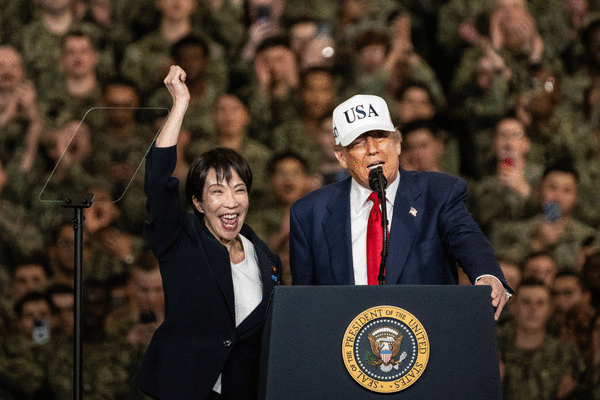
Prime Minister Sanae Takaichi faces a diplomatic balancing act at a summit this week with Donald Trump, after the U.S. president called on Japan to deploy warships to help secure the war-stricken Strait of Hormuz — before abruptly dropping the demand.
Takaichi’s first trip to Washington on Thursday since winning a sweeping mandate has been viewed by Tokyo as an opportunity to showcase the strength of the U.S.-Japan alliance, despite challenges over trade. Perhaps more importantly, it was a chance to gain the president’s ear before his meeting with Chinese leader Xi Jinping.
Instead, a showdown over Iran is dominating the conversation. Trump’s call for Japan and other U.S. allies to send battleships into the Middle East handed Takaichi a nearly impossible request — then on Tuesday, Trump angrily withdrew that call, after a lack of support. While most of his ire appeared reserved for NATO allies, he also named Japan in a social media post declaring the U.S. didn’t “NEED THE HELP OF ANYONE!”
Further complicating Takaichi’s trip, Trump has postponed his visit to Beijing because of the Iran war.
“Takaichi has built a strong relationship with Trump,” said Bloomberg Economics’ Adam Farrar. “The question is whether she can craft an approach that advances Japan’s interests while still placating Trump’s tendency to lash out when he feels partners are not pulling their weight.”
World leaders from the U.K. to South Korea, who responded with chilly caution to his warship request, will be watching for how Takaichi manages the fallout, marking a key test of her leadership on the world stage.
Adding to the tensions, Japan is still in the firing line of Trump’s tariff campaign. That includes new global investigations by the U.S. designed to impose duties on imports from countries deemed to have unfair trade practices, which are poised to replace levies struck down by the U.S. Supreme Court.
Trump has displayed a willingness for publicly confronting leaders who defy him, most famously in an Oval Office showdown with Ukraine’s Volodymyr Zelenskiy. While Takaichi arrives on far firmer footing with the Republican leader — who endorsed her election bid and has lauded her as “beautiful” — he’s also harbored a grudge against Japan for decades for a perceived dependence on the U.S. military.
Takaichi has so far avoided expressing support for the U.S.-Israeli war with Iran. Part of that calculation is potentially far-reaching economic consequences because of Japan’s reliance on oil from the Middle East and its historical ties to Tehran. Japan’s tight constitutional limits on deploying its military overseas also make it hard for Takaichi to consent to the dispatch of naval assets to a conflict zone.
“Takaichi is being squeezed between the legal limits of Japan’s security framework and the political expectations of President Trump,” said Kenichi Doi, a senior research fellow at the Institute of Geoeconomics in Tokyo.
‘A Little Backbone’
Trump’s frustrations for what he sees as Japan’s over-reliance on the U.S. military goes back decades. In 1987, he took out a full-page national newspaper advert berating Tokyo for relying on American military might to secure oil from the Middle East. That missive called for U.S. defense policy to have just a “little backbone.”
Since then, Japan has deployed military assets to the Middle East, although never during an active conflict. Japan’s first overseas deployment since World War II was the dispatch of minesweeper ships to the Persian Gulf in April 1991 — a month after the U.S. concluded Operation Desert Storm, which ended the Gulf War.
Takaichi has ruled out a similar deployment this time around.
One key difference with the current war is that the U.S. didn’t inform its allies or build consensus, said Kunihiko Miyake, a former Japanese diplomat who served in Iraq and China. “Japan must do what it can, but it’s still too early to discuss joining a coalition because it’s not even clear whether such a coalition can actually be formed,” he said.
Trump has recently praised Takaichi’s desire to build-up Japan’s military strength as a bulwark against China, however, and some political analysts see the president’s change of strategy over the Strait of Hormuz as clearing the way for a more productive summit.
“It takes some pressure off of the summit and allows the two leaders to engage broader set of topics and have a discussion about Iran without focusing on a very specific demand from Trump,” said Jacob Stokes, a senior fellow and deputy director of the Indo-Pacific Security Program at the Center for a New American Security.
Still, Trump earlier said he was looking for “great enthusiasm” from partners about participation — meaning Takaichi could still face pressure to suggest something. One possibility could be offering logistics support for refueling and stocking ships, while staying out of the conflict zone. Alternatively, she could pledge contributions for when the situation moderates.
Any moves from Japan risk inflaming ties with China, a longtime friend of Iran that’s repeatedly warned against Japan’s return to “militarism.” Beijing is ramping up a campaign of economic and diplomatic coercion on Tokyo, in a bid to force Takaichi to reverse her remarks on Taiwan, which the Chinese Communist Party considers its own despite never having ruled it.
“With hostilities deepening between Tokyo and Beijing, Takaichi would like Trump to weigh in on Tokyo’s behalf,” said Emma Chanlett-Avery, deputy director of the Asia Society Policy Institute. Failing that, she could appeal to Trump against making “concessions on Taiwan that would further rattle the region.”
For Takaichi, staying on safe ground such as her U.S. investment program worth $550 billion will be key to ensuring a smooth trip. Japan has pledged up to $36 billion in U.S. oil, gas and critical mineral projects as part of that program, with more cooperation on rare earths in the pipeline.
Deflect and delay will likely be Takaichi’s strategy to fielding Trump’s requests on Iran, said John Nilsson-Wright, professor of Japanese politics at the University of Cambridge.
“Japanese public opinion would not really tolerate anything more ambitious,” he added. “There’s no real precedent for Japan providing combat support.”
____
(With assistance from Colum Murphy, Yoshiaki Nohara, Rebecca Choong Wilkins, Akemi Terukina and Paul Jackson.)
©2026 Bloomberg L.P. Visit bloomberg.com. Distributed by Tribune Content Agency, LLC.




Comments