More than $30M in outside spending shaped Illinois primaries, but wins were a split for big-monied interests
Published in News & Features
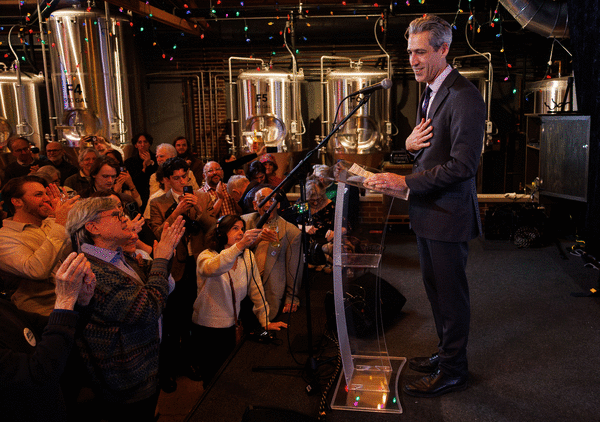
The flood of outside money that reshaped Illinois’ Democratic primaries on Tuesday delivered uneven returns for the big-money interests that fueled it.
So-called super PACs, or political action committees with unlimited raising and spending power, and aligned organizations poured nearly $33 million into four closely watched Chicago-area congressional races — an unprecedented sum for House primaries in the state. Outside groups spent about $23 million in the Democratic Senate primary, according to Federal Election Commission filings.
Much of that spending came from groups tied to the American Israel Public Affairs Committee, or AIPAC, as well as major investments from cryptocurrency and artificial intelligence advocacy groups.
But despite the scale of that spending, victories were far from guaranteed.
The preferred candidates of AIPAC or closely tied PACs prevailed in two Chicago-area Democratic congressional primaries and lost in two others, including the high-profile 9th Congressional District contest where Evanston Mayor Daniel Biss defeated AIPAC-supported state Sen. Laura Fine as well as progressive commentator Kat Abughazaleh.
Other well-funded efforts fell short.
Fairshake, the pro-crypto political group, spent close to $10 million opposing Lt. Gov. Juliana Stratton in the Democratic primary for retiring U.S. Sen. Dick Durbin’s seat. Stratton still secured the nomination. The group also spent nearly $2.5 million opposing state Rep. La Shawn Ford, who Democrats nominated to succeed retiring U.S. Rep. Danny Davis in the 7th District, though the crypto industry’s smaller investments appeared to pay off in the 2nd and 8th districts.
While Stratton beat back spending from Fairshake, as well as massive individual fundraising from second-place finisher U.S. Rep. Raja Krishnamoorthi and additional outside spending including more than $1.1 million from an affiliate of the nonprofit Indian American Impact, she benefited from $12.2 million in spending on her behalf by Illinois Future PAC, a group staffed by veterans of Gov. JB Pritzker’s political operation and funded by a $5 million contribution from the governor.
And Think Big, a pro-artificial intelligence group, went 1-for-2, with former U.S. Rep. Melissa Bean earning the Democratic nod in the 8th District and former U.S. Rep. Jesse Jackson Jr. losing to Cook County Commissioner Donna Miller in the 2nd District. Think Big spent more than $2.5 million across those two races, with slightly more spent in the 2nd District.
“Money isn’t everything, but it’s still really important. Most of the people who won were still prolific fundraisers even if they got outspent by super PACs or other groups,” said Alisa Kaplan, executive director of Reform for Illinois.
Asked at an unrelated event on Thursday whether Democratic candidates should accept AIPAC support, Pritzker said candidates shouldn’t accept money from organizations they don’t agree with and then change their positions.
“But if you’re in agreement with the position that they’re taking already, then it seems to me like in this world of way-too-much special interest money, it’s probably OK to accept that money,” said Pritzker, coming off a major political win in his support for Stratton.
“Including AIPAC or any other,” he added after a follow-up question.
With the key groups that poured an unprecedented amount of money into four Chicago-area congressional primaries seeing mixed results, the response across the Democratic political spectrum reflected the divided political positions that exist within the party.
“KAT ABUGHAZALEH NARROWLY LOSES PRIMARY, BUT SO DOES AIPAC,” the group Justice Democrats proclaimed in a press release late Tuesday, pointing to Fine’s third-place finish behind Abughazaleh, whom the progressive organization endorsed and AIPAC strongly opposed.
On social media, AIPAC said it was disappointed by Fine’s loss but touted that “voters rejected two anti-Israel candidates” in Abughazaleh and school board member Bushra Amiwala, who received about 5% of the vote in the North Side and north suburban 9th, according to unofficial results from The Associated Press.
“We were especially proud to help defeat Abughazaleh, who centered her campaign on attacking Israel and demonizing pro-Israel Americans,” the organization wrote.
Biss, who was backed by the more liberal pro-Israel group J Street and frequently criticized AIPAC’s role throughout the campaign, took credit at a brief postelection stop on Wednesday.
“We really told the story of what was happening and why,” Biss said of his campaign. “The people of this district, I think, knew what the story was, and therefore rejected it.”
“My recommendation to candidates across the country would be, be clear, tell that story, explain what’s going on. Voters — respect voters’ intelligence, and tell them the truth. But if they don’t know the truth, they can’t act on it,” he said after greeting people at the Davis “L” stop in Evanston.
Overall, PACs directly or indirectly associated with AIPAC spent close to $20 million across the four congressional races, forming the largest single bloc of outside spending in the primaries.
In each House race, one candidate benefited from a combination of direct contributions from people who had recently contributed to AIPAC or its affiliated super PAC, and heavy independent expenditures from super PACs that appeared to be tied to AIPAC. Neither AIPAC nor Chicago-based leader Martin Ritter responded to repeated questions during the campaign about ties to several high-spending entities that did not explicitly disclose connections.
The results were mixed.
Miller and Bean — candidates who appeared to have AIPAC’s support in, respectively, the South Side and south suburban 2nd District and the mostly northwest suburban 8th District — won their primaries. But Fine and Chicago Treasurer Melissa Conyears-Ervin lost in their races in the 9th and 7th districts, respectively, despite similar backing.
In the 8th and 9th district races, yet another super PAC that opponents said was tied to AIPAC spent about $1.9 million specifically opposing Abughazaleh and tech entrepreneur Junaid Ahmed, both of whom lost.
Asked about support from AIPAC-linked groups and individuals, Miller has said she didn’t coordinate with the groups, but aligned herself with one of AIPAC’s top goals: securing more military aid to Israel.
In Miller’s 2nd District, Fairshake, which is heavily backed by venture capitalists Marc Andreessen and Ben Horowitz, also spent $817,000 against state Sen. Robert Peters, who was endorsed by the Congressional Progressive Caucus and finished in third place. And one of Fairshake’s affiliates spent $557,000 in favor of Bean in the 8th.
“Illinois voters have elected more pro-crypto members of Congress and we are just getting started in our nationwide fight for American innovation,” Fairshake spokesperson Geoff Vetter said.
Josh Vlasto, co-head of Think Big and the affiliated pro-artificial intelligence PAC Leading the Future, congratulated Bean in a social media post and said his group “looks forward to working with leaders who will prioritize innovation over doomerism.”
Bean, like Fine and many other Democrats on the primary ballot, has said she would support campaign finance reform and greater transparency.
“At the same time, we have some folks out there making pledges. ‘I don’t want anybody to support me,’ or whatever. I just don’t think we as Democrats should tie our hands behind our back,” Bean said on WCPT-820 before the election. “One of us is going to prevail and run against potentially a very well-funded Republican, and so we shouldn’t tie our hands behind our back, when the Republicans are not calling for that.”
Asked about whether AIPAC support contributed to her win on Tuesday, Bean told reporters that people chose her because of her record.
The sheer volume of spending raised questions about whether additional dollars translated into meaningful gains with voters.
While outside groups saturated airwaves and digital platforms with ads, turnout remained low — a dynamic that watchdogs and reform advocates have increasingly highlighted.
“All this money isn’t getting people excited and motivated to vote for these candidates,” Kaplan said. “It’s exhausting and stressful.”
For organizers like Alex Nelson of IfNotNow, a group of progressive American Jews opposed to U.S. military aid for Israel, the results underscored both the power — and limits — of outside spending.
Money “obviously had a huge influence across the board,” Nelson said, but it was different in each race.
Nelson was among several protesters arrested last week during a demonstration in a hallway outside AIPAC’s downtown office in an act of civil disobedience. She wore a black shirt that read, “Voters over billionaires.”
“This is a corruption of our elections. Save democracy,” she said as an officer escorted her away, her hands cuffed behind her.
Despite the scale of outside spending, Nelson argued, the mixed outcomes on Tuesday point to how local groups should fight against big money in the future. Activists can talk to their communities about anonymous groups and show up in person for their neighborhoods, as they did in last year’s aggressive federal deportation raids, Operation Midway Blitz, she said.
“AIPAC is not going to show up … at a street corner if somebody is being kidnapped by federal agents and start blowing whistles,” Nelson said. “The money that comes in can’t completely overwrite the community structures that we’ve built.”
Voters are looking for “not just a politician but a public servant and someone that’s willing to speak truth when lies are being told,” Ford, whom Davis endorsed, said in an interview Wednesday. Fairshake targeted Ford with an ad campaign that highlighted criminal tax charges from 2012. The commercials did not mention that two years later, all felony counts against Ford were dropped without explanation, and that Ford pleaded guilty only to a single misdemeanor tax charge, resulting in probation.
“We had a strong case to make with 19 years of dedicated service to our constituents, where we proved our loyalty to the people and not special interests,” he said. “That is a lesson that we should not forget.”
Looking ahead to the general election, which Ford will be heavily favored to win in a district stretching from downtown Chicago to the South Side, West Side and west suburbs, Ford told reporters Tuesday night: “I’m not afraid of their PAC money.”
____
(Chicago Tribune’s Christy Gutowski contributed.)
____
©2026 Chicago Tribune. Visit at chicagotribune.com. Distributed by Tribune Content Agency, LLC.




Comments