Epstein's ties to Arab royals: An offer to tutor crown prince, a gift from Mecca
Published in News & Features

In his attempts to position himself at the confluence of money and power, Jeffrey Epstein cultivated myriad relationships among the ruling elite of the Middle East, according to an extensive Miami Herald review of several million pages of documents recently released by the U.S. Justice Department.
From his Palm Beach and New York mansions and his luxurious apartment in Paris, Epstein enjoyed a remarkable level of access to sensitive information like the outcomes of political meetings and the itineraries of Gulf royals.
The disgraced financier, the Herald found, regularly corresponded with members of the ruling classes in Saudi Arabia, Qatar, Yemen and the United Arab Emirates. He invited them to his properties and gave them business advice — even suggesting to Saudi palace officials that he tutor the crown prince about the ways of Wall Street.
He asked that he be given a “small palace” to live in while schooling the prince and demanded that the Saudis give him sweeping oversight over the kingdom’s fortunes.
When Qatar was accused of supporting Al Qaeda and the Islamic State, Epstein detailed to a Qatari royal a four-point campaign on how the country could clean up its image. Epstein also intervened on behalf of a Yemeni billionaire’s son to help him fight murder and rape allegations in Britain.
Nor did his time in the Palm Beach County stockade stop Epstein. While serving an 18-month sentence after pleading guilty to two prostitution charges in 2009 in a well-documented sweetheart deal where he could leave the jail for 12 hours a day, Epstein helped an Emirati businessman lobby the British government to construct a megaport outside London. Epstein hosted him in his Palm Beach mansion a few months after his release.
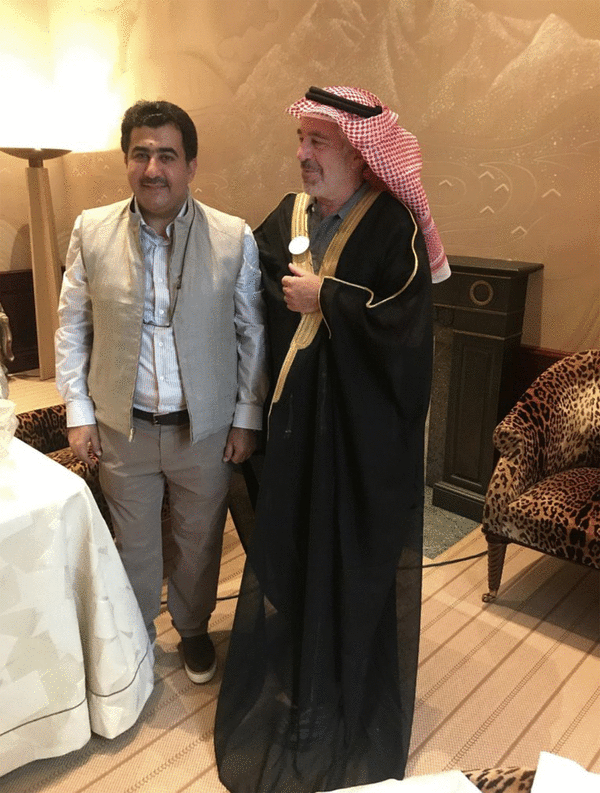
Epstein also seemed to revel in being photographed with the royals, grinning broadly as Crown Prince Mohammed bin Salman of Saudi Arabia stands side by side with him, his arm draped over the disgraced financier. In another photo released by the U.S. House Oversight Committee, Epstein appears to be garbed in traditional Arab black-and-gold robes and a red-and-white headdress known as a Shemagh.
For his efforts, Epstein got lavish gifts from the Middle Eastern elite, including sacred Islamic drapes from Mecca that he had shipped to Miami, the records show. Epstein later sent the gifts to his private island in the Caribbean, where he allegedly preyed upon countless women and girls.
Many of the influential Arabs Epstein corresponded with held him in high regard, at times calling him “Sheikh Jeffrey,” “cousin brother” and “habibi” — Arabic for “loved one.” But while they likely believed their conversations with the financier were private, the Herald found Epstein had little qualms in repeating what he had heard to others, even if the person was from another country.
While Epstein kept abreast of political and business developments in the Middle East, his sexual proclivities were never far from his mind.
“She wanted some BUSINESS! while I only wanted some PUSSYNESS! [sic.]”, Sultan bin Sulayem, an Emirati businessman, wrote to him in a 2013 email after meeting an unnamed woman in New York.
“Praise Allah, there are still people like you,” Epstein replied.
Offer to Saudi crown prince
Epstein was introduced to Raafat Al-Sabbagh, a close advisor of Prince Mohammed bin Salman, the crown prince of Saudi Arabia, in 2016 by Norwegian diplomat Terje Rød-Larsen.
Correspondence between Epstein and Al-Sabbagh shows them meeting and inviting each other to their homes, even though Al-Sabbagh was aware of Epstein’s reputation.
“I am sure you are opening so many legs there,” he wrote in a 2016 message to Epstein, who was in Florida at the time.
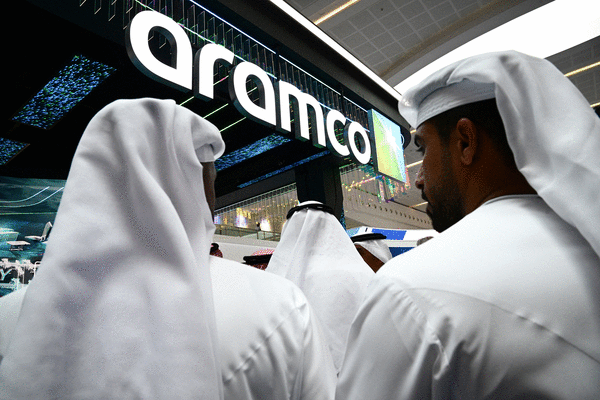
Around this time, Prince Mohammed had announced his Vision 2030 project to diversify the kingdom’s economy and make it less reliant on oil. Central to this plan was publicly selling shares of Saudi Aramco — the state energy company.
But a flurry of messages from Epstein to Al-Sabbagh and his assistant shows how Epstein found the idea to take Aramco public to be “silly” and warned that Wall Street viewed it as “taking a cow to slaughter.”
“Shareholders are the last thing the kingdom [Saudi Arabia] needs,” Epstein wrote in an Aug. 15, 2016, email to them.
Among Epstein’s chief concerns about an Aramco stock listing in New York was the passage of a U.S. federal law in 2016 that allows American citizens to sue foreign countries for terrorist acts.
The nightmare scenario, according to Epstein’s September 2016 email to Al-Sabbagh’s aide: A U.S. lawsuit claiming reparations for 9/11 gets a $50 billion judgment and “some crazy judge” attaches the kingdom’s shares in Aramco to fulfill it, essentially making the shares “worthless.”
Epstein advised the Saudis take steps to protect their assets from American courts. Epstein visited the Saudi capital of Riyadh in early November 2016, the released records suggest.
A few days later, he wrote to Al-Sabbagh’s assistant making a sweeping proposal — that he be made “financial confidant” to Prince Mohammed and become a major contributor to the economic restructuring of the kingdom. He asked for 30-minute biweekly meetings with the prince and demanded he be given powers to review all financial aspects of the country.
Epstein also claimed that the prince had asked that he be allowed to see details of legal structures, organization charts, goals and initiatives of the Saudi central bank, the royal purse and the country’s sovereign wealth fund, his emails to Al-Sabbagh’s aide show.
He offered to work for free for the first year but was hoping, the records show, to be able to live in a “small palace” during his stay in the country.
“I am happy to represent KSA [Kingdom of Saudi Arabia] interests,” he wrote in a message to Al-Sabbagh’s aide on Nov. 9, 2016.
Aramco was listed in the stock exchange three years later but in Riyadh, not New York. The records do not show if Epstein’s advice was considered by the Saudi rulers. The records also do not indicate whether the Saudis passed any information about their country’s finances to him.
But four months after Epstein’s trip to the kingdom, a British Airways plane carrying a shipment from Riyadh landed in Miami International Airport.
The cargo comprised parts of the “Kiswa,” the sacred black silk, embroidered with verses from the Quran in gold, that is draped over the Kaaba in Mecca — Islam’s holiest site.
It was a gift from the Saudis. Its final destination: Little Saint James — Jeffrey Epstein’s secluded 72-acre private island in the Caribbean.
Epstein’s staff, the records show, described the sacred drapes as “pieces from the Kaaba” and classified them as “artwork” to ensure that they passed easily through U.S. customs in Miami.
Other gifts included a traditional Bedouin tent and tables, cushions and carpets that Epstein later set up on his island.
The Herald was not able to contact Al-Sabbagh. The Saudi government did not provide answers to the specific questions sent by the Herald about Epstein’s trip to the kingdom, his relationship with Al-Sabbagh or how he demanded oversight of the country’s financial system.
A Saudi source familiar with the matter only said that meetings with public officials are typically introductory and do not imply any ongoing relationship and that exchanging gifts is a common practice.
“Epstein was responsible for serious crimes that caused significant harm to many victims,” he said. “He was known to exaggerate and misrepresent his connections.”
Helping suspected murderer and rapist
Epstein first got acquainted with Yemeni billionaire Shaher Abdulhak in the spring of 2012.
Abdulhak, at the time, was in a fix.
His son, Farouk, was a suspect in the rape and murder of 23-year-old Norwegian student Martine Vik Magnussen in London in 2008. According to the British press, British authorities wanted him for questioning, but Farouk had fled to Yemen.
Epstein, the records show, claimed to have facilitated an introduction with British attorney Lord Ken Macdonald, who had previously served as the top prosecutor in England and Wales.
Epstein told Abdulhak in a June 2012 email that he had spoken to Macdonald, who believed that Farouk could get a reduced charge and be granted bail, records show. Epstein advised Abdulhak to focus on “what punishment would be acceptable.”
“I think you are right, something like house arrest, plus charity work,” Abdulhak replied.
“I have no recollection of the single telephone call I seem to have received from Jeffrey Epstein and I had no dealings with him prior to it and none afterward,” Macdonald told the Herald. “He was never my client and I have never met him.”
The attorney said that his fees were paid by Abdulhak, not Epstein. He “would never have told Epstein that Abdulhak’s son would have got bail,” he added.
“I expect Epstein was embellishing our conversation for his own purposes,” he said.
The records do not detail what happened next.
Farouk is still in Yemen and remains wanted in the United Kingdom, according to the British press.
Around the same time Epstein was helping Abdulhak with his son, the Arab Spring reached Yemen. That led to the ouster of Abdulhak’s friend, President Ali Abdullah Saleh. In the next few years, a power-sharing agreement between the Yemeni government and the Iran-backed Houthi rebels broke down. A Saudi Arabia-led alliance intervened against the rebels, precipitating a civil war.
In 2018, Abdulhak called Epstein a potential “peace maker in Yemen” and requested him to speak to Saudi Crown Prince Mohammed to freeze bombing for four days so Abdulhak could navigate the various factions and broker a peace deal.
Whether Epstein ever corresponded with the prince about Yemen is not known.
There was a brief ceasefire in the country that year, but it was brokered by the United Nations, not Epstein.
Abdulhak passed away in 2020. The civil war is still ongoing.
Epstein and the World Cup
Epstein’s involvement with Abdulhak was not the only time the financier waded into political affairs of the Middle East.
Qatar was in the midst of an international crisis in 2017: An alliance of Arab states led by Saudi Arabia had initiated a de facto blockade claiming that Qatar was funding terrorist organizations like Al Qaeda and the Islamic State — an allegation the country steadfastly denied.
Epstein had advice for Jabor Yousuf Al-Thani, a member of the Qatari ruling family.
“[Q]atar should stop kicking and arguing,” he wrote. “Qatar needs to come out against terrorism LOUD … FM [Foreign Minister Sheikh Mohammed Al-Thani] is not experienced and it shows.”
Epstein’s suggestions: Recognize Israel; put $1 billion into a “fund to benefit the victims of terrorist acts” that would be administered by the U.S., U.K. and the United Nations; pay for electricity in Gaza; and support an international committee to look into terrorism financing around the world.
Al-Thani, whom Epstein knew from at least 2012, agreed with some of Epstein’s views, their correspondence suggests. But whether they were conveyed to the foreign minister or Qatar’s leader, Emir Tamim bin Hamad Al-Thani, is unclear.
Epstein was also in frequent correspondence with Anas Al-Rasheed, an academic and former information minister of Kuwait, which was mediating between Qatar and the other Arab countries.
Epstein, the records show, tried to initiate a back-channel meeting between the Saudi crown prince and Qatar’s ex-prime minister.
“I know that HBJ [Qatar’s Hamad bin Jassim Al-Thani] would like to sit with MBS [Crown Prince Mohammed bin Salman] in a face to face [sic.],” Epstein wrote in a July 4, 2017, email to Al-Rasheed. “I think it would be a good step.”
It is unclear whether such a meeting ever took place. The crisis was finally resolved in 2021, long after Epstein was found dead in federal custody on Aug. 10, 2019.
Epstein also facilitated a meeting between former Israeli premier Ehud Barak and Qatar’s former prime minister Emir Hamad bin Jassim Al-Thani in the winter of 2018 in Knightsbridge, an upscale neighborhood in London.
The released records show that Barak had made a pitch to the Qataris.
Carbyne, an Israeli tech startup for which Barak was a lead investor and board chairman, wanted to provide security services and anti-drone technology when Qatar hosted the soccer World Cup in 2022. Barak was cognizant of how the Arab populace would perceive Israeli involvement.
“We can work through a European company of your choice and minimize Israeli profile,” he wrote.
What neither Barak nor Epstein mentioned was that at least $1 million of Barak’s investment in Carbyne had come from Epstein’s Southern Trust Company.
Bruce Goodman, an attorney for Barak, told the Herald that Barak had conducted some “preliminary due diligence” to explore whether Carbyne could support security at the World Cup but it “quickly became clear that the company was not suited for that role.”
He said Carbyne did not pursue a bid and added that all of Barak’s activities were conducted in compliance with all laws.
Qatar’s embassy in Washington and the country’s International Media Office, which handles all press requests, did not respond to the Herald’s queries. The Herald also tried to contact Al-Thani through Seib Insurance, on whose board he sits, but did not receive any response.
From Dubai to London
Sultan Ahmed bin Sulayem, then chairman of DP World, Dubai’s primary cargo logistics company, emailed Epstein on May 9, 2009.
At the time, Epstein was serving his 18-month sentence in the Palm Beach County stockade but was allowed to spend 12 hours a day, six days a week, in his office under a work-release program his attorneys had negotiated.
Bin Sulayem, who had a years-long relationship with Epstein, was in a fix. The 2008 global recession, triggered by the U.S. subprime mortgage crisis, had dried up the funds for DP World’s $3-billion project to build the London Gateway, a commercial megaport roughly 30 miles east of the British capital.
“The project is now on hold,” bin Sulayem wrote in a memo to Epstein on May 9, 2009. “We would like U.K. Government support to fund this immediate of site infrastructure [sic.].”
Epstein forwarded the memo to Lord Peter Mandelson who said he would speak to bin Sulayem. Mandelson was the U.K.’s business secretary at the time.
Other correspondence — many after Epstein’s release in July 2009 — show him triangulating communications between the British bureaucrat and the Emirati businessman.
In a November correspondence, Epstein edited a letter bin Sulayem sent Mandelson demanding funding guarantees from the U.K. government.
“Unfortunately without such assurance [that the U.K. government would cover any funding shortfall], the viability of the Project remains uncertain,” the letter said.
The records do not reveal what conversations Mandelson may have had with the country’s financial institutions about the project and what role Epstein may have played in them. The Royal Bank of Scotland was the only British institution that participated in the roughly $800-million financing package put together by a consortium of global banks.
“Im [sic.] proud of you,” Epstein wrote in an email to bin Sulayem after the public announcement of the opening date for the port in 2011.
British authorities arrested Mandelson earlier this year for allegedly passing sensitive government information to Epstein while serving as business secretary. Mandelson has not been charged and is currently out on bail.
The Herald sent questions to the attorneys representing him but did not receive any answers.
Epstein, whose relationship with bin Sulayem began before the financier’s arrest in Florida in 2008 on the prostitution charges, met and corresponded with the Emirati for more than a decade.
Bin Sulayem sought to introduce the financier to Sheikh Hamdan bin Mohammed Al-Maktoum, the crown prince of Dubai and shared the prince’s contact information with him, the records show.
Whether the prince and the financier ever spoke is unclear.
Bin Sulayem also often kept Epstein abreast of sensitive meetings between the United Arab Emirates and heads of other countries, like Vladimir Putin and Dmitry Medvedev of Russia.
Bin Sulayem stepped down from his post as DP World’s chairman and chief executive in February this year, following immense pressure regarding his relationship with Epstein.
Neither the Emirati embassy in Washington nor DP World responded to the Herald’s queries. The Herald also attempted to reach bin Sulayem through an email ID that was released along with the records but did not receive any response.
Among the last correspondence Epstein had about the Middle East is a chat with far-right provocateur Steve Bannon in June 2019.
They were discussing the arrest of George Nader, a Lebanese-American businessman and once advisor to the U.A.E, for possession of child pornography.
“Can you imagine,” Epstein wrote. “He [Nader] actually, literally, had pictures of some kid f---ing a goat.”
Epstein himself was arrested by federal agents in New York just a month later on sex-trafficking charges. He was found dead on Aug. 10, 2019 in a federal detention center in Lower Manhattan.
©2026 Miami Herald. Visit at miamiherald.com. Distributed by Tribune Content Agency, LLC.




Comments