Inside Alligator Alcatraz, Rep. Wasserman Schultz finds men crammed in cages, smell of urine, inadequate food
Published in News & Features
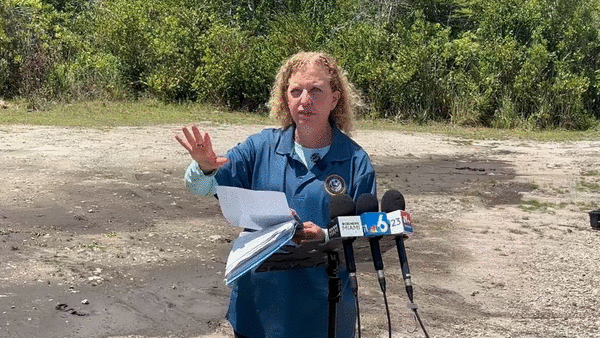
FORT LAUDERDALE, Fla. — After three hours inside the confines of the immigrant detention center in the Florida Everglades on Thursday, U.S. Rep. Debbie Wasserman Schultz said she discovered needlessly inhumane conditions, including 32 men housed in each cage, minimal food, and a persistent odor of urine.
“Everything about this screams inhumane and unnecessary, and the cruelty is the point,” the Florida Democrat told reporters after touring the detention center “unfortunately known as Alligator Alcatraz by the cynics who run it.”
She described it as “a violation of people’s human rights.”
The inside view came after Wasserman Schultz showed up unannounced, and demanded a tour of the facility that the state built and operates for the federal government. Congressional oversight tours are allowed under federal law, and about the only positive thing she shared about the experience was that staff at the facility complied.
The congresswoman said she only had to wait about 15 minutes, which suggests she had an unsanitized view of what was going on inside because, she said, they didn’t have a chance to clean up.
Aides accompanied Wasserman Schultz to the site, but she toured the facility alone, without her staff.
There were 1,499 detainees at the facility on Thursday based on numbers Wasserman Schultz was given. Of those, 37% were categorized as “low risk,” 35% “high risk,” and the rest at levels in between.
She said 360 of the detainees were older than age 55, and 59 were younger than 22. Almost all were Hispanic.
Most detainees are in one large tent, in multiple fenced-in areas, each of which houses 32 men.
“They are literally housed in cages with 3 small toilets that essentially require them to urinate and defecate out in the open. There’s a small little wall that blocks the toilet, but if you are using the facility, then you are having to do that in front of the 31 other people that are in your cage,” she said. “The caged dorm area smells like urine. It was very humid. There was no privacy, and it was wall-to-wall men, and just a very disturbing environment.”
There was feces around the toilets, she said.
“Every single individual in this facility is a man, and the small portions of food, I don’t see how possibly they are appropriately providing nutrition,” she said. “Lunch was a small turkey sandwich, a bag of chips, and a Nutri-Grain bar.”
The Florida Department of Emergency Management, the state agency assigned to establish and run the facility, said the facility is run according to federal ICE standards.
“In compliance with ICE detention standards, each section of the facility has no more than 32 detainees. Detainees are provided meals based on ICE detention dietary standards and all handling of food is also in compliance with those standards as well. Toilets are cleaned daily. Each toilet area is separated by a privacy wall, making it impossible to see them from outside the pod,” the agency’s director of communications, Stephanie Hartman, said via email.
Wasserman Schultz also:
— Faulted the state and federal governments for a lack of transparency about what is happening at the facility, including the costs, how decisions are made to send people there, and how people’s security risk level is determined.
— Said she was shown around by people from the state and private contractors and told ICE “has a permanent daily presence there, which of course they’ve been denying in court.” After they went to “all of the places in the facility I wanted to see, they told me ICE was refusing to talk to me.”
— Brought signed detainee privacy releases, but “they refused to let me talk to any of the detainees.” She said that was an essential missing element of the tour, which would have allowed her to get a balanced view of what’s happening there. “That is unacceptable.”
— Said she saw a group of detainees playing soccer in a caged recreation area. But for most, in the cages, she “saw people in varying stages of lethargy and discomfort.” Wasserman Schultz, who speaks Spanish, said some men leaning up against cage walls were calling out to her or the guards, “ICE release me and I want to go home and things like that.”
Environmental organizations have challenged the siting of the facility, at the site of the former Dade-Collier Training and Transition Airport in Ochopee. Wasserman Schultz said she was driven around the perimeter of the facility, at her request, but was unable to assess if there is environmental damage beyond the airport site.
Republicans have consistently defended the operation, which was conceived by state Attorney General James Uthmeier, who was appointed by Gov. Ron DeSantis.
DeSantis hosted Trump for a tour of the facility on July 1 and detainees began arriving on July 3.
Democrats, who have sometimes been blocked from inspection visits of ICE facilities, have been showing up at some of its locations in recent days. Wasserman Schultz said her timing was motivated by wanting to show up without the agencies getting wind that she was coming.
©2026 South Florida Sun-Sentinel. Visit sun-sentinel.com. Distributed by Tribune Content Agency, LLC.






Comments