Snowpack peak falters; all-time low for Colorado River on the table
Published in News & Features
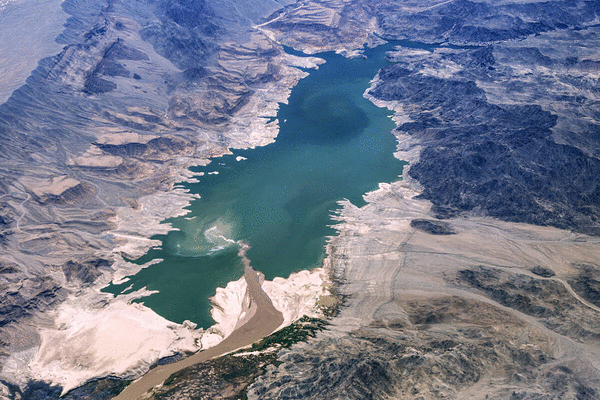
The outlook for Southern Nevada’s lifeline has only worsened as the Colorado River heads into runoff season.
Colorado Basin River Forecast Center hydrologist Cody Moser said in a webinar this week that if conditions persist as expected, it’s possible that runoff into Lake Powell could be under the lowest year on record, 2002, which is largely considered the year that ushered in a new era of modern mega-drought.
Currently, the most probable forecast shows 1.4 million acre-feet of water flowing into Lake Powell, which would be the third lowest amount on record. But that could change fast, Moser said.
“If we were to see 2002 precipitation and temperature from now through the end of July, that would result in a new record low,” Moser said.
Snowpack across the region has been puny this season, and unseasonably early March temperatures accelerated the snowmelt. According to meteorologists, the larger American Southwest had its warmest March since 1895.
April 1, which is traditionally the date water managers use to determine where the summer is headed, delivered record-low snowpack numbers. According to federal scientists, most basins in the West peaked between 21 and 34 days early.
Every state in the Colorado River Basin except California had its most meager April 1 snowpack reading on record since surveys began in the 1980s. Those states include Nevada and Arizona. California had its second lowest snow reading for that date.
Numbers have come in low for both the Sierra Nevadas and the Rocky Mountains, where the headwaters of the Colorado River are.
“The numbers are not looking good,” said Nels Bjarke, a research scientist with the Western Water Assessment at the University of Colorado, Boulder. “A combination of a very dry March with all of the heat that we experienced is hastening the melt in the month of March, which means that the forecast at the beginning of April is even more dire than it was before.”
It’s an especially concerning scenario to come this year, when the seven states that share the Colorado River are nearing a point of no return where the federal government could impose a 20-year deal that assigns reductions. That route would almost certainly lead states to the U.S. Supreme Court.
Some states, led by Nevada, are pushing for a stopgap, two-year measure to stabilize Lake Powell with water from a different reservoir upstream. Because of hydrology like this year, Nevada officials say operating plans for the Colorado River should be revisited twice a year.
The Bureau of Reclamation, the federal agency tasked with managing water and dams in the West, is likely to release plans to move water into Lake Powell in the coming weeks.
Bjarke said little hope remains for any semblance of the snowpack or runoff season bouncing back.
“The notion that a wet April, May, June, is going to save us is quickly leaving the building,” Bjarke said.
___
©2026 Las Vegas Review-Journal. Visit reviewjournal.com.. Distributed by Tribune Content Agency, LLC.






Comments