Produce lobby asks US agencies to quell fears hurting sales
Published in News & Features
A major produce lobby group asked U.S. health officials to change how they communicate about a parasite outbreak that’s sickened thousands, citing battered consumer confidence and sagging sales of fruit and vegetables.
The International Fresh Produce Association asked the Centers for Disease Control and Prevention and the Food and Drug Administration to be more precise about which foods are unsafe to eat and urge Americans to keep eating fresh fruits and vegetables, the group said in an Aug. 10 letter viewed by Bloomberg News.
“Consumers need to hear clearly when there is a risk, and they need to hear just as clearly when that risk has passed and what is not implicated,” Max Teplitski, IFPA’s chief science officer, said in a statement provided to Bloomberg News. “Otherwise, people unnecessarily avoid certain fruits and vegetables even though they are safe.”
Teplitski added that the IFPA has offered to amplify federal messaging when useful.
The request highlights another point of tension between the produce industry and U.S. health officials over a cyclospora parasite outbreak. The FDA and Taylor Farms, which grew iceberg lettuce tied to the outbreak, have clashed — at times, publicly — over the other’s reaction to the spread of the foodborne illness. The dispute has mostly related to the speed of the response and accuracy of communication surrounding it.
“FDA and CDC’s top priority is protecting consumer health, and we are committed to providing clear, science-based information that accurately identifies implicated products without causing unnecessary concern over safe ones,” said Emily Hilliard, a spokesperson for the U.S. Department of Health and Human Services. “Partnering with industry stakeholders to keep Americans safe while maintaining confidence in our food supply remains a central priority now and as our investigation moves forward.”
Growers have said health officials haven’t been clear enough that most produce remains safe to eat, leading customers to categorically steer clear of fruits and vegetables. Meanwhile, Taylor Farms, an IFPA member, slow-walked its recall of tainted lettuce and released statements about the issue that stoked confusion. At one point, the company drew a public rebuke from the FDA after it incorrectly stated regulators had apologized.
The letter shows the back-and-forth has carried on behind the scenes, even as cyclosporiasis cases ebb. The IFPA pointed to internal polling that found 81% of consumers said the outbreak had affected their confidence in the safety of produce. At the same time, the IFPA said, about 70% of people said they trust public health agencies most during an outbreak.
“When confidence declines across produce categories, the cost is measured not only in lost sales but in foregone nutrition, undermining long-standing goals to increase fruit and vegetable consumption,” IFPA Chief Executive Officer Cathy Burns said in the letter.
“Our request is not for less communication, but for communications as precise, targeted and contextual as the evidence allows,” she said.
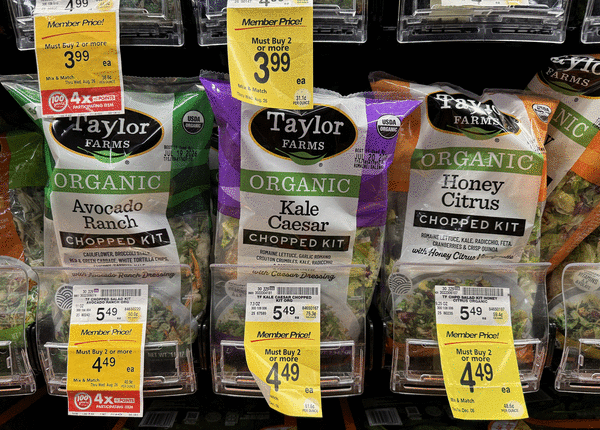
After health officials in July tied iceberg lettuce grown in central Mexico to a parasite outbreak, demand for produce plummeted, the IFPA said, citing data from Circana. Salad kit sales were down 19% that month compared with a year earlier while sales of fresh raspberries — which have not been tied to the latest outbreak — fell as much as 31%.
At least 6.5 million households paused buying salad kits and mixes in July, according to data from the market research firm Numerator. For every month the dip in buying continues, at least $280 million in spending is at risk.
The tainted lettuce has been linked to 20 states and infected more than 11,400 people, the CDC said on Thursday. Health agencies are investigating other clusters of cyclosporiasis in the U.S. The lettuce outbreak was first discovered in early July as customers who ate iceberg lettuce served by some Taco Bell locations in Michigan started to fall ill. State and federal authorities were in contact with the restaurant chain weeks before the public was alerted.
Cyclospora can cause severe gastrointestinal symptoms. Two deaths in Michigan were linked to the outbreak, in people who had other underlying health conditions.
Federal agencies are also grappling with the spread of other foodborne illnesses, including salmonella in eggs and jalapeño peppers and E. coli in frozen blueberries. The outbreaks come as agencies are short staffed following cuts to the workforce from Elon Musk’s Department of Government Efficiency and career scientists electing to leave.
____
(With assistance from Kristina Peterson, Elizabeth Elkin and Rachel Cohrs Zhang.)
©2026 Bloomberg L.P. Visit bloomberg.com. Distributed by Tribune Content Agency, LLC.






Comments