Venezuela's repressive apparatus remains intact despite prisoner releases, UN says
Published in News & Features
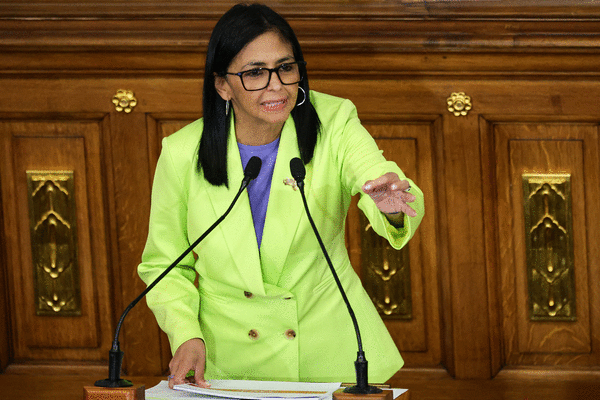
Venezuela has released hundreds of political prisoners and eased some of its harshest forms of repression since Nicolás Maduro was captured by U.S. forces in January, but the security apparatus responsible for years of torture, disappearances and other serious abuses remains largely intact, United Nations investigators said Wednesday.
The U.N. Independent International Fact-Finding Mission on Venezuela said intelligence agencies, security forces and pro-government armed groups known as "colectivos" continue to operate with many of the same structures and practices that existed before Maduro’s removal.
“The reduction in some of the harshest forms of repression is notable, but it does not yet amount in any way to a transformation of the system that made them possible,” said Sofía Macher, chair of the mission.
The report found a significant decline in long-term political detentions and related enforced disappearances following the Jan. 3 U.S. military operation that led to Maduro’s apprehension. Hundreds of people detained for political reasons were subsequently released, while authorities allowed somewhat greater space for protests, public gatherings and civil society activity.
But investigators said those changes have not been accompanied by institutional reforms. Laws used to criminalize dissent remain in force, intelligence and security agencies retain essentially the same structures and practices, and authorities have taken no steps to disarm or dismantle the colectivos.
At least 19 officials previously identified by the mission as having been involved in serious human rights violations remain in key government positions or have been reassigned to other important posts, according to the report. Journalists and other civil society actors also continue to face obstacles in their work.
The persistence of torture was among the mission’s starkest findings. Investigators documented 64 new cases of torture since Jan. 3, indicating that such practices have continued despite the broader decline in political detentions.
At El Rodeo I, a maximum-security prison, the mission documented practices including forced intubation and prolonged confinement in a sealed underground cistern known among detainees as the “time machine.”
At Fuerte Guaicaipuro, a military facility, investigators documented detainees being confined in pit-like cells dug below ground level and subjected to cold, food deprivation and other degrading treatment.
The mission also warned that hundreds of detainees continue to live in poor conditions, with severely restricted access to safe drinking water, adequate food, medicine and health care. Investigators concluded that several deaths in custody involving people detained for political reasons were linked to inadequate medical attention and mistreatment.
Among the cases highlighted was that of Víctor Quero Navas, a street vendor who died in custody while subjected to enforced disappearance. His mother, Carmen Teresa Navas, repeatedly sought information about her son but was not told of his fate until more than a year after his detention, and 10 months after his death. She died 10 days later, according to the mission.
Civil society organizations recorded at least 214 arbitrary detentions for political reasons between Sept. 1, 2025, and July 29, 2026, with 94% occurring before the end of 2025.
After Jan. 3, investigators said, a different pattern emerged: shorter arbitrary arrests intended primarily to intimidate opposition activists, journalists and other members of civil society.
Although the prisoner releases substantially reduced the number of people held for political reasons, nongovernmental organizations estimate that as many as 500 remain in detention.
The U.N. investigators said they could not establish a precise number because Venezuelan authorities have not provided transparent and verifiable information about who has been released, where those still detained are being held or their legal status.
A major portion of the new investigation focused on Venezuela’s colectivos, armed pro-government civilian groups that have operated for years in communities across the country.
The mission concluded that the groups are a central part of the state’s repressive apparatus and a broader system of local political and social control, operating with varying degrees of government support and, in many cases, in coordination with state authorities and security forces.
Investigators found evidence of longstanding relationships that included political backing, direct and indirect financing, logistical support, operational coordination and institutional protection. The mission said it had reasonable grounds to believe the government regularly supplied colectivos with firearms, ammunition, motorcycles, mobile phones and radio equipment.
The groups have carried out surveillance and intelligence work, helped security agencies identify and locate individuals they were seeking and participated in violent crackdowns on demonstrations and the selective repression of actual or perceived government opponents, according to the report.
Their influence has also extended into everyday life. Through control of community councils, public services and social programs, the mission found, some colectivos have been able to reward political loyalty and punish criticism or dissent.
Investigators also found significant overlap between the armed groups and government security forces, with members of security agencies joining colectivos and members of the civilian groups moving into state institutions.
The mission concluded that when colectivos exercise public authority granted under Venezuelan law or act under the instructions or control of government agencies, their conduct can be attributed to the state. Even when particular acts cannot be directly attributed to the government, investigators said, Venezuelan authorities have failed to prevent, investigate and punish abuses committed by the groups.
The investigators called on Venezuelan authorities to pursue accountability for past abuses, strengthen judicial independence and establish a victim-centered transitional justice process. They also urged Venezuela to reverse its withdrawal from the Rome Statute of the International Criminal Court and cooperate with international human-rights organizations.
“Years of entrenched impunity must give way to accountability,” said María Eloisa Quintero, one of the mission’s experts.
The mission also called on the United States and other governments with influence in Venezuela to press for human-rights reforms while ensuring their own policies do not contribute to violations. It urged countries to continue providing international protection to Venezuelans abroad given the conditions documented in the report.
©2026 Miami Herald. Visit at miamiherald.com. Distributed by Tribune Content Agency, LLC.





Comments