US seeks to expand passport records access for voter checks
Published in News & Features
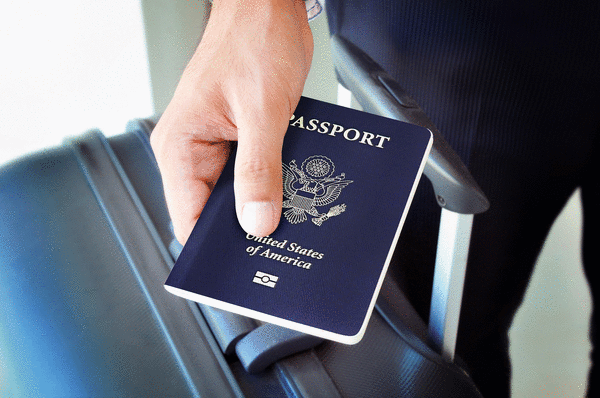
WASHINGTON — The U.S. State Department is moving to give state and local officials, as well as potentially some nonprofit organizations, access to passport records to verify voters’ citizenship.
The plan, laid out in a notice recently sent to key lawmakers on Capitol Hill, would add “voter eligibility” to the official list of “routine uses” for the State Department’s passport services records and provide access beyond government entities. Historically, uses of the data have primarily involved domestic and international government agencies and officials.
The expansion would dovetail with a controversial campaign by the Trump administration to tap into federal records to pursue election fraud investigations and aid states reviewing their voter rolls. It could give more entities access to sensitive data, which is subject to U.S. privacy laws.
The State Department’s notice, a copy of which was obtained by Bloomberg News, doesn’t specify what nonprofit groups would be eligible to gain access.
Based on bureaucratic timelines, the proposal wouldn’t take effect until after the Nov. 3 midterms, when Republicans are defending their slim majority in Congress.
Still, the changes could end up factoring in the administration’s broader push to play a bigger role in some aspects of elections. States, and not the federal government, are primarily in charge of running voting under the U.S. Constitution.
Critics allege President Donald Trump is pressing baseless claims of widespread fraud and unlawfully asserting a larger federal role in elections. Trump and his allies have advocated for more aggressive federal efforts to root out noncitizen voting and fraud. Studies in the past have shown that such incidents are relatively rare.
State Department spokesperson Edgar Vasquez said in a statement that “President Trump has been unequivocal that this administration will protect the meaning and value of American citizenship. In order to uphold the highest degree of national security, it is basic common sense for the US government to use all the information available across agencies to protect election integrity. We are laser focused on delivering results for the American people.”
A number of conservative-leaning advocacy groups have backed the Trump administration’s “election integrity” policies and some have filed lawsuits accusing Democrat-led states of failing to clean up their voter rolls.
The Justice Department notified a judge about the State Department’s plan earlier in the week in a pending fight over Trump’s March executive order directing federal agencies to play a larger role in voter verification. The department didn’t include a copy or the full text of the proposed language in the public court filing.
Anna Baldwin, director of voting rights litigation at the Campaign Legal Center, one of the groups pursuing the litigation, said they’re concerned that the State Department’s proposal is “not just unprecedented but unlawful,” given the privacy protections for personal information that Americans share with federal agencies.
“In the service of chasing this fiction of an epidemic of noncitizen voting, the administration is just determined to vacuum up data from wherever they can,” Baldwin said. “Here they’re talking about disclosing it to even nongovernmental entities.”
In addition to passport-related services, the other approved uses for these records in the past have included verifying citizenship and identity for “social security benefits, employment applications, estate settlements, and federal and state law enforcement and counterterrorism purposes,” according to the existing guidelines.
The Justice Department’s notice earlier this week came in a trio of lawsuits in Washington federal court contesting key sections of Trump’s executive order, which included instructions to create a list of U.S. citizens potentially eligible to vote using information from “relevant federal databases” to provide to state election offices as guidance.
Democratic Party leaders and organizations and voting rights advocates that sued have accused Trump and administration officials of unlawfully overstepping in an effort to assert greater federal control over elections and, in the short term, to help Republicans keep their majorities in Congress.
The judge had required the government to update the court on any “material factual developments” while the case is pending. Democracy Docket earlier reported the Justice Department’s notice.
According to the Justice Department, the State Department will formally publish the proposal in the Federal Register 30 days after it notified the congressional committees. After that, the public will get another 30 days to submit comments.
Another part of Trump’s contested order related to the U.S. Postal Service became the focus of intense legal wrangling in recent weeks. Federal judges blocked the postal agency from quickly implementing new restrictions on how it handles mail-in ballots in time for the November midterms, and the Supreme Court rebuffed the Justice Department’s request to immediately intervene.
Separately, the U.S. Supreme Court on Friday lifted a lower court block on its expansion of the Systematic Alien Verification for Entitlements, or SAVE, database to include information from the Social Security Administration as well as immigration records, and to allow states to run bulk searches.
A federal district judge in Washington had concluded that plan violated U.S. privacy laws and put Americans at risk of having their voter registrations wrongly canceled.
Hours after the Supreme Court released its order, a federal judge in Maryland heard arguments in another lawsuit challenging how administration officials are seeking to carry out Trump’s March executive order and compile citizenship lists.
With less than six weeks until the Nov. 3 midterms, states are within a 90-day window when federal law bars any program to “systematically” remove ineligible voters from their rolls, but election officials can still take steps to cancel registrations on an individualized basis.
©2026 Bloomberg L.P. Visit bloomberg.com. Distributed by Tribune Content Agency, LLC.






Comments