Lawyers offer contrasting views of South Florida pastor in Moise assassination trial
Published in News & Features
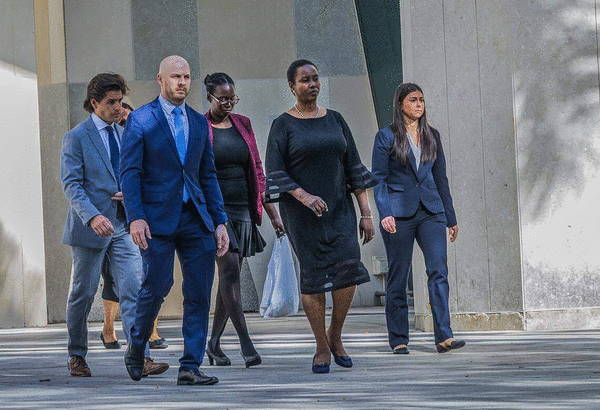
MIAMI — Lawyers in the federal trial of Christian Emmanuel Sanon painted two starkly different portraits Tuesday of the Haitian American pastor prosecutors accuse of planning and helping to execute the violent overthrow of Haiti’s government that culminated in the assassination of President Jovenel Moise.
Prosecutors portrayed Sanon, 67, as a deeply indebted man driven by “greed, arrogance and power” who traveled across Florida to film what he called “a freedom speech” and invoked Bible verses to justify Moise’s downfall and death.
“I take no pleasure in violence, but the Bible says that ... those who sow trouble reap it,” Assistant U.S. Attorney Sean T. McLaughlin told jurors, as he quoted what he described as Sanon’s words.
During a 50-minute opening statement, McLaughlin told jurors that Sanon didn’t just talk about his ambitions, he took action.
Sanon and several associates flew to Haiti from South Florida on a private jet, smuggling a handful of ballistic vests supplied by a Doral-area security company, prosecutors said. The vests, McLaughlin said, were for “a four-man Colombian mercenary team.”
Sanon, also told the team and “his Haitian underlings that President Moise must be killed,” McLaughlin said.
The group “proudly and repeatedly” discussed among themselves the importance of obtaining the support of the leaders of some of Port-au-Prince’s violent gangs to eliminate the president, the prosecutor said. Among those discussed were Jimmy “Barbecue” Cherizier, the head of the G-9 gang, and Fantom 509, a rogue outfit of disgruntled and active Haitian police offices.
Initial efforts, including attempts to kidnap Moise and have Sanon replace him, failed, McLaughlin said, but Sanon persisted.
“Sanon doesn’t give up,” the prosecutor said as he ran through key dates between January and July 2021, and showed photos of some of the individuals they will hear about during the trial. “He doesn’t pack it in. He continues.”
A different take
Sanon’s lawyers did not dispute that Moise, 53, was assassinated on July 7, 2021. But they argued in their opening statement that their client was not responsible.
As Sanon’s wife, two adult sons and grandchildren looked on from the audience, defense lawyer Humberto Dominguez presented a different portrait.
Dominguez placed Sanon’s actions in the context of the political turmoil that was engulfing Haiti in the months before Moise’s assassination, during which the president faced widespread protest and was at the center of a bitter dispute over when his presidential term was supposed to end.
“February to July, there were several coup attempts,” Dominguez said.
In February 2021, Haitian police arrested a Supreme Court justice and others in the middle of the night, accusing them of plotting to overthrow the president. The arrests later led to intensified protests against Moise, who was ruling by decree and had failed to hold elections.
“That’s basically why Mr. Sanon became interested in running for president and in the country that he loves,” Dominguez said. “He studied in the Dominican Republic, where he learned Spanish, to become a doctor. But his heart’s always been in Haiti.”
The defense attorney sought to turn the prosecution’s theme of greed, arrogance and power back onto Haiti’s political establishment and the U.S. government.
“The greed here is … all of the political families that control and run Haiti. It’s a small group,” he said. “The power of the U.S. government is the umbrella in this case.”
Dominguez also went after the credibility of the government’s cooperating witnesses, several of whom have pleaded guilty in the sprawling assassination case.
Unlike Sanon, some of them were at a mountaintop house hours before a six-car convoy drove toward the Pèlerin 5 neighborhood of the capital where Moise lived in a rented residence.
“You’re going to hear from people that the government will present who actually killed a man,” Dominguez said. “A person who kills another person, what would they not do for freedom to reduce their time?”
He also accused the prosecutors of “deliberately” presenting text messages and conversations out of sequence and urged jurors to “use your common sense” and look at the timelines and charts carefully.
“The problem with a text message is it doesn’t carry emotion,” Dominguez said. “When somebody says something, you don’t know if they’re joking. You don’t know if they’re playing around.”
Widow is first witness
Just as prosecutors did earlier this year in the trial of four of Sanon’s co-defendants who were convicted, they opened their case with testimony from former first lady Martine Moise.
She described being awakened by gunfire in the middle of the night. “He just looked at me and said, ‘Honey, we are dead,” she said about the president’s reaction.
Martine Moise then described the final minutes of her husband’s life, in which no member of his security team came to their rescue. She also spoke of her own struggle to survive after being wounded in the arm inside their bedroom.
As gunfire erupted around the house and concrete fell from the ceiling, Martine Moise said she crawled on all fours down the wooden staircase toward the first floor where the couple’s two college-age children were sleeping.
She told them to hide in a bathroom “because there was no window in the bathroom, and they would be safer in there.”
The children hid there with one of the family dogs, Delilah. “They were holding onto Delilah’s mouth so that she wouldn’t bark.”
She told them she would return once the shooting stopped. “I told them that in this difficult time, I could not leave their father alone,” Martine Moise said.
She then crawled back up the stairs on her hands and knees, Martine Moise said. Back in the bedroom, she asked the president who had he had called. He listed the heads of his three-layer security detail and Léon Charles, the then-director of the Haiti National Police.
The president, she said, then asked her to lie under the bed so she wouldn’t get hit by a stray bullet.
“I said, ‘Honey, I’m too big. I cannot go under the bed.’ He told me, ‘Put as much as you can underneath the bed, since they’re on their way to rescue us.’”
Wearing a black pantsuit and pale pink shirt, Martine Moise broke down when prosecutors presented a photo that showed her husband’s bloodied body lying on top of a copy of Haiti’s constitution, on the floor of their disheveled bedroom.
She was lying down, she testified, when she was shot. “I saw Joe look at me. I saw his face bewildered, like someone who said, “God, I’ve lost my wife.’”
Moise said she could see her husband, who was still alive, on the other side of the bed.
She described hearing the intruders speaking Spanish and searching for a document. She heard the names “Jefe” and “Pipe,” she said. Prosecutors say that “Pipe” is Victor Albeiro Pineda Cardona, a 45-year old Colombian member of the so-called “Delta Team,” tasked with entering the president’s house first.
A 20-year veteran of his country’s military, Pineda was jailed in Haiti since the day after Moïse’s assassination. He was transferred to South Florida on Sept. 20, along with 15 other former Colombian soldiers and a former Haitian government functionary, Joseph Félix Badio, 63. On Monday, Pineda pleaded not guilty and was denied bond by a U.S. magistrate judge in Miami.
Moise said that while she was lying on her stomach on the other side of their bed, she kept looking at her husband.
“Once they shot him,” she said, breaking down in tears, “I closed my eyes because there was nothing left. It was over.”
The defense began their cross-examination of Moise, who is scheduled to return to the stand on Wednesday. Defense lawyers aim to show that the president, who came to power after a disputed 2015 election that had to be rerun because of fraud, had many enemies in Haiti. They also want to show inconsistencies in the former first lady’s testimony between what she testified to at the first trial and what she said on Tuesday.
At the first trial she mentioned the names of several influential Haitians who could have been involved in her husband’s killing. On Tuesday, Martine Moise declined to name names, or confirm past names she had cited.
After being asked by defense lawyer Zeljka Bozanic about various individuals she accused in the past, she replied: “I believe the investigation will be used to give the answer.”
_____
©2026 Miami Herald. Visit miamiherald.com. Distributed by Tribune Content Agency, LLC.



Comments