Halzen wins Physics Nobel for cosmic neutrino discovery
Published in News & Features
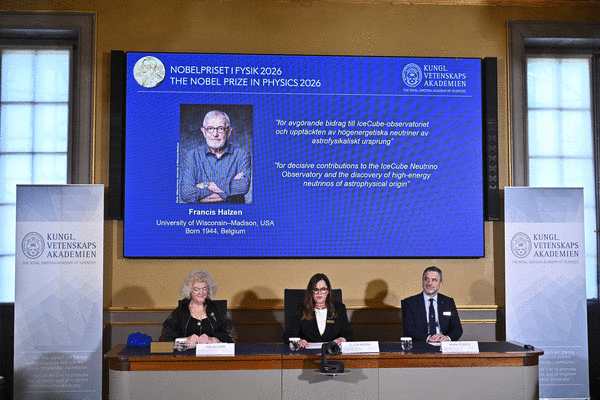
Belgian-born Francis Halzen was awarded the 2026 Nobel Prize in Physics for helping discover particles from deep space using a detector buried beneath the Antarctic ice.
Halzen, 82, will receive a 12 million-krona ($1.2 million) award, the Royal Swedish Academy of Sciences in Stockholm said in a statement Tuesday. He is currently affiliated with the University of Wisconsin-Madison.
The scientist laid the foundation for a new type of astronomy with an idea to use glacial ice at the South Pole to capture neutrinos, hard-to-detect particles with no electric charge and almost no mass, the committee said. The result was the IceCube Neutrino Observatory — a cubic kilometer of ice equipped with light sensors — that can track neutrinos originating far away in the cosmos.
It was a breakthrough that gave astronomers a new way to study the distant universe and learn more about the cosmic environments where neutrinos are produced. The hope is that neutrinos will provide information about phenomena that are hidden behind dust clouds, or objects that are so distant that other forms of radiation have disappeared along the way, according to the committee.
Halzen grew up in Belgium, getting his PhD in 1969 from research university KU Leuven before moving to the University of Wisconsin-Madison in the U.S.
Nobel prizes previously handed out for discoveries relating to the neutrinos include awards in 2002 and 2015.
The Nobel prizes are given out annually for achievements in physics, chemistry, medicine, literature and peace. The five awards were established in the will of Alfred Nobel, the Swedish inventor of dynamite, who died in 1896. A prize in economic sciences was added by Sweden’s central bank in 1968.
The prize money this year was increased by 1 million kronor per category in connection with the 125th anniversary of the awards. When the first Nobel Prizes were given out in 1901, the amount was 150,782 kronor each.
Last year’s physics prize saw three scientists share the award for their discovery of macroscopic quantum mechanical tunneling and energy “quantization” in an electric circuit. It was a breakthrough that helped advance quantum computing and sensors.
The laureates are announced through Oct. 12 in Stockholm, with the exception of the Nobel Peace Prize, whose recipients are unveiled on Friday by the Norwegian Nobel Committee in Oslo.
On Monday, the Nobel Prize in Physiology or Medicine was awarded to scientists from the U.S. and Germany for laying the groundwork for a new era in neuroscience that seeks to unravel some of the brain’s mysteries.
©2026 Bloomberg L.P. Visit bloomberg.com. Distributed by Tribune Content Agency, LLC.





Comments