Saudi Arabia faces a grim choice as Houthis intensify attacks on airports and oil sites
Published in News & Features
BEIRUT — This wasn't the way the story was supposed to go for Saudi Arabia. In recent years, headlines about the country focused on the scale of its ambition, or the fantastical giga-projects girding Vision 2030, the full-steam-ahead drive to remake the kingdom into a business and entertainment powerhouse.
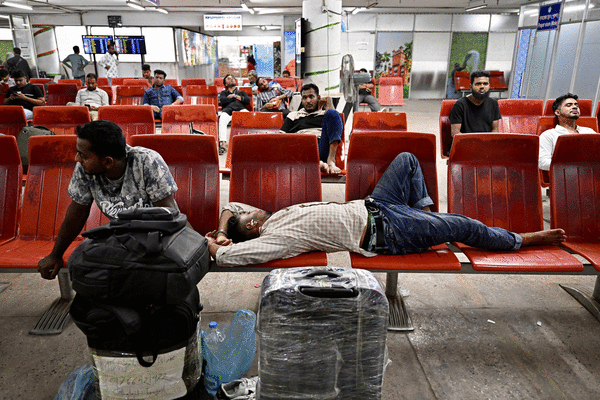
But all that was upended Saturday, when a Houthi missile lanced through Terminal 3 of the capital's international airport, killing 13 people, including a U.S. national, and wounding more than 300 others.
The attack — the deadliest Saudi Arabia has endured in years — made real a war that for most Saudis had remained notional.
It also laid bare the bevy of bad scenarios facing Saudi leaders as they contend with an increasingly formidable enemy that, unlike them, has little to lose.
That the Houthis are able to score hits from 500 miles away, despite the Saudi military spending tens of billions of dollars on multi-layered air defense systems, has puzzled experts.
"To me it's shocking. Yes, the Houthis have gotten better, but it's not a matter of them using a new weapons system," said Wolf-Christian Paes, an associate fellow at the London-based International Institute for Strategic Studies.
"The problem must be on the Saudi side," Paes said. "Something must have gone horribly wrong and continues to go horribly wrong."
Videos on social media Saturday showed passengers trudging slowly in a security line before the missile hit, sending them sprinting through the smoke-filled terminal, pieces of debris raining around them.
Although Riyadh's King Khalid International Airport was shuttered after the attack — more than 99% of flights were canceled, according to the aviation analytics firm Cirium — the Houthis struck another terminal building Sunday, killing one person.
On Monday, aviation authorities extended the airport's closure. Other airports across the kingdom were also targeted, along with gas facilities and oil refineries, the Houthis said.
Yahya Saree, the Houthis' military spokesman, on Sunday warned airlines and travelers to avoid Saudi airports, calling them "unsafe."
Meanwhile, many Riyadh-based firms told their employees to work from home, and schools shifted to online classes.
On Monday, the U.S. Embassy in Riyadh cautioned citizens to keep their distance from the airport and surrounding areas.
The timing of the Houthi campaign seems calculated for maximum reputational harm. On Sunday the kingdom began hosting the World Petroleum Congress, an event that normally draws oil heavyweights from across the world, including energy ministers as well as CEOs from BP, Exxon Mobil Corp., Shell and TotalEnergies.
Yet it's unclear how many were able to attend, with some delegates forced to drive hours across the desert from Bahrain or Jordan to reach Riyadh. Others, including Italy's energy minister, attended a meeting via video link.
Similar concerns now swirl around the Future Investment Initiative, Saudi Arabia's flagship business conference, which is set for the end of the month. Officials, maintaining a show-will-go-on attitude, insist the event, known as "Davos in the Desert," will happen on schedule.
In response to the Houthi attacks, Saudi Arabia's military said it peppered rebel-held areas with more than 120 strikes, including the airport in the Houthi-controlled Yemeni capital, Sanaa.
But those strikes underscore the asymmetry of the fight, experts say, with Saudi military planners hunting for Houthis in areas already ravaged by conflict, even as they must defend an area more than five times the size of California.
"Saudi Arabia is a country of 2 million square kilometers, with a very large number of soft targets — airports, pipelines, urban infrastructure that needs to be protected, government infrastructure. We've seen them all attacked," said Thomas Juneau, a security analyst at Ottawa University.
He added that the Saudi military "has not distinguished itself in terms of military performance against the Houthis."
The Saudi-Houthi conflict dates to 2014, when the Houthis swatted the Yemeni government aside and took over Sanaa before blitzing through other parts of the country.
The Saudis countered with an air campaign and ground force composed of Yemeni pro-government paramilitary factions, Saudi and Emirati troops and mercenaries.
The result was a humanitarian crisis that at the time was considered the world's worst, with some 377,000 people killed, according to the Yemen Data Project, which tracks casualties from Yemen's various conflicts. More than half of the deaths were due to the collapse of the health system, along with epidemics and famine.
The Houthis, toughened by decades of fighting against the government, lost much of the territory they took in south Yemen, but otherwise grew stronger in the war.
With training from Iran and the Lebanese faction Hezbollah, they evolved from a ragtag band of fighters with sandals and Kalashnikovs to a disciplined force fielding missiles and manufacturing its own projectiles. (Recently, Anthropic, the maker of Claude AI, warned the Houthis were using its AI models to program missile computers.)
In 2022, with front lines in a stalemate, Saudi Arabia and the Houthis signed a truce that largely held.
But in July, warplanes struck Sanaa airport to prevent an Iranian plane with Houthi officials from landing. Though the Saudi-backed Yemeni government claimed responsibility, the Houthis blamed Saudi Arabia.
Since then, the Houthis, whose official name is Ansar Allah or God's Supporters, have restarted their missile and drone salvos and announced a "blockade within a blockade" on Saudi shipping. In September, they routed pro-government fighters and captured Yemen's Red Sea coast.
Yemen's government last week launched an offensive to retake the areas under Houthi control, backed by a fresh Saudi bombing campaign.
The renewed hostilities come as Saudi Arabia has been battling an economic slowdown and rolling back some of its flashier investments.
That economic malaise has since been compounded by the Iran war. With the Strait of Hormuz largely sealed by rival U.S and Iranian blockades, Riyadh shifted its exports from Hormuz, its main energy corridor, to the Red Sea coast. Houthi advances, however, now jeopardize that conduit.
One possible reason for the kingdom's vulnerability is that it entered the confrontation with the deck stacked against it.
The Saudi military has 108 Patriot missile launchers and a small number of THAAD missiles, allowing it to intercept missiles and drones at different altitudes and ranges.
But during the U.S.-Israeli war on Iran, which saw Tehran lash out with attacks on its Persian Gulf neighbors, Saudi Arabia expended some 86% of its 2,800 missiles, according to reports.
The almost 400 interceptors that remain are augmented by a Greek army contingent with a Patriot missile battery and roughly 100 soldiers. Pakistan and Turkey, Saudi Arabia's partners in a recently signed mutual defense pact, are also fielding their own air defense weapons inside the kingdom. But those are unlikely to be sufficient to protect the entire country, analysts say.
Crown Prince Mohammed bin Salman, the country's de facto leader, has called on the U.S. and other allies to come to his country's defense. Officials at the World Petroleum Congress on Monday echoed his message, with many stressing that disrupting Saudi energy supplies would have consequences beyond its borders.
"No nation, even one as capable and confident as ours, can safeguard them alone," said Amin Nasser, chief executive of Saudi's oil giant ARAMCO.
But President Trump has so far proved reluctant to provide more than intelligence and logistical support. On Saturday, after the airport attack, Trump said he "may" join the Saudis' campaign. "We're going to look at it," he said.
Even if more robust assistance were to materialize, the Saudis will still face tough choices.
The best option, Paes said, would be for Saudi Arabia to find a new understanding with the Houthis. But he acknowledged that the group has political demands — including having Saudi Arabia pay Houthi civil servant salaries — that will be difficult for Saudi leaders to swallow.
"The deal they'll get out of the Houthis will be a lot worse than what they could have got a few months ago," Paes said.
Still, he added, "that's the least worst outcome."
©2026 Los Angeles Times. Visit at latimes.com. Distributed by Tribune Content Agency, LLC.




Comments