Colorado's massive Aspen Acres fire sparked by tree falling on power lines, investigators conclude
Published in News & Features
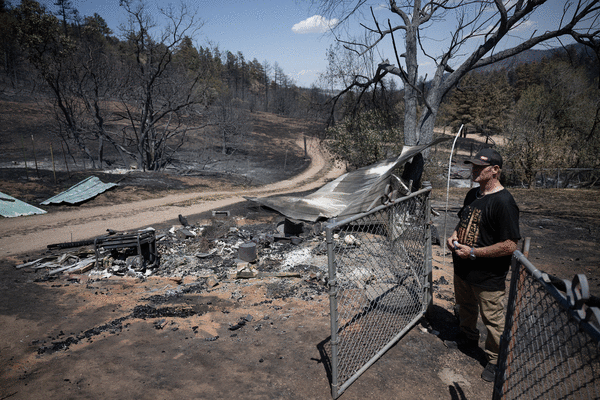
DENVER — An aspen tree fell across power lines around dawn on June 29, sending sparks flying and igniting the Aspen Acres fire, which grew into the seventh-largest wildfire in Colorado history and destroyed hundreds of homes, investigators concluded in a new report.
The tree, blown down by 45 mph winds, stretched across the power lines, pushing them to within three feet of the ground in a forest about 200 feet west of Colorado 165 in Custer County, according to the Colorado Division of Fire Prevention and Control’s 46-page report on the wildfire’s origin and cause.
Sparks from electrical arcing caught fire in grass, pine needles and other low-lying foliage, slowly burning about one acre before exploding into southern Colorado’s massive Aspen Acres fire.
“Melted aluminum was observed under the area where the conductor contacted the tree,” state fire investigator Josh Dreher wrote in the report. “The melted aluminum dripping from the conductor should also be considered as contributing to the ignition of the fire.”
Strong winds and dry brush caused the fire’s intensity to accelerate, the report stated.
The power lines belonged to San Isabel Electric Association in West Pueblo, and the utility company is facing multiple lawsuits over the origin of the fire.
Paris Daugherty, a San Isabel Electric spokeswoman, said the utility could not comment on the state’s investigation report because of the pending litigation.
“Our focus remains on supporting the families and communities affected by the Aspen Acres fire and on continuing to serve our members,” she wrote in an emailed statement.
Dreher wrote in his report that when he went to the ignition site on July 15, San Isabel crews at the scene told him that lawyers and investigators for the electric cooperative had removed the tree and the power lines.
The report said private fire investigators and people from two law firms, representing San Isabel Electric and private individuals, removed the tree and power lines from two sites where the fire potentially ignited. The trees and equipment in question were later tested at private labs with state investigators present.
The first 911 call about the fire was placed at 5:39 a.m. on June 29 by a passerby, the report said.
One witness who was interviewed for the report said he woke at 5:30 a.m. when his lights flickered and his generator turned on. He stepped outside to see what caused the generator to start and smelled smoke.
A second man reported that he smelled smoke and saw plumes originating south of the Aspen Acres Campground on the west side of Colorado 165 around 5:45 a.m.
The two men, who were neighbors, drove to the campground area and saw smoke and fire in the tree line along the power lines near Colorado 165 and Custer Drive, according to the report. They also said flames had jumped the road by that time.
By then, multiple people had called 911, the report stated.
The Aspen Acres fire has burned 102,700 acres and was 82% contained as of Oct. 2, the most recent update available. The fire destroyed more than 850 structures, including 337 homes, but an estimate of the total financial losses has not yet been determined.
It is the seventh-largest wildfire in Colorado’s recorded history, and five of the 10 largest have burned since 2020 due to the state’s ongoing drought.
At its peak in early July, firefighters described the wildfire as “a monster” eating everything in its path, and said they were struggling to contain it. The fire was largely under control by mid-July, with authorities allowing residents to begin returning to their property.
Fire officials decided to let it burn itself out rather than risk firefighters’ safety once the wildfire moved into remote, rugged terrain.
The people who live in Beulah Valley and other areas hit by the fire remain at risk of flooding because there is little vegetation left to absorb water.
A number of people who lost homes did not have insurance because of an ongoing insurance crisis in Colorado. The crisis is driven by the growing threat of wildfires and severe weather, caused by climate change, and insurance companies that do not want to risk big payouts in areas prone to those disasters.
Typically, the federal government provides financial assistance, but President Donald Trump has refused to send the full arsenal of federal aid to Colorado.
Gov. Jared Polis was forced to battle the Trump administration for a federal disaster declaration in order to receive money to help residents and governments rebuild after the fire. Trump had denied similar requests in 2025 after the Elk and Lee fires.
This time, Trump approved some federal assistance for the Aspen Acres fire as well as the Gold Mountain fire near Ouray and the Ferris wildfire in Dolores County in western Colorado. That money will help pay for debris removal and to replace public infrastructure. But he denied the state’s request for individual assistance and hazard mitigation grants.
Individual assistance would have helped people find temporary housing and repair or rebuild homes, while hazard mitigation would have assisted with flood prevention and stormwater system upgrades.
Polis announced Monday that Colorado had requested disaster assistance from the U.S. Small Business Administration to provide low-interest loans to help homeowners and businesses repair and rebuild, according to a news release.
The news release said the governor has appealed Trump’s denial of hazard mitigation funding, but that he would not appeal the denial of individual assistance. Federal rules prevent states from receiving Small Business Administration assistance while there is an active appeal for individual assistance from the Federal Emergency Management Agency.
“Given that uncertainty and recent delays in disaster assistance nationwide, Colorado is pursuing SBA assistance as the most reliable and immediate path to additional recovery resources for affected families and businesses,” the governor’s news release said.
Polis announced on Oct. 2 that the state would cover part of the financial gap needed to address flooding risks after the U.S. Department of Agriculture’s Natural Resources Conservation Service agreed to pay 75% of the costs. Colorado will be responsible for the remaining 25% needed, and Polis said the state would cover three-quarters of that.
The remaining 6.25% will be shared by the affected counties, according to a news release.
------------
©2026 MediaNews Group, Inc. Visit at denverpost.com. Distributed by Tribune Content Agency, LLC.






Comments