French violence emerges ahead of nationwide Yellow Vests and student protests
Published in News & Features
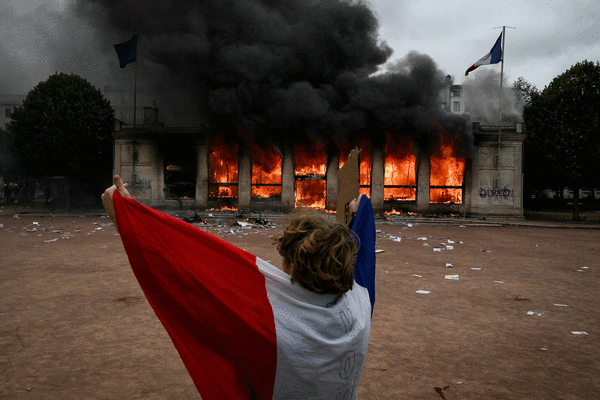
Rioters attacked French public buildings and looted stores in cities including Paris as protests against the high cost of living drew more than half a million people, underscoring the nation’s challenges ahead of presidential elections next year.
Some 550,000 demonstrators took part in marches across France on Saturday, including 110,000 in Paris, Interior Minister Laurent Nunez said. On the fringes, ultra-left activists assaulted police forces and public buildings and were joined by “massive arrivals” of looters, he said.
“These actions are continuing now,” Nunez told journalists just before entering a government crisis meeting. Some groups are seeking to approach “centers of power,” he said, without elaborating.
President Emmanuel Macron’s government is grappling with a cost of living crisis while seeking to contain France’s debt. Opposition groups that have twice toppled prime ministers over budget plans in the last two years have been reluctant to compromise.
There’s “no place for violence in our Republic,” Macron posted on X. “Those who vandalized and attacked prefectures and businesses, and looted even our town halls, will be prosecuted and punished.”
In Paris alone, repairing buildings damaged by arson may cost tens of millions of euros, Mayor Emmanuel Gregoire said. Police stations were attacked in Marseille and Brest, Nunez said.
Riots also erupted in cities including Strasbourg, Rouen, Nantes, Toulouse and Pau as groups pelted police and set fire to street furniture, cars and bikes. The city hall of Limoges in central France and a tourism office in Lyon were set alight.
Security forces arrested 400 people across the country, while 60 police officers were wounded, according to the interior minister. Overnight, an arson attack damaged a building of the University of Rouen.
France’s unrest isn’t unique as protests have sprouted throughout Europe, including in Spain, Italy, Albania and Belgium. Demonstrators’ demands have included more affordable housing and lower living costs.
In Portugal, Tiago Oliveira, leader of the CGTP trade union federation, said demonstrations that began on Saturday in Lisbon and other areas aim to give a voice to people struggling with the “brutal increase” in housing, fuel and food prices.
Yellow Vests
France’s Yellow Vests activists, an occasionally radical grass-roots movement that emerged in 2018 to fight rising living costs, took the opportunity to try to revive the movement with calls on social media to take to the streets.
The Yellow Vests protests triggered by a proposed fuel-tax increase under Macron.
Continuing demonstrations by high school students to protest classroom conditions, teacher absences and university admissions were initially unrelated to the Yellow Vests. About 57% of the French support the student movement, according to a Cluster 17 poll published Oct. 11.
The French government has vowed to take the students’ complaints into account, but isn’t in a position to dramatically increase the education budget. With debates underway at the National Assembly, Prime Minister Sebastien Lecornu is trying to get parliamentary backing to sharply restrain spending and pare the fiscal shortfall to 5% of economic output in 2027 — a target it missed this year.
The protests in Portugal follow a housing demonstration in Porto earlier this week that escalated into clashes between police and demonstrators camping in a square. Home prices in Portugal jumped more than 16% in the second quarter from a year earlier, the fastest pace in the European Union, according to Eurostat.
———
(With assistance from Henrique Almeida.)
©2026 Bloomberg L.P. Visit bloomberg.com. Distributed by Tribune Content Agency, LLC.






Comments