DOJ seeks to remove 2 Minnesota judges from cases over public immigration remarks
Published in News & Features
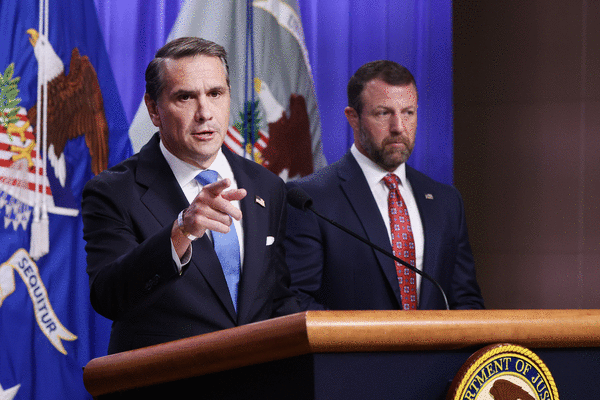
MINNEAPOLIS — The Justice Department is asking to disqualify two federal judges in Minnesota from presiding over a pair of cases regarding citizenship and illegal voting, challenging their impartiality in the matters.
In the filings, associate attorney general Stanley Woodward Jr. demanded that U.S. District Judge Patrick Schiltz and U.S. District Judge John Tunheim recuse themselves from the cases due to their public remarks about the impact of the Trump administration’s immigration enforcement on the courts in Minnesota.
Woodward argued both Schiltz’s and Tunheim’s comments in a recent New York Times article “unquestionably” call into doubt whether the judges can be impartial.
In the Times article, Schiltz, a George W. Bush appointee, discussed how the immigration enforcement operation swamped the courts, creating widespread noncompliance from the federal government that posed a “grave threat to the rule of law.” Tunheim, appointed by President Bill Clinton, disputed the Trump administration’s claim that immigration agents were arresting the “worst of the worst” people during the surge.
Schiltz spoke again most recently about the strain of immigration cases during a University of St. Thomas School of Law symposium: “ICE versus the States: State-Law Remedies for Federal Lawlessness.”
“As a judge, it’s none of my business whether people get deported or not,” he said. “It is my business to make sure that before somebody is put on a plane to Texas ... that their rights are quickly addressed and that they are heard and that’s what we were doing.”
After the New York Times article, the Justice Department brought a judicial misconduct complaint against Schiltz, Tunheim and other federal judges in Minnesota, alleging they violated their ethical duties by speaking to the reporter. The Justice Department demanded the Court of Appeals for the Eighth Circuit investigate the judges’ conduct and that those who spoke to the New York Times recuse themselves from matters involving the Department of Homeland Security.
The bench has denied acting outside the ethical rules for judges, pointing to an opinion from the Committee on Codes of Conduct that allows federal judges to “‘speak and write’ about core judiciary matters such as advocacy for the rule of law and judicial independence.”
“That is exactly what I did,” Schiltz told the Minnesota Star Tribune at the time.
In the filing, Woodward argued that Tunheim’s comments about whom the immigration agents arrested during the surge could translate to his opposition in prosecuting a noncitizen accused of voting illegally, as in the case against Hester Sophia Weihmann, one of 10 people charged last month by the Justice Department.
“If Judge Tunheim perceives her as an ordinary, non-dangerous person, a reasonable observer might conclude that he views the enforcement of federal law (immigration, election, criminal, or otherwise) against her as unwarranted,” he wrote.
In the case assigned to Schiltz, Woodward argued that the judge’s remarks revolved around immigration enforcement and therefore call into question whether Schiltz can be impartial as the Justice Department seeks to strip citizenship from Salah Osman Ahmed, who pleaded guilty in 2009 to providing support to terrorist organization al-Shabaab.
“A judge who has publicly taken sides on the political issue of immigration enforcement cannot then preside over a case concerning one of the Justice Department’s key immigration initiatives: pursuing the largest denaturalization effort in Department history to restore trust and integrity in U.S. citizenship,” Woodward wrote.
Daniel Gerdts, Ahmed’s attorney, called the Justice Department’s arguments “contrived and baseless” and said he intends to oppose the motion.
“Who precisely do they think would be a better choice for them on this bench, especially with such a weak case?” he asked. “Judge Schiltz is the epitome of a principled, call-it-like-he-sees-it judge who knows the rules of evidence and applies them equally to both sides.”
Neither judge has indicated yet whether they would agree to recuse.
_____
©2026 The Minnesota Star Tribune. Visit startribune.com. Distributed by Tribune Content Agency, LLC





Comments