What happens after Maryland voters change the state Constitution?
Published in News & Features
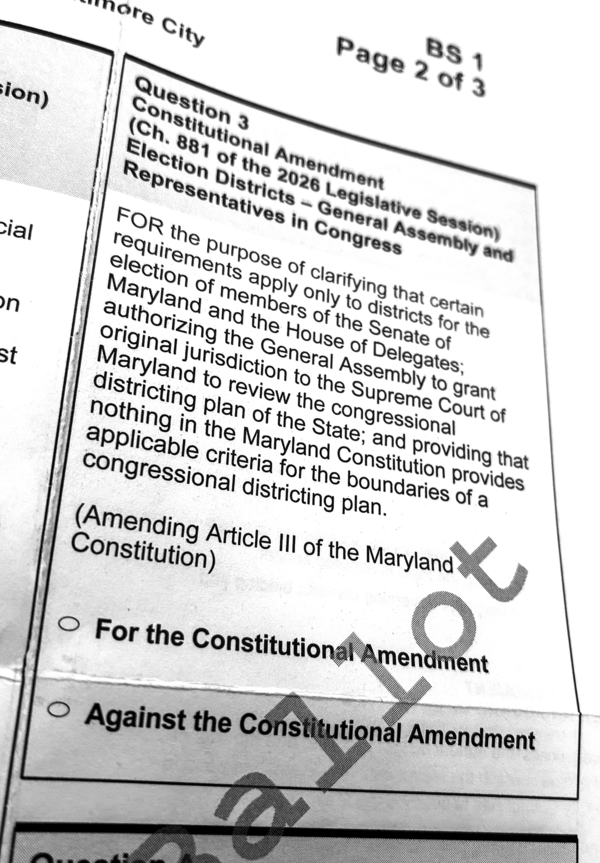
BALTIMORE — Maryland voters legalized recreational cannabis, strengthened abortion protections and required state lawmakers to live in the districts they represent. But approving those constitutional amendments did not settle every question about how they would work.
Lawmakers still had to establish rules for cannabis sales. Separate legislation was needed for abortion funding access. And residency disputes continue to raise questions about who qualifies to serve.
Maryland voters will soon decide whether to change the state Constitution on three more issues, including a proposal that could reshape the rules governing congressional districts. The earlier amendments offer a lesson for voters: What a ballot question promises and what a “yes” vote delivers can depend on decisions made after Election Day.
This year’s Question 3, for example, would not redraw congressional districts; that will be up to lawmakers later. Instead, it would remove state constitutional criteria for drawing congressional districts and allow the General Assembly to authorize the Supreme Court of Maryland to hear challenges to congressional maps directly.
Maryland’s current congressional delegation includes seven Democrats and one Republican. Supporters of Question 3 want to clear the way for a new map that could give Democrats all eight seats. They argue that would help offset Republican gains from redistricting in other states.
The Baltimore Sun reviewed three amendments approved since 2022 to examine what voters changed, what required further action and what remains unsettled.
Cannabis legalization left sales rules to lawmakers
In 2022, Maryland voters approved a constitutional amendment allowing adults 21 and older to use cannabis legally.
But the amendment did not establish a system for selling cannabis. Lawmakers set those rules, and licensed dispensaries began recreational sales in July 2023.
In a separate action after legalization, Gov. Wes Moore issued 175,000 pardons for certain marijuana-related convictions, arguing that prior convictions had disproportionately affected people of color.
A 2025 Baltimore Sun analysis found that cannabis use among drivers doubled after Maryland began adult-use sales, while deaths and arrests involving impaired driving did not show a corresponding increase.
Legalization also did not end illegal sales. Baltimore officials have taken steps to address illegal cannabis sales to minors. Last week, Baltimore Mayor Brandon Scott signed an ordinance allowing the police commissioner to close businesses found to be involved in illegal sales for up to a year, following an investigation conducted by The Sun that found that some of Baltimore’s 1,400 smoke shops sold products employees described as marijuana and edibles labeled as containing intoxicating THC, despite state restrictions on what unlicensed retailers may sell.
Abortion rights gained constitutional protection
Maryland voters in 2024 approved a constitutional amendment establishing a right to reproductive freedom, including “the ability to make and effectuate decisions to prevent, continue, or end one’s own pregnancy.” Abortion rights were already protected under state law, but the amendment placed reproductive freedom in the state Constitution.
The amendment followed the U.S. Supreme Court’s 2022 decision overturning Roe v. Wade, the ruling that had recognized a federal constitutional right to abortion. About 76% of Maryland voters supported the amendment.
The amendment protected a right; a separate law enacted in 2025 provided funding for care, establishing the Public Health Grant Abortion Program, which helps people who cannot afford abortion care.
Residency rule changed, but eligibility questions remain
In 2022, Maryland voters approved a constitutional amendment requiring state legislators to maintain their primary residence in the districts they represent while in office. Previously, candidates were required to reside in their districts for at least six months before an election.
The amendment took effect Jan. 1, 2024, adding an ongoing residency obligation to the existing six-month residency requirement.
But recent disputes concern whether candidates qualify to take office — a separate issue from where legislators must live while serving.
John Dove, a Democrat who sought a seat in District 12B, was disqualified after the Maryland Supreme Court ruled that he did not meet the applicable residency requirements. Dove failed to provide truthful information about his address when he filed to run, the court said. However, it did not comment on whether the candidate filing deadline pushed the residency requirement to earlier than six months before the November election.
Republican Charles Murphy, who is running for the House of Delegates in Baltimore County, remained listed as an active voter in Texas as of September, according to Harris County records reviewed by The Sun. Maryland election records show that Murphy filed to run for office and registered to vote in Maryland on Feb. 23. The Texas registration does not, by itself, establish where Murphy lives or whether he meets Maryland’s constitutional residency requirements.
Maryland’s early voting period runs from Thursday through Oct. 29, and Election Day is Nov. 3.
_____
©2026 The Baltimore Sun. Visit at baltimoresun.com. Distributed by Tribune Content Agency, LLC.




Comments