'Thinly veiled voter purge': San Diego, Imperial counties respond to DOJ demands for voter info
Published in News & Features
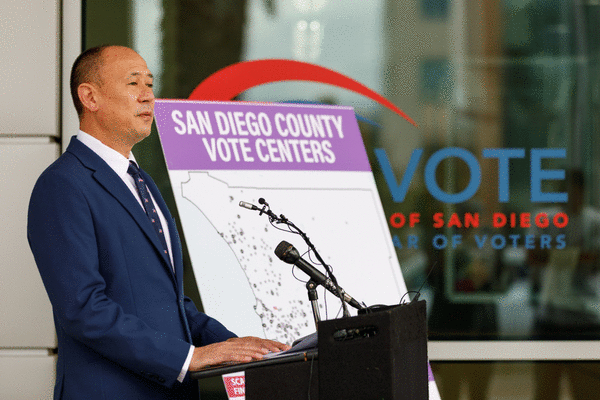
Officials from San Diego and Imperial counties responded Tuesday evening with strongly worded letters informing U.S. Attorney Adam Gordon that they would not comply with his demands to segregate nearly 1,900 ballots sent to individuals whom the U.S. Department of Justice has claimed are “likely” noncitizens.
“The DOJ’s request is a thinly veiled voter purge,” San Diego County Counsel Damon Brown wrote in his response to Gordon. “The County will not be bullied into participating in DOJ’s fishing expedition … DOJ is demanding that the (Registrar of Voters) engage in an unlawful course of conduct. The ROV will not do so. It intends to carry out its constitutional mandate ethically and soundly.”
On Wednesday afternoon, a federal district judge in Los Angeles largely agreed, ruling in an order highly critical of the Trump administration that it cannot force California elections officials to segregate more than 20,000 ballots, including those Gordon had identified in San Diego and Imperial counties.
“Constitutional rights and our democracy are at stake,” U.S. District Judge David Carter wrote in his ruling.
Gordon sent letters Friday to San Diego County Registrar Shawn Brom and Imperial County Registrar Linsey Dale demanding that they commit within 48 hours to working with federal officials to determine the citizenship status of 1,709 registered voters in San Diego County and 161 registered voters in Imperial County.
The Friday letters from Gordon, as well as similar letters sent by the Trump administration to officials in all 58 counties in California, threatened election officials with potential criminal charges if they “knowingly tabulate ballots cast by individuals identified by federal agencies as noncitizens.”
Brown wrote Tuesday in response that San Diego County considered those threats “to be an effort to unlawfully intimidate both election officials and California voters,” and that the county “reserves its rights to pursue all legal remedies against DOJ for its unlawful intimidation.”
The lists of names sent by Gordon to San Diego and Imperial counties allegedly came from the statewide list of more than 20,000 names the Trump administration claims it has identified on voter rolls as “likely aliens.”
It was that list that was at the center of the lawsuit Carter ruled on Wednesday. The federal government had asked the judge to order state and local election officials to segregate and not count those ballots until the local officials could prove the voters were citizens.
Carter ruled against such an effort, writing that it “would risk disenfranchising an untold number of voters” on the basis of “unfounded allegations stemming from a procedure rife with uncertainty and errors.”
The Trump administration immediately appealed the ruling to the 9th U.S. Circuit Court of Appeals.
The judge wrote, “Constitutional rights and our democracy are at stake” and chastised the Trump administration and Department of Justice.
“Never before in American history has the federal government, on the eve of an election, sought to coerce a state and local government to abandon their own Constitutional elections procedures and bend to the will of the Executive Branch,” Carter wrote.
The judge’s order did not appear to address the appointment of an independent special master to evaluate the substance of both sides’ claims, as he had contemplated during a hearing in the case Tuesday.
State officials have said the federal government’s list of 20,000 alleged noncitizen registered voters is already falling apart under scrutiny — just as similar Trump administration claims of widespread noncitizen voting have fizzled out in other states in recent months.
Brown, the attorney for San Diego County, wrote in his response that the county conducted “a spot check of a random 10% of the list” of the 1,709 names identified by Gordon. That initial check “reveals significant reasons to doubt the reliability of that list,” Brown wrote.
He wrote that 59% of the subset of names checked by the county “currently have canceled voter registrations and 74% have no recorded history of voting in San Diego County.”
In Gordon’s letters to the county registrars, he asked that they share with the federal government “nonpublic information” about the names on the lists, including Social Security numbers, copies of state IDs or driver’s licenses and other documents submitted at the time of registration.
Imperial County Interim Counsel Kris Becker asserted that such information was “absolutely confidential.” Becker said other information Gordon requested could not be provided “absent a subpoena, warrant or other court order.”
Brown also wrote that it was notable that the Department of Justice had not presented a judicial warrant for the confidential information it seeks.
“DOJ certainly knows how to obtain a judicial warrant and could have done so if it had a sufficient evidentiary basis for the allegations in the letter,” Brown wrote. “But … it is clear that DOJ’s lists are deeply flawed.”
Brown asserted that the requests made by the Trump administration were unconstitutional and would violate several federal and state laws.
“DOJ’s requests would jeopardize San Diegans’ constitutional right to vote and risk violation of the Voting Rights Act, the (National Voter Registration Act), the California Constitution, and California state laws affording eligible voters the right to access a mail-in ballot and cast a vote,” Brown wrote. “The ROV rejects DOJ’s invitation to violate both state and federal law based on nothing more than unsubstantiated suspicions regarding a person’s citizenship.”
Gordon’s office declined to comment Wednesday on the responses sent by the counties.
©2026 The San Diego Union-Tribune. Visit sandiegouniontribune.com. Distributed by Tribune Content Agency, LLC.






Comments