Moore talks Maryland budget, redistricting, Democrats' future after reelection
Published in News & Features
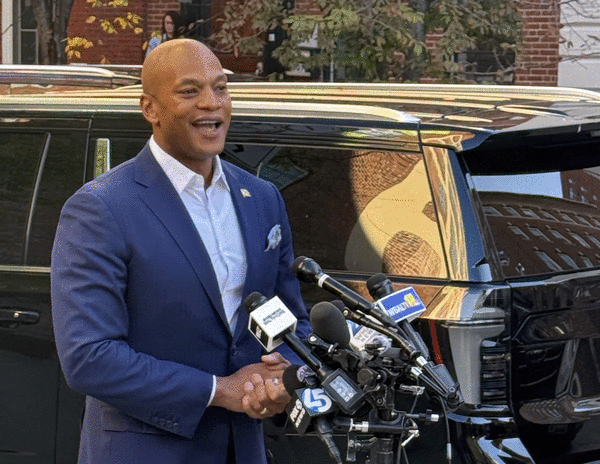
Gov. Wes Moore is heading into a second term promising to make Maryland more affordable, but a projected $2.5 billion budget shortfall will test how he delivers on that pledge.
A day after defeating Republican challenger Dan Cox by nearly 30 percentage points, Moore defended his administration’s fiscal record, pointing to four consecutive balanced budgets. Still, he didn’t speak on the potential for future tax increases, despite Maryland lawmakers previously saying they could be on the table during the 2027 legislative session.
“My commitment is we are going to make sure that we are addressing affordability in the state of Maryland,” Moore said Wednesday at a news conference in Baltimore. “And we have now gone four straight years where we have a balanced budget inside of the state of Maryland.”
His administration has also previously enacted or increased taxes and fees while pledging to ease the cost of living, leaving questions about how the state will close its budget gap without putting further pressure on households and businesses.
The governor also faced questions about what comes next for Maryland’s congressional map after voters approved Question 3, a constitutional amendment that removes several requirements for drawing congressional districts, including that they be compact and contiguous and account for natural boundaries and local government lines.
Moore has argued that the amendment would help Democrats respond to Republican-led redistricting efforts in other states, even as he has said he does not support partisan gerrymandering. He did not say whether he would push for a new congressional map during the 2027 legislative session and General Assembly leaders haven’t confirmed if they would pursue a new map either.
“There needs to be national redistricting reform inside of this country. I also know that I’m not holding my breath for Donald Trump to do it because Donald Trump believes in unilateral redistricting to be able to protect his power and protect his grip,” Moore told reporters. “Maryland cannot just sit on our hands while we are watching this remarkable and unprecedented power grab that is taking place in Washington, D.C.”
Although Moore’s potential national ambitions for 2028 were a recurring subject of discussion during the campaign, he was not asked about them during Wednesday’s post-election media appearances.
Offering a glimpse at the Democratic Party
Earlier Wednesday, in an appearance on CNBC’s “Squawk Box,” Moore turned to the Democratic Party’s future, arguing that party leaders need to rethink where they invest political resources. He pointed to candidates that had historic wins, including Keisha Lance Bottoms in Georgia, Gina Hinojosa in Texas — who he said he campaigned with — and David Crowley in Wisconsin, as examples of Democrats who could help the party build support in places it has long overlooked.
As chair of the National Governors Association, Moore also identified immigration and permitting reform as potential areas of cooperation with President Donald Trump’s administration. He described an approach to immigration that would combine tighter border security with a pathway to legal status for longtime undocumented immigrants, and said lengthy permitting processes have hindered economic development across states.
Moore also criticized the influence of wealthy donors in politics, arguing that billions of dollars are spent on elections while the country struggles to address health care costs and child poverty.
“The amount of billionaires that we have in our society is not something that keeps me awake at night,” he said. “The amount of children we have growing up in poverty does.”
________
©2026 The Baltimore Sun. Visit at baltimoresun.com. Distributed by Tribune Content Agency, LLC.



Comments