US envoys leave Moscow after talks with Putin to meet Zelenskyy
Published in News & Features
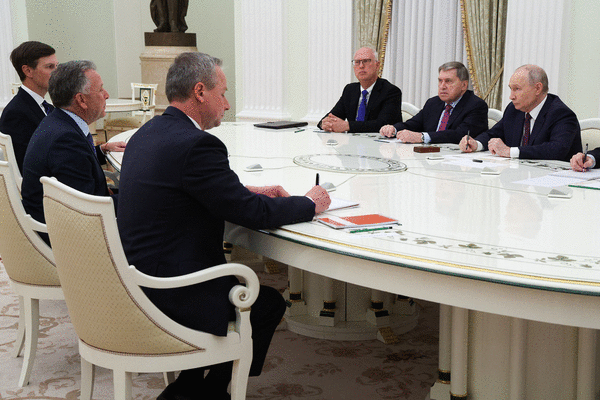
U.S. envoys left Moscow for talks with Ukrainian President Volodymyr Zelenskyy after meeting with President Vladimir Putin, as Kyiv warned restrictions had reappeared on the Starshield air-defense system used by frontline troops.
U.S. negotiators Steve Witkoff and Jared Kushner met with Putin in the Kremlin for more than two hours, according to state media. The Russian leader was joined by his aides Yuri Ushakov and Kirill Dmitriev, as well as Vladimir Medinsky, the leader of Russia’s delegation in this week’s talks in Abu Dhabi between officials from Kyiv and Moscow. They later departed Moscow, according to state media.
Putin asked Witkoff and Kushner to thank U.S. President Donald Trump for arranging the talks between Ukraine and Russia, the first trilateral negotiations since February. He also said that foreign troops in Ukraine would be unacceptable for Russia.
Zelenskyy is in Dublin taking part in a meeting of European and world leaders, and where he is expected to meet Kushner and Witkoff later Thursday.
Russia and Ukraine remain far apart on many issues including territory and security guarantees in the negotiations to end Europe’s biggest conflict since World War II. The war has disrupted shipping in oil and grains, spurring increased energy and food prices globally.
Neither Russia nor Ukraine has changed positions, according to a person close to the Kremlin, who asked not to be identified discussing sensitive information. The person characterized the meeting as a courtesy visit.
Elsewhere, Zelenskyy on Thursday said Ukraine’s military had “unfortunately recorded significant Starshield outages for several days,” along the front line and in Russian-occupied territories.
Ukraine relies on Starlink terminals and SpaceX’s satellite constellation to access high-speed internet at frontline positions. Services cut out when a terminal travels faster than 161 kilometers (100 miles) per hour, complicating Ukraine’s ability to use the service to intercept fast-flying Russian jet-powered drones, Zelenskyy said.
The development threatens a repeat of the controversy last month when Ukraine reported similar limitations in its use of the system provided by billionaire Elon Musk’s SpaceX. Zelenskyy at the time accused Musk and Trump of ordering the internet system to be throttled to pressure Kyiv into concessions for a deal to end Russia’s war on Ukraine.
Trump said he didn’t order speed limits for Starlink operations, but criticized Zelenskyy, saying the Ukrainian is more difficult to deal with than Putin. Musk accused Ukraine of violating its terms of service by using the system for offensive drone strikes. The limits were lifted on Oct. 24.
“We are trying to get details from the American side, but so far we know very little,” Zelenskyy said on Thursday in Dublin. “If someone in America is making decisions that basically treat Ukrainian territory as if it is not Ukrainian, then this tells us where things are going.”
Territorial issues remain the hardest part of the negotiations, though the two sides are discussing a substantial exchange of prisoners, Kushner told reporters on Wednesday. Zelenskyy said the exchange could include up to 1,200 prisoners.
Kushner also said on Wednesday that the meeting with Putin aimed to “make more progress on some of the issues that we discussed, because we see some openings and some opportunities there.”
Russia and Ukraine have different approaches on the matter of territory, Putin said at the meeting with U.S. envoys. “For us, there is only one line of demarcation: the line of the state border,” he said, adding that Ukraine has proposed so-called gray zones, which he said would quickly be the subject of disputes.
There’s little sign of de-escalation in Russia’s full-scale invasion of Ukraine, now well into its fifth year. Moscow has stepped up missile and drone attacks on Ukrainian energy infrastructure, logistics and business while Kyiv regularly strikes oil refineries and other targets deep inside Russia to try to curb the Kremlin’s war revenue. Fighting continues along the frontline, with neither side making significant gains.
The war will dominate discussions Thursday at the summit of the European Political Community, which brings together more than 50 leaders from the continent and beyond.
Zelenskyy earlier said that political shifts in the U.S. and elsewhere are creating a “window of opportunity” to discuss peace with Russia. He implored his European allies to finally pick a representative to join the peace talks after years of disagreement.
“We need to choose who will represent Europe. We need to choose concrete leaders of Europe,” said Zelenskyy, who met with Irish Prime Minister Micheal Martin in Dublin. “We need to do it in November.”
The Americans are warming to Europe being part of the talks, Zelenskyy added. “We want Europe to be not there on the margins, not on the sidelines of the meetings,” he said. “We want them to participate on equal footing the next time.”
Zelenskyy insisted that if everyone is involved, negotiations could show progress by the beginning of 2027.
Putin on Thursday told Witkoff and Kushner that Russia was never opposed to dialogue with Europe.
Europe, however, has struggled to agree on who should speak for the region in any peace talks with Russia.
Big powers like Germany, France and the U.K. have at times taken the lead, while the leaders of Norway and Finland recently created their own direct channel to Putin. European Council President Antonio Costa even put out feelers to Moscow on behalf of the European Union.
Europeans have been forced to face a resurgent Russia mostly alone, after Trump cut much-needed aid to Ukraine, dropped sanctions on Russian diesel and openly derided NATO and the European security architecture.
The previous trilateral talks in Abu Dhabi were suspended in February, when Trump shifted focus to his war with Iran.
Europe’s attention is turning to how to fund Ukraine into 2027 and beyond. E.U. countries are starting to consider another loan as Kyiv’s military and financial needs rise.
Officials are once again exploring jointly borrowing money — similar to what the E.U. did to secure a €90 billion ($99.8 billion) loan for Ukraine to cover 2026 and 2027.
—With assistance from Aliaksandr Kudrytski.
©2026 Bloomberg L.P. Visit bloomberg.com. Distributed by Tribune Content Agency, LLC.






Comments