Boston Logan Airport struggles to recover from FAA ground stop: 'Very avoidable,' expert says
Published in News & Features
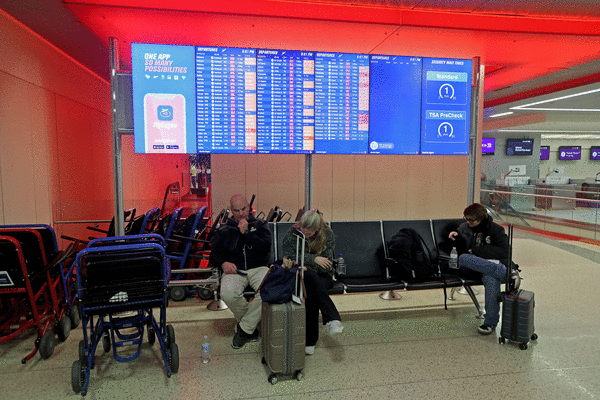
Massport says it hopes operations are back to normal at Boston Logan Airport by Monday following the nationwide ground stop, a situation a leading federal aviation expert called “very avoidable.”
Friday’s massive disruption rippled into Saturday, with over 200 flights canceled and more than 100 delayed at Logan as airlines rushed to get crews and aircraft back on schedule.
A Massport spokesperson told the Herald on Saturday evening that airlines are approaching the recovery similarly to how they handle major snowstorms, following the nation’s longest ground stop in 25 years.
“We are encouraging passengers to please check with airlines directly regarding the status of their flights,” the spokesperson said in a statement, “and we thank them for their patience during this time. We also have extra staff throughout the airport to assist passengers and answer questions if needed.”
Mary Schiavo, an aviation attorney who served as Inspector General of the U.S. Department of Transportation from 1990 to 1996, told the Herald that the immediate silence from the Federal Aviation Administration and federal leaders on Friday prompted unnecessary public panic until an evening news conference.
“People were scared, people were saying, ‘It’s terrorism,’ ‘Iran is attacking us,’ it’s this, it’s that, it’s sabotage,” Schiavo told the Herald in a phone interview Saturday afternoon.
“When in fact,” she added, “it was a highly criticized, frequently criticized contractor doing routine patches, wiring changes on a system that the FAA had been warned it could cause exactly what happened on Friday.”
Transportation Secretary Sean Duffy told reporters earlier Saturday, “Our contractor didn’t meet the moment,” blaming L3Harris Technologies Inc. for Friday’s ground stop that lasted more than four hours.
Duffy said the contractor had been replacing a section of the nation’s air traffic control system’s old copper wire with new fiber-optic lines, overloading antiquated equipment on the FAA’s Telecommunications Infrastructure (FTI) network. That triggered “intermittent” communications and radar gaps across the airspace.
Officials are investigating whether contractor “incompetence” or a faulty router — which Schiavo noted was manufactured between 2001 and 2006 and overloaded with data when it rebooted — caused the outage, the transportation secretary added.
Schiavo said the longtime federal contractor has been the subject of complaints for decades over what she described as “inadequate contract management and oversight.” She added that the FAA has long been criticized for its woeful control of contractors, “resulting in tremendous fraud, waste and abuse.”
Schiavo recounted the FAA building out its air traffic control system in the 1990s “just as piecemeal as it is now,” plagued by cost overruns and roughly a million lines of unfixable code that forced the agency to scrap entire systems.
The former U.S. DOT inspector general also pointed to the FAA’s launch of the Next Generation Air Transportation System in 2003 — a $36 billion modernization effort with airlines to transition air traffic management from ground-based radar to satellite navigation, digital communication and automation.
However, a Government Accountability Office report in September found that more than 75% of the FAA’s air traffic control systems are unsustainable due to decades-old computers, floppy disks and copper wiring — and that taxpayers have received just 16% of what the NextGen system promised.
“I am disappointed in this three-decades patchwork system,” Schiavo said, “and the FAA still does not seem to understand that they have to manage their contractors, and they have to understand that after three decades, they have to deliver a new system because there is no alternative at this point.”
“It is 75% unsustainable,” she emphasized.
In Washington, Duffy said Saturday that 70% of the system has been replaced with fiber-optic wire, though his agency still needs new air traffic control towers and runways.
The FAA has replaced thousands of miles of old copper wire with fiber-optic lines and upgraded hundreds of radio systems as part of an overhaul that began last year after Congress approved $12.5 billion in funding.
Duffy and the White House are pushing for more than $30 billion to complete the “Brand New Air Traffic Control System.”
“We have aging infrastructure throughout the airspace,” Duffy said, while stressing that flying remains safe. “You won’t get to your destination if we don’t think you can get there safely.”
The FAA also deployed an artificial intelligence-powered air traffic management system across all 22 air route traffic control centers last Tuesday, just days before Friday’s nationwide communications outage.
Duffy confirmed that the AI system did not cause the ground stop.
“I immediately thought, ‘Uh-huh, we are deploying AI – high levels of computing abilities onto a system that can’t handle it,’ and that was not it,” Schiavo told the Herald.
“It was even more basic than that,” she added.
_______
©2026 MediaNews Group, Inc. Visit at bostonherald.com. Distributed by Tribune Content Agency, LLC.






Comments