ICE buys Washington immigrant detention center from GEO Group for $453 million
Published in News & Features
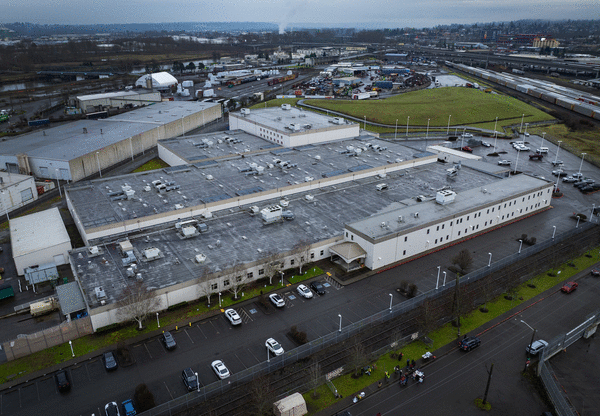
SEATTLE — GEO Group announced Wednesday that it has sold the Northwest ICE Processing Center in Tacoma to the U.S. Department of Homeland Security for $453 million.
The sale shores up the Trump administration’s efforts to expand its nationwide mass deportation campaign and marks the latest roadblock for local and state officials hoping to oversee the facility, as regulating a federally-owned property may pose a legal challenge. GEO expects to receive about $340 million in net proceeds after taxes and transaction fees, according to a news release.
While the detention center is now owned by U.S. Immigration and Customs Enforcement, it will continue to be operated privately by GEO Group. The Florida-based company will provide services such as transportation, meals and staffing at the detention center under a $1.5 billion 10-year contract that runs through Oct. 27, 2036.
Thousands of people swept up in the Trump administration’s ratcheted-up immigration enforcement effort have been detained at the Tacoma ICE detention center, a jail-like facility where some wait months or years for their case to be processed. While many detained there are from the Pacific Northwest, others are flown in from other parts of the country. As of late October, the facility held about 1,270 people.
As part of President Donald Trump’s $45 billion push to expand the country’s ICE detention system, the federal government has purchased several detention centers this year, including two GEO Group facilities in California last month for $950 million.
Immigration policy experts and political leaders have warned that ICE may be buying detention centers to circumvent local attempts to inspect and regulate such facilities.
“Since Trump returned to office, for-profit prison corporations, including GEO Group and CoreCivic, have raked in federal funding and taxpayer money, while avoiding oversight every step of the way, said Rep. Pramila Jayapal (D-Seattle), an outspoken critic of the detention center who has visited the facility several times, in a statement Wednesday.
"Now GEO and ICE are teaming up in Washington State to avoid having to answer for any of their abuses, while also taking home more of Americans’ hard-earned money," she said.
ICE did not immediately respond to a request for comment.
Wednesday's GEO Group announcement notes the facility has a 1,635-bed capacity — appearing to confirm that the company has increased the number of beds at the facility beyond the local zoning limit of 1,575 beds, which had been listed on previous contracts.
It was not immediately clear when that 60-bed expansion occurred and whether it was legally permissible. The city of Tacoma in 2018 passed zoning laws making it virtually impossible for the facility to increase its capacity beyond 1,575 beds. GEO Group previously sued over that ordinance and lost.
Tacoma spokesperson Maria Lee said in a statement Wednesday the city is "working with our state and federal partners to understand what this means for the facility, the individuals held there, and our local community." She did not immediately respond to a question about whether Tacoma officials had taken actions to enforce its zoning restrictions prior to the sale.
Rufina Reyes, executive director of La Resistencia, a local immigrant rights group that advocates for the facility’s closure, sharply criticized the sale.
She noted there have been 22 hunger strikes this year at the detention center over “numerous life threatening conditions,” including severe medical neglect, unsanitary food, swamplike water, a lack of COVID-19 protocols, sexual abuse and assaults, excessive uses of force and solitary confinement. Detention researchers and immigration advocates suspect the facility, which has never been sanctioned for breaching its contract, is now under weakened federal standards first introduced in March.
"We know that these sales are happening because of fear, fear of the accomplishments and protests of people detained and grassroots groups like La Resistencia,” Reyes said in a statement. “We will continue to work to shut down this detention center even if it becomes a federal facility."
Washington officials have taken steps in recent years to issue more oversight of the facility. The state sued GEO Group for violating state minimum wage law by paying detained people as little as $1 per day, securing $23 million in back wages and penalties last year. And in 2023, then-Gov. Jay Inslee signed a law allowing the state Department of Health to inspect private detention facilities.
But detention researchers say that if the federal government owns the property, local and state capacity restrictions and inspection efforts could be bypassed. They point to the U.S. Constitution’s supremacy clause, which prevents states from directly regulating the federal government.
ICE, in an August request for proposals that later resulted in the 10-year operations contract with GEO Group, said it does not expect contractors to abide by local attempts to inspect or regulate detention facilities. “If any conflicts between federal, state, or local laws or rules arise, the federal rules shall be followed,” it said.
That language appeared to reject oversight efforts, such as the state law requiring GEO Group to allow the state health department inspections. Those inspections, which continue to be blocked by GEO as it appeals a federal court order, are the subject of ongoing litigation.
"I'm extremely disappointed and concerned" about ICE's purchase of the facility, said Angelina Snodgrass Godoy, director of the University of Washington Center for Human Rights, which has published extensive research on conditions at the detention center.
"I think that’s the primary reason why they are interested in buying these facilities in the first place," she said, "to shake off the nuisance ... of attempts by states like Washington to regulate those facilities."
Jayapal also raised concerns Wednesday that the Trump administration overpaid for the detention center because of its ties with GEO. Numerous administration officials have worked or consulted for GEO Group, and a subsidiary of the company donated more than $1.4 million to President Donald Trump’s political action committee in July.
The city of Tacoma assessed the value of the property at around $72.6 million, less than one-sixth of the price ICE paid, Jayapal said. Meanwhile, GEO Group said it intends to use the net proceeds of the sale for stock buybacks, as a part of a previously announced plan to purchase $1.25 billion of its own shares through the end of 2029.
“I am deeply concerned by what appears to be a gross misuse of taxpayer dollars to pad the pockets of the GEO Group" as families across the U.S. suffer economically, Jayapal said.
Rep. Emily Randall (D-Bremerton), who has conducted a dozen oversight visits at the facility, said in a statement, “We are going to continue to fight to do oversight, and next year in 2027 … you better believe that we will be calling in witnesses to testify about how this deal happened, who got rich, and what the cost is for actual human beings who are being warehoused in this facility.
“We’re coming after ICE, and we’re coming after the Department of Homeland Security, and we’re coming after all of the Trump cronies that are getting rich on taxpayer money,” she said.
GEO Group remains in “active negotiation” for the sale of several other company-owned facilities to ICE, according to its Wednesday news release. Those negotiations could result in the sale of up to three additional GEO-owned facilities before the end of 2026, the announcement stated.
©2026 The Seattle Times. Visit seattletimes.com. Distributed by Tribune Content Agency, LLC.






Comments